Temperature25 – 26 °C
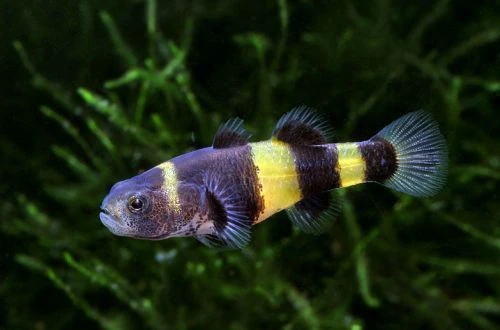
The fish known as the Bumblebee Goby, Gold-banded Goby, or Bumblebee Goby, has the scientific name Brachygobius doriae and belongs to the family Gobiidae. For a long time, this species was confused with Brachygobius xanthozonus, which is actually not found in the aquarium hobby. However, both of these fish look almost identical and prefer similar living conditions, so for most aquarists, inaccuracies in scientific names are not particularly significant.
Adults of this fish reach a length of up to 3 cm. The Bumblebee Goby has a large head with a blunt end and expressive eyes. Its fins are short, and the dorsal fin is divided into two parts. The coloration is characterized by alternating wide black and yellow stripes. Noticeable differences between males and females are subtle, with no obvious sexual dimorphism. However, during the spawning period, the yellow stripes on males take on a reddish hue, which distinguishes them.
Its natural habitat covers the islands of Borneo and Sumatra, as well as adjacent parts of Peninsular Malaysia and Singapore. This species prefers low-lying coastal areas with brackish water, such as mangrove swamps and estuaries, which are river mouths flowing into the sea. It is extremely rare to find it in freshwater bodies. Natural biotopes are characterized by silty or sandy substrates, rich in mud and organic deposits.
Although males exhibit territorial behavior and compete for areas on the bottom, it is recommended to keep these fish in groups of at least 6 individuals. This helps to avoid concentrating aggression on individual aquarium inhabitants. This is why it is important to provide a large number of shelters. They get along well with other peaceful species of comparable size that can tolerate brackish water. Preference is given to fish that inhabit the water column or near its surface.
For a small group of these fish, an aquarium with a volume of 80 liters or more is recommended. The decor should include many shelters, such as snags, so that the Gold-banded Gobies can hide from a dominant individual. Coral sand is ideal as a substrate, as it helps maintain the necessary high hardness and alkaline pH of the water. Although plants are not mandatory, unpretentious species can be used after acclimating them to brackish conditions. Successful keeping of these fish directly depends on the stability of hydrochemical parameters and high water quality. For this, it is necessary to use an effective filtration system and regularly maintain the aquarium: weekly partial water changes and removal of organic residues. When choosing a filter, it is worth preferring models that do not create excessive current.
Being a carnivorous species, this fish readily accepts live or frozen foods in a home aquarium, such as bloodworms, daphnia, and artemia. Dry foods, as a rule, remain untouched.
Spawning in Bumblebee Gobies occurs in small shelters, which can be ceramic pots, hollow tubes, or shells. The male chooses a suitable spawning site and awaits the female. It is worth noting that the most dominant individual will have the best spot in the aquarium. A female ready to spawn accepts courtship and lays 100 to 200 eggs in the chosen cave, after which she leaves the clutch. The male remains to guard the future offspring. The incubation period lasts about 9 days. Initially, the fry feed on the remnants of the yolk sac, then they should be offered micro-food, such as artemia nauplii.
Under favorable conditions, fish rarely get sick, so the detection of the first symptoms of an ailment often indicates a deterioration in water quality or composition. Often, when water parameters are normalized, the fish's body copes with the disease on its own, and the symptoms disappear. However, in advanced cases, medication may be required.
When choosing a Bumblebee Goby in a store, you should pay attention to the overall activity and health of the individuals. Healthy fish should have a bright, clear pattern without pale areas, clear eyes without cloudiness, and tightly pressed fins. It is important to avoid buying individuals with signs of emaciation, skin damage, or unnatural behavior, such as constant chaotic swimming or, conversely, complete apathy. Before purchasing, it is recommended to clarify the conditions in which the fish are kept in the store, as this species often requires brackish water to maintain immunity. Inspect the aquarium for dead individuals, signs of disease, or unsatisfactory sanitary conditions, as poor keeping conditions in the store often lead to hidden pathologies in gobies. If possible, prefer active fish that show interest in their surroundings and stay near the bottom.
The essentials: size, tank volume, water parameters and care
An adult reaches 3 cm in length. Plan the tank around the maximum size: the fish quickly outgrows a cramped setup.
The recommended volume is 80 L. A smaller tank speeds up nitrate build-up and raises stress levels.
Temperature 25–26 °C, pH 7.6–8, hardness 10–20 dGH. Stability matters more than exact values: sudden swings are harder on the fish than a small deviation from the ideal.
Around 4 years when kept properly. Lifespan depends directly on tank volume, water quality and a varied diet.
Temperament: territorial (often aggressive). Keep this in mind when choosing tank mates.
Recommended setup: small group (5–6 individuals). Ignoring this is a common cause of stress and disease.
Diet type: meat / protein (live, frozen, fresh). Feed small portions that are finished within a couple of minutes — overfeeding does more harm than underfeeding.
The scientific name of the species is Brachygobius doriae, family Gobiidae. It also appears in the literature as: Gobius doriae, Hypogymnogobius doriae.
Matched by family, categories and overlapping keeping conditions
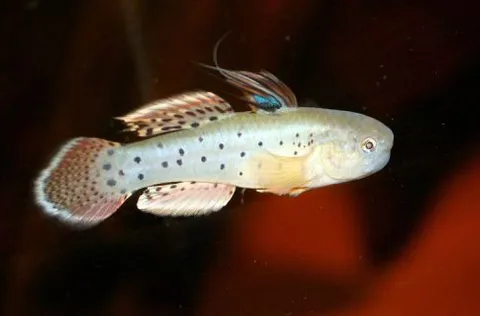
Stigmatogobius sadanundio
The Knight Goby, also known as the Spotted Goby (scientific name Stigmatogobius sadanundio), belongs to the family Gobiidae. Keeping them may not be the easiest, as they require brackish water and careful selection of…
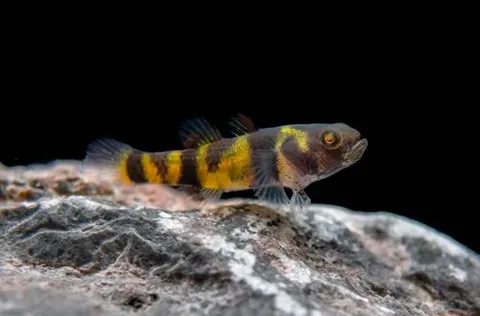
Brachygobius xanthomelas
The fish Brachygobius xanthomelas, known as the Brachygobius goby, belongs to the family Gobiidae (Gobies). Its native habitat is Southeast Asia, specifically the marshy waters in southern Thailand and Malaysia, located…
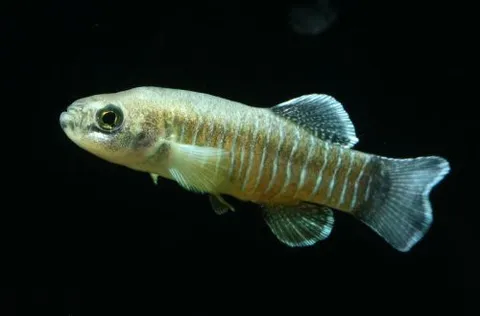
Esmaeilius arakensis
Esmaeilius arakensis, or the Arak Killifish, belongs to the family Cyprinodontidae. This fish is not frequently encountered in aquariums, partly due to its modest coloration and not always docile temperament.…
Rhinogobius nantaiensis
The Taiwan Goby, known scientifically as Rhinogobius nantaiensis, belongs to the Gobiidae family. As its name suggests, this species inhabits the island of Taiwan, located 180 km east of the Chinese coast. Its natural…