Temperature20 – 28 °C
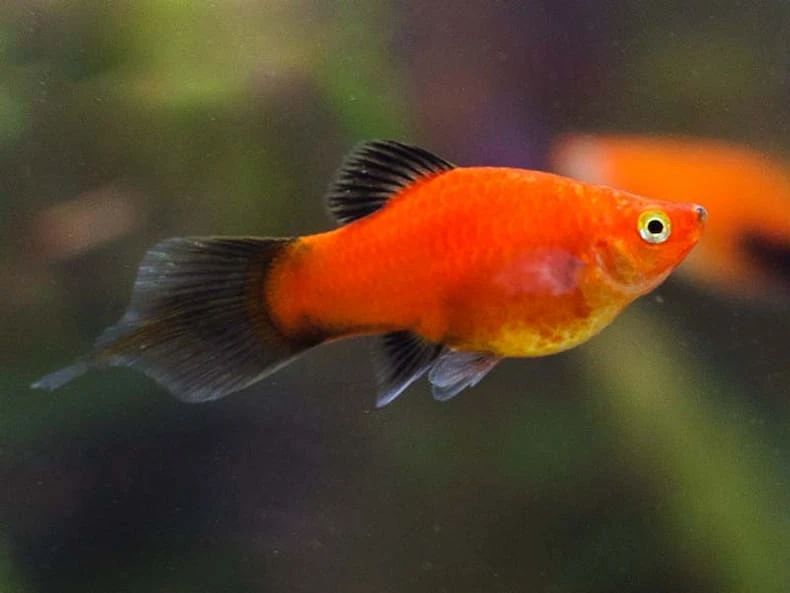
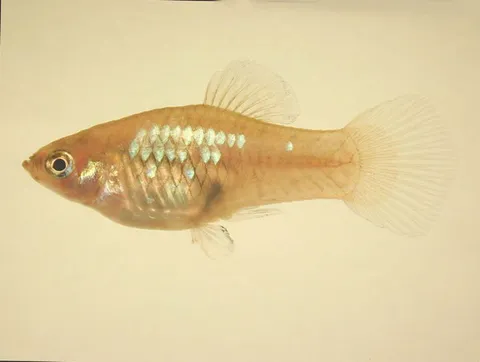
The Pintail Platy, known in English as Platy Pintail, is a selective breeding form of the common Platy, not found in the wild. A distinctive feature of this fish is the unusual structure of its caudal fin, the central rays of which are elongated, resembling a small brush. Since this is an inherited trait, it can be passed on to hybrid offspring resulting from crosses with other varieties of Platies. Consequently, fish of the most diverse colors are offered under the same name.
The Pintail Platy is a selective form bred artificially. It is characterized by a dense body, flattened laterally, and a distinctive caudal fin structure, with elongated central rays resembling a brush or a sword. The fish reach a size of 5–7 cm. Coloration varies, with red and orange shades being the most common. Males are usually smaller and slimmer than females and have an anal fin modified into a gonopodium.
This selective breeding form is not found in nature. In aquarium conditions, it prefers fresh water. Optimal water parameters: temperature 20–28 °C, hardness 10–30 dH, pH 7.0–8.2. Weekly water changes of up to 30% of the volume are necessary.
A peaceful and active fish, suitable for a community tank. It can be kept alone or in groups. It coexists well with similarly sized peaceful species, such as other livebearers, tetras, gouramis, danios, and small cichlids. Aggressive and large predators are not recommended as tank mates.
As a rule, the closer aquarium fish are to their wild ancestors, the higher their resilience. This means that artificially bred ornamental varieties sometimes require more attentive care. Fortunately, the Pintail Platy is not one of these demanding species. It adapts well to various conditions, including keeping in a relatively empty aquarium, although this is not the optimal option. For long-term successful keeping, a spacious aquarium with warm, slightly alkaline water, plenty of hiding places in the form of vegetation, access to quality food, and the companionship of peaceful fish of comparable size are necessary. Stable water parameters are ensured by reliable equipment operation and regular aquarium maintenance. Minimum mandatory procedures include periodic partial water changes and the removal of accumulated organic waste – food remnants and excrement. Regarding feeding, the fish readily accepts most popular aquarium foods. It is important that plant components are included in their diet, otherwise, the fish may start to damage delicate parts of aquarium plants. Breeding and reproduction of these fish are not difficult, which is characteristic of most livebearing species, and the Platy is no exception here. Under favorable conditions, they are capable of producing offspring almost monthly. Fry appear fully formed. To prevent predation by adult fish, juveniles should be moved to a separate aquarium. It is also important to remember that these fish can interbreed not only with other varieties but also with closely related species, such as Swordtails.
An omnivorous species. The diet should include a variety of quality dry foods, as well as live and frozen foods such as bloodworms, daphnia, and cyclops. It is important to supplement the diet with plant components, such as specialized vegetable flakes or finely chopped vegetables, to maintain health and coloration.
A livebearing species, sexual maturity occurs at 4–6 months. Gestation lasts from 30 to 50 days. The female gives birth to up to 40–80 fry per litter. To preserve the offspring, it is recommended to move the pregnant female to a separate tank with dense plant thickets where the fry can hide. Initial food for juveniles includes Artemia nauplii, rotifers, or specialized dry foods.
They have a strong immune system but are sensitive to water quality and keeping conditions. If hygiene is not maintained, they can be susceptible to bacterial infections and fungal lesions. Prevention involves maintaining stable environmental parameters, regular aeration, and filtration. At the first signs of illness, short-term salt baths are sometimes used.
When purchasing, choose active fish with clean fins and no visible damage or white spots on the body. It is important to ensure that the fish show interest in food and do not appear emaciated. Avoid individuals that stay at the water surface or appear sluggish, as this may be a sign of stress or disease.
The essentials: size, tank volume, water parameters and care
An adult reaches 5–7 cm in length. Plan the tank around the maximum size: the fish quickly outgrows a cramped setup.
The recommended volume is 60 L. A smaller tank speeds up nitrate build-up and raises stress levels.
Temperature 20–28 °C, pH 7–8.2, hardness 10–30 dGH. Stability matters more than exact values: sudden swings are harder on the fish than a small deviation from the ideal.
Around 4 years when kept properly. Lifespan depends directly on tank volume, water quality and a varied diet.
Temperament: peaceful (regular). Keep this in mind when choosing tank mates.
Recommended setup: mixed (solitary / pair / group). Ignoring this is a common cause of stress and disease.
Diet type: any (universal). Feed small portions that are finished within a couple of minutes — overfeeding does more harm than underfeeding.
The scientific name of the species is Xiphophorus maculatus, family Poeciliidae. It also appears in the literature as: Platypoecilus aurata, Platypoecilus cyanellus, Platypoecilus maculatus.
This fish damages plants, especially when its diet is short of vegetable food.
African Onion PlantAfzelius's AnubiasAmazon FrogbitAmazon SwordAnacharisAnubiasArrowhead CryptAsian WatermossBalansa Water TrumpetBanana PlantBarth's SwordBeckett's Water TrumpetBlue BuceBoivin's AponogetonBroad-leaf Water SpriteBrookweedChristmas MossCognac AmmanniaCongo AnubiasCreeping JennyCreeping SpotflowerCrinkled AponogetonDark SwordDelta ArrowheadDense MayacaDitch StonecropDwarf AmbuliaDwarf CloverDwarf CloverDwarf HairgrassDwarf HygrophilaDwarf RanalismaDwarf RotalaDwarf SagittariaDwarf ValDwarf Water TrumpetEelgrassFanwortFeathered LimnophilaFloating Aponogeton
Matched by family, categories and overlapping keeping conditions
Xiphophorus maculatus
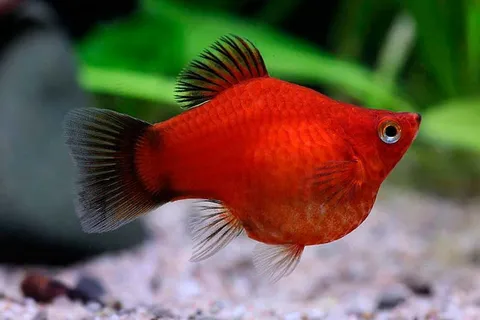
The Balloon Platy, also known as the Disc Platy, is known in the English-speaking commercial world as the Balloon Platy. A distinctive feature of this fish is its peculiar appearance: it has a strongly arched, hunched…
Xiphophorus maculatus
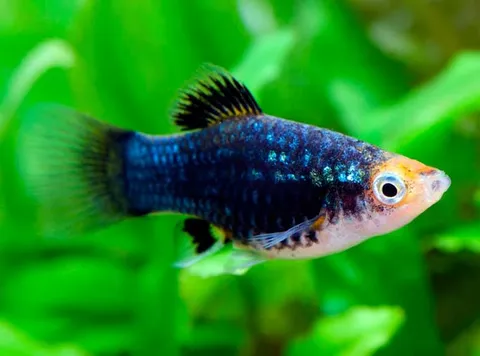
Platy Black is the trade name for this variety of Black Platy in the English-speaking market. This fish is not found in nature, as it is an artificially bred color variation derived from the common Platy (Xiphophorus…
Xiphophorus maculatus
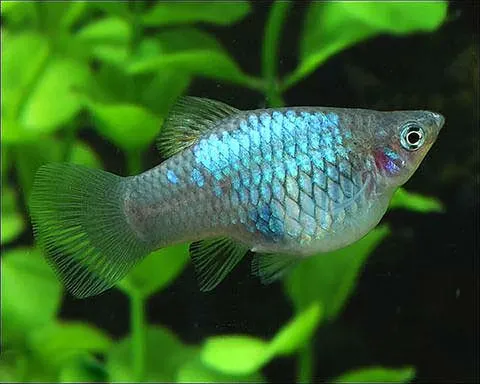
The Blue Platy, also known by the commercial English names Platy Blue, Blue Moon Platy, and Platy Neon Blue, is a selectively bred form of the common Platy and does not exist in the wild. Its main distinguishing feature…
Xiphophorus maculatus
The Platy, or Spotted Platy (scientific name Xiphophorus maculatus), belongs to the family Poeciliidae. Its hardiness and vibrant coloration make it one of the most sought-after aquarium fish. However, it should be…