Temperature22 – 26 °C
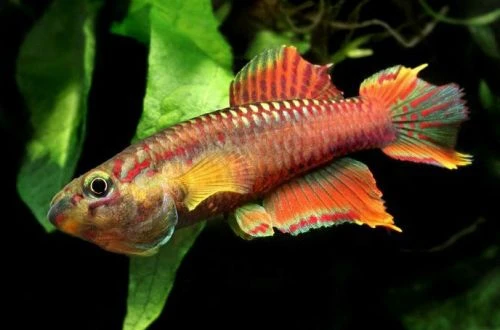
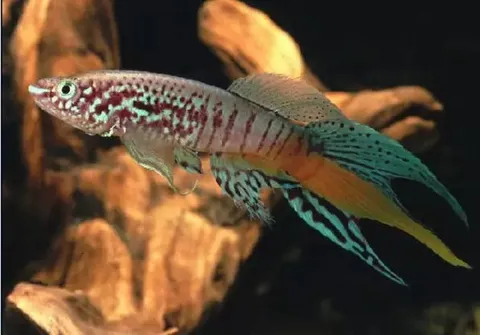
Aphyosemion splendopleure, known as the Aphyosemion Splendid, is a member of the Nothobranchiidae family. The coloration of the male fish is unique, as it's impossible to pinpoint a dominant shade, making it very attractive. Although this fish is peaceful and easy to care for, breeding it at home will require significant effort and time. For this reason, the species is not widely distributed in the aquarium hobby; it can be found primarily with professional breeders, in large pet stores, or through aquarist communities.
The differences in appearance between males and females are so pronounced that it is sometimes difficult to believe they belong to the same species. Male Aphyosemion Splendid surpass females not only in size and more developed fins but also in their incredibly beautiful, iridescent, multicolored coloration. However, depending on the region of origin, one of the shades may be more prominent. Females, on the other hand, have a modest appearance: their body and fin structure are simple, and their coloration is typically gray and unremarkable.
The natural habitats of Aphyosemion Splendid are located along the equatorial coast of West Africa. The fish are found in the territories of modern-day Cameroon, Equatorial Guinea, and Gabon. They can be found in small tributaries of rivers and slow-flowing streams that run through dense evergreen humid forests.
Within the species, relationships are built on constant competition between males for the attention of females. Adult males often exhibit territorial behavior, engaging in duels with each other. Fortunately, serious injuries are usually avoided. Nevertheless, for their well-being, it is best to avoid keeping males together or to provide each of them with sufficient space, based on 30 liters of water per individual. The ideal solution would be a combination of one male and several females. Towards other aquarium inhabitants, Aphyosemion Splendid usually shows peacefulness and even some timidity. Even the most active fish can easily frighten it. Therefore, calm species of comparable size should be chosen as tank mates.
A spacious aquarium of at least 50 liters, decorated to mimic its natural habitat, will be an ideal environment for a group of Aphyosemion Splendid. It is best to use a peat-based substrate or its analogues; slight silting over time is a normal process. The main focus of the decoration is on plants, both rooted and floating, which should form areas of dense vegetation. The presence of shelters in the form of snags, branches, or wooden elements is also welcome. Optimal water parameters include a slightly acidic pH level and soft to medium hardness. Since the range of acceptable pH and dGH values is not too wide, it is necessary to check the parameters of tap water before use and adjust them if necessary. Additional information on pH and dGH parameters, as well as methods for changing them, can be found in the "Water Hydrochemical Composition" section. A standard set of aquarium equipment includes a heater, aerator, lighting system, and filtration. The filter should be installed in such a way that the outgoing water currents do not create excessive flow, as this fish species tolerates it poorly. Directing the jet towards an obstacle, such as the tank wall or a snag, will significantly reduce its energy, weakening or completely eliminating internal current. In a balanced biological system, aquarium care is limited to weekly water changes of 10–15% of the volume with fresh water and regular cleaning of the substrate from fish waste. Organic film on the glass is removed as needed with a scraper.
Individuals raised in controlled aquarium conditions demonstrate unpretentiousness in feeding. They readily accept dry foods, provided their composition includes a sufficient amount of protein. To diversify the diet, it is recommended to add live or frozen foods, such as daphnia, artemia, and bloodworms. Feeding should be done 2–3 times a day, giving an amount of food that the fish can consume within 5 minutes. Any leftover food must be promptly removed from the aquarium.
For safe breeding and protection of offspring from parents and other aquarium inhabitants, it is recommended to use a separate spawning tank. A small aquarium of about 10 liters will be suitable for spawning. Equipment needs are minimal: a simple sponge air filter, a heater, and a light fixture for illumination. A few large plants can be used for decoration, but substrate is not recommended to simplify future maintenance. A fine-mesh net can be placed on the bottom of the tank, allowing eggs to fall through it. This design is necessary to protect the eggs, as parents are prone to eating their offspring. The chosen pair of adult fish is placed in the spawning aquarium. The following conditions stimulate breeding: maintaining water temperature in the range of 21–24°C, a slightly acidic pH level (6.0–6.5), and including meaty live or frozen foods in the daily diet. It is important to regularly clean the substrate of food remnants and organic waste (excrement), as water quickly becomes polluted in a confined space. The female lays eggs in batches of 10–20 daily for two weeks. Each batch of eggs should be carefully removed from the spawning aquarium (which is why substrate is not used) and transferred to a separate container, such as a tray with high sides, where the water depth is only 1–2 cm. 1–3 drops of methylene blue are added to the water, depending on the volume, to prevent the development of fungal infections. A dark and warm place must be provided for the tray, as the eggs are extremely sensitive to light. The incubation period lasts approximately 12 days. An alternative method is to place the eggs in moist or even wet peat at the same temperature and in complete darkness. In this case, the incubation period increases to 18 days. Fry also do not hatch all at once, but in batches; newly hatched fry are transferred to the spawning aquarium, where the parents should no longer be present by this time. The first food, consisting of microscopic organisms such as artemia nauplii and paramecia, can be given after two days. From the second week of life, the fry are switched to live or frozen foods such as artemia, daphnia, and others. Great attention must be paid to water cleanliness, as during the spawning period. In the absence of an effective filtration system, the spawning aquarium should be cleaned regularly, at least every few days, and a portion of the water replaced with fresh.
A balanced biological system in their habitat, complemented by suitable water parameters and a well-thought-out diet, guarantees the excellent well-being of aquarium fish. If one of these key aspects is disrupted, the likelihood of diseases significantly increases. After all, most health problems are directly rooted in housing conditions, and the diseases themselves are merely a consequence.
When purchasing, choose active individuals with clean fins and no white film or sores on their bodies. Avoid fish that stay near the surface or appear emaciated, as this species is sensitive to transport conditions and water quality. In the store, the fish should exhibit their natural caution but not show signs of apathy or constant stress, expressed as faded coloration.
The essentials: size, tank volume, water parameters and care
An adult reaches 6 cm in length. Plan the tank around the maximum size: the fish quickly outgrows a cramped setup.
The recommended volume is 50 L. A smaller tank speeds up nitrate build-up and raises stress levels.
Temperature 22–26 °C, pH 6–7.2, hardness 3–15 dGH. Stability matters more than exact values: sudden swings are harder on the fish than a small deviation from the ideal.
Around 4 years when kept properly. Lifespan depends directly on tank volume, water quality and a varied diet.
Temperament: semi-peaceful (including aggression during spawning / intraspecific conflicts). Keep this in mind when choosing tank mates.
Recommended setup: pair (male/female). Ignoring this is a common cause of stress and disease.
Diet type: any (universal). Feed small portions that are finished within a couple of minutes — overfeeding does more harm than underfeeding.
The scientific name of the species is Aphyosemion splendopleure, family Nothobranchiidae. It also appears in the literature as: Fundulopanchax splendopleuris.
The water suits 197 of 208 plants in the catalogue — the easiest ones are shown first.
Afzelius's AnubiasAnacharisAnubiasBrazilian PennywortDwarf CloverDwarf CloverDwarf HygrophilaDwarf SagittariaDwarf ValGuppy GrassHornwortJava FernJava MossMoneywortMud SwordNair's LagenandraNarrow Leaf AnacharisNarrow-leaf CloverStringy MossSüsswassertangTaiwan MossTape GrassTemple PlantUssuri Watermilfoil
Matched by family, categories and overlapping keeping conditions
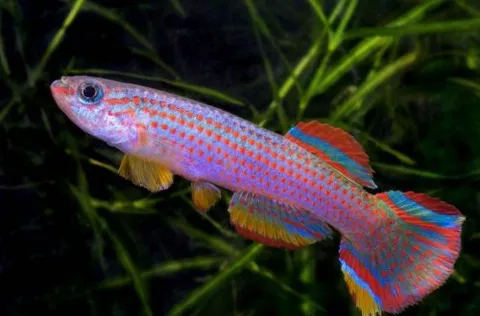
Aphyosemion striatum
Aphyosemion striatum, also known as the Red-striped Killifish, belongs to the family Nothobranchiidae. This miniature and beautiful fish is undemanding and peaceful, making it an excellent choice for beginner aquarists.…
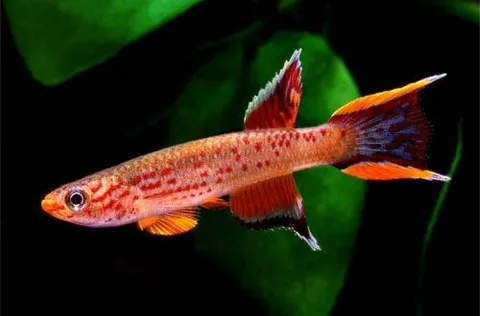
Aphyosemion australe
The Southern Aphyosemion, also known as the “Golden Pheasant” (scientific name Aphyosemion australe), is a representative of the family Nothobranchiidae. This fish was one of the first killifish to gain popularity in…
Callopanchax huwaldi
The fish Roloffia huwaldi, known scientifically as Callopanchax huwaldi (formerly Roloffia huwaldi), belongs to the family Nothobranchiidae, or nothobranchs. Its homeland is West Africa, where it is found in Sierra…
Fundulopanchax sjostedti
The Blue Gularis Killifish, scientifically known as Fundulopanchax sjostedti, belongs to the family Nothobranchiidae. Previously, this species was classified under the genus Aphyosemion. It can be found for sale under…