Temperature18 – 23 °C
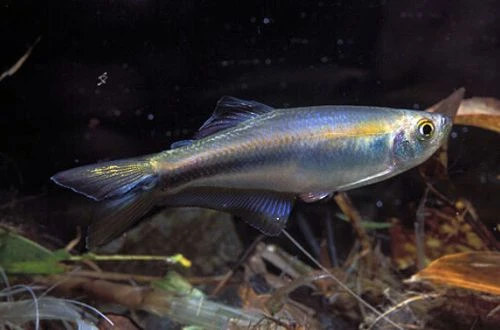
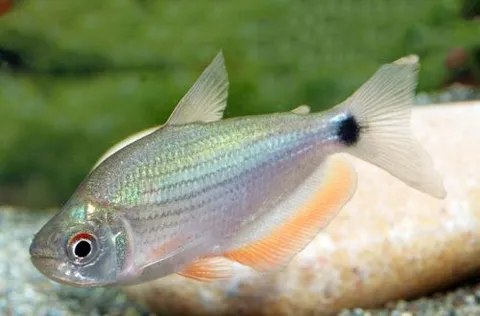
A representative of the Stevardiidae family, Mimagoniates microlepis, also known as the Blue Tetra. This beautiful schooling species has the unique ability to produce sounds, which are most likely used to attract a mate during the breeding season. Males enhance this effect by releasing pheromones from special glands at the base of their tails. Thanks to its unpretentiousness in keeping and good compatibility with numerous other fish species, the Blue Tetra is an excellent choice for beginner aquarists.
Adults of this fish reach a length of about 6 cm in nature, although in aquarium conditions their size may be slightly smaller. They are distinguished by a delicate blue coloration; in males, this hue is usually more intense, and their fins are noticeably longer than in females. During the breeding season, males use special pheromones to attract females and are capable of producing characteristic “croaking” sounds using their swim bladder.
This fish is widespread on the South American continent, its range covering the southeastern states of Brazil, extending from part of Bahia to Rio Grande do Sul. It inhabits numerous rivers, their tributaries, as well as coastal and river floodplains.
This peaceful schooling fish successfully coexists with other species of similar size and temperament that can adapt to similar keeping conditions (moderate current and low temperatures). However, excessively active or, even more so, aggressive tank mates should be avoided.
For a small school of Blue Tetras, an aquarium of at least 70 liters will be required. Dark substrate is preferable for decoration. Various shelters, such as snags or decorative elements (e.g., sunken ships, castles), as well as dense thickets of plants, including those floating on the surface, will be very useful. Plants should be arranged so as not to allow the aquarium to become completely overgrown, leaving enough open areas for swimming. To imitate the conditions of their natural habitat, a small amount of natural “debris” can be added to the bottom, such as short twigs or sticks that will roll freely. It is also useful to install a low-power artificial current system. Such a system should be placed so that the water flows are directed at an angle to the surface, rather than parallel to it. This will create a slight ripple and moderate turbulence. It is recommended to turn it off during feeding so that food does not spread throughout the aquarium. Water parameters for these fish include a pH close to neutral and a wide range of acceptable hardness values. The optimal water temperature is quite low and should not exceed 23°C. Aquarium care and maintenance for Blue Tetras are similar to most tropical aquariums.
In a home aquarium, these fish readily accept all types of available foods, whether dry, frozen, or live. It is important to remember that the quality and composition of the diet significantly affect the brightness of the fish's coloration, so it is recommended to prefer foods from trusted and well-known manufacturers.
The appearance of fry is possible even in a community tank, but their number, as a rule, will be insignificant and tends to decrease daily if they are not promptly transferred to a separate tank. This is due to the fact that adult fish view fry as a potential addition to their diet. To increase the chances of offspring survival and for a more systematic breeding process, it is recommended to use a separate spawning aquarium. Sexually mature fish are placed in it during their breeding activity. Usually, a small container of about 20 liters is suitable for this. The design of the spawning tank can be arbitrary, but the main emphasis is on the substrate. To protect the eggs from being eaten, as Blue Tetras are prone to eating their own offspring, the bottom is lined with a fine mesh, or fine-leaved plants or mosses, such as Java moss, are used. An alternative method is to place a layer of glass marbles with a diameter of at least 1 cm. The lighting should be subdued, and the equipment is sufficient with a heater and a simple air-driven filter. The stimulus for the start of the breeding period is a gradual change in the water parameters in the main aquarium to the following values: pH 5.5–6.5, dH 2–8 at a temperature of about 22–23°C. The basis of the diet during this period should be frozen or live foods. Careful observation of the fish will allow you to notice when the females become noticeably rounded, which indicates the presence of eggs. The males will begin to make characteristic “croaking” sounds, attracting the females. Then it is necessary to prepare and fill the spawning aquarium with water from the main tank. First, the females are placed there, and the next day a pair of the brightest and largest males are added. After this, it remains to wait for spawning; its completion can be determined by the significant “thinning” of the females and the appearance of eggs among the vegetation (or under the fine mesh). Then the adult fish are returned to the community tank. Fry will hatch within 48–72 hours, and after a few days, they will begin to swim freely in search of food. They should be fed specialized micro-food.
The best guarantee of fish health from any disease is a balanced aquarium biosystem with optimal keeping conditions. Therefore, if you notice changes in behavior, fish coloration, the appearance of uncharacteristic spots, or other symptoms, you should first check the water parameters, and only after that proceed with treatment measures.
When choosing individuals in a store, pay attention to their activity and the integrity of their fins. A healthy fish should show curiosity, stay in a school, and have no visible damage, spots, or signs of emaciation. Avoid buying fish that appear sluggish, stay alone, or constantly hide in the corners of the aquarium. It is also worth checking the cleanliness of the water in the retail aquarium and the absence of dead individuals, as the condition of the environment directly affects the fish's immunity. Before purchasing, it is recommended to ask the seller how long the fish has been imported to avoid the risk of buying weakened individuals that have not adapted after transportation.
The essentials: size, tank volume, water parameters and care
An adult reaches 6 cm in length. Plan the tank around the maximum size: the fish quickly outgrows a cramped setup.
The recommended volume is 70 L. A smaller tank speeds up nitrate build-up and raises stress levels.
Temperature 18–23 °C, pH 6–7, hardness 2–20 dGH. Stability matters more than exact values: sudden swings are harder on the fish than a small deviation from the ideal.
Around 4 years when kept properly. Lifespan depends directly on tank volume, water quality and a varied diet.
Temperament: peaceful (regular). Keep this in mind when choosing tank mates.
Recommended setup: group (8–10 individuals). Ignoring this is a common cause of stress and disease.
Diet type: any (universal). Feed small portions that are finished within a couple of minutes — overfeeding does more harm than underfeeding.
The scientific name of the species is Mimagoniates microlepis, family Stevardiidae. It also appears in the literature as: Coelurichthys iporangae, Coelurichthys microlepis, Mimagoniates iporangae.
The water suits 196 of 208 plants in the catalogue — the easiest ones are shown first.
Afzelius's AnubiasAnacharisAnubiasBrazilian PennywortDwarf CloverDwarf CloverDwarf HygrophilaDwarf SagittariaDwarf ValGuppy GrassHornwortJava FernJava MossMoneywortMud SwordNarrow Leaf AnacharisNarrow-leaf CloverStringy MossSüsswassertangTaiwan MossTape GrassTemple PlantUssuri WatermilfoilWater Wisteria
Matched by family, categories and overlapping keeping conditions
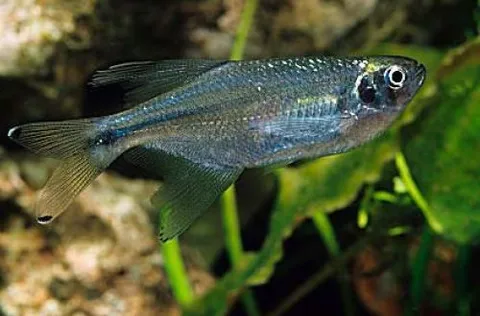
Pseudocorynopoma doriae
The scientific name Pseudocorynopoma doriae indicates the Dragon Tetra's belonging to the Stevardiidae family. This species is not often found in home aquariums outside the American continent, mainly due to its modest…
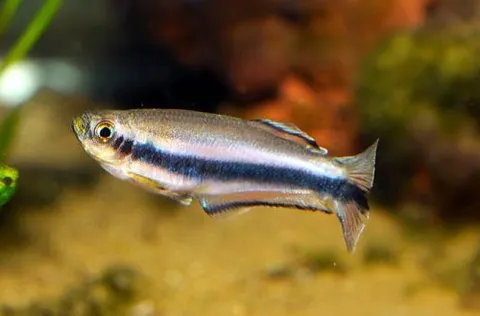
Mimagoniates barberi
Mimagoniates barberi, scientifically known as Mimagoniates barberi, belongs to the family Stevardiidae. These fish are agile and active, and their coloration is notable for beautiful blue hues. They will be an excellent…
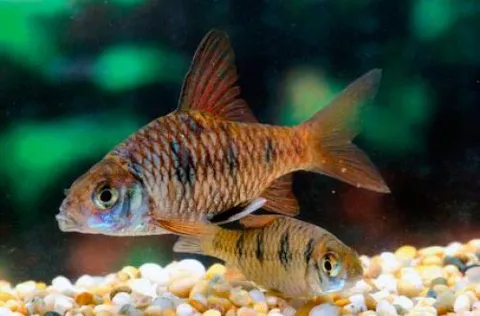
Puntius sahyadriensis
Puntius sahyadriensis, or Maharashtra Barb, is a member of the Cyprinidae family. Among various barb species, it stands out with its distinctive angular body shape, making it easily recognizable. This species is easy to…
Markiana nigripinnis
Markiana nigripinnis, also known as the Blackfin Markiana, is a member of the Stevardiidae family, which includes characin fish. Its native range is the subtropical regions of South America. These fish inhabit the…