Temperature26 – 33 °C
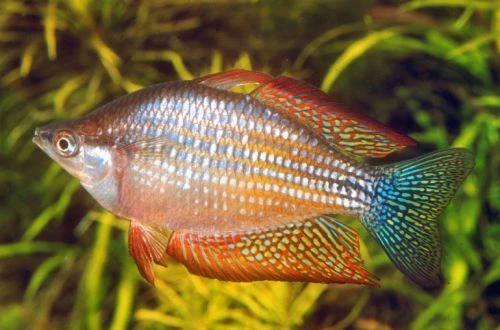
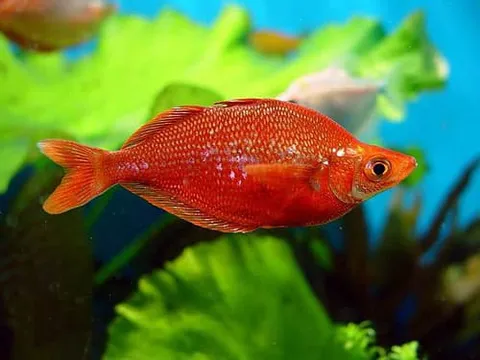
The Cherry Rainbowfish, also known as the Cherry Melanotaenia (scientific name Melanotaenia splendida inornata), belongs to the family Melanotaeniidae. It is an excellent choice for beginner aquarists because it is undemanding to keep, easy to breed, and has attractive body coloration. Furthermore, this species coexists well with many other aquarium inhabitants.
This species is a close relative of the Eastern Rainbowfish and the Red-striped Melanotaenia, which often leads to confusion due to their similar appearance. Adult individuals reach approximately 15 cm in length. Their coloration varies from pink to red-orange, with barely noticeable bluish horizontal stripes. The fins are adorned with bright, colorful speckles that create a continuous pattern. Sexual dimorphism is weakly expressed: males are slightly larger than females, and their anal and dorsal fins are more developed.
The natural habitat of this fish is the Australian continent, specifically a narrow strip of humid tropical rainforests located around the perimeter of the mainland. The Cherry Rainbowfish inhabits streams, slow-flowing rivers, and swamps. It prefers areas with abundant aquatic vegetation, including surface-floating plants, and often stays near the banks, among submerged shrubs and trees.
This active and peaceful fish is well compatible with other non-aggressive species of similar size. However, the excessive activity of the Cherry Rainbowfish can cause discomfort to slow-moving inhabitants, so it is best to avoid such tank mates. It is recommended to keep them in groups of at least 6–8 individuals of both sexes.
For a small group of these fish, an aquarium of at least 100 liters is recommended. When decorating, provide areas with dense vegetation interspersed with open swimming spaces. Floating plants are also welcome, as they create additional shade. The substrate can be chosen at the aquarist's discretion, based on the needs of the plants. The Cherry Rainbowfish prefers subdued lighting, tolerates strong internal currents poorly, and requires high water quality. The selection of aquarium equipment should be based on these characteristics. For successful keeping, it is crucial to install an efficient filtration system and perform regular partial water changes (15–20% of the total volume) with fresh water, which will provide comfortable living conditions for these tropical fish.
This species is not demanding regarding its diet and readily accepts most common foods, whether live, frozen, or dry. To allow the fish to display the best shades of their coloration, it is recommended to combine various products. For example, flakes and pellets can be alternated with bloodworms or brine shrimp.
For successful breeding of rainbowfish, both a community tank and a specially prepared breeding tank can be used. To stimulate the onset of the breeding period, favorable conditions must be created: the water temperature should be within 27–30°C, and the water itself should be slightly alkaline (up to pH 7.0) and of medium hardness. An important decorative element is thickets of fine-leaved plants or their artificial imitations; it is among these that the females will lay their eggs. Spawning continues for approximately two weeks, with the female laying several dozen eggs daily, which are then fertilized by the male. These fish lack parental instincts, so after spawning, they show no interest in their future offspring. If breeding occurs in a community tank, it is advisable to transfer the eggs to a separate tank with similar water parameters. Otherwise, there is a high risk of the eggs being eaten by other inhabitants. If it is not possible to set up a separate breeding tank, dense clusters of floating plants can be used; they will serve as a reliable hiding place for the fry. The incubation period lasts about 7–12 days. In the first days of development, the fry feed exclusively on microscopic food, such as infusoria. After about a week, their diet can be expanded by offering Artemia nauplii or special powdered foods for young aquarium fish. It is important to note that feeding rainbowfish fry in a community tank is significantly more difficult than in an isolated breeding tank.
Health problems usually arise only as a result of injuries or keeping in unsuitable conditions, which leads to a weakening of the immune system and, as a rule, provokes the development of various diseases. At the first signs of illness, the primary task is to check the water parameters for excesses or dangerous concentrations of toxic substances (nitrates, nitrites, ammonia, etc.). After bringing all indicators back to normal, treatment can begin.
When choosing rainbowfish, pay attention to the overall activity of the shoal and the cleanliness of their skin. Healthy individuals should be active, brightly colored, without visible damage, ulcers, film, or signs of emaciation. Avoid purchasing fish with deformed fins or unnatural behavior, for example, if an individual isolates itself, constantly hides, or makes chaotic movements. Since these fish are schooling, it is recommended to acquire a group of 6–8 individuals at once to reduce stress during adaptation to a new aquarium.
The essentials: size, tank volume, water parameters and care
An adult reaches 15 cm in length. Plan the tank around the maximum size: the fish quickly outgrows a cramped setup.
The recommended volume is 100 L. A smaller tank speeds up nitrate build-up and raises stress levels.
Temperature 26–33 °C, pH 6.5–8, hardness 8–20 dGH. Stability matters more than exact values: sudden swings are harder on the fish than a small deviation from the ideal.
Around 5 years when kept properly. Lifespan depends directly on tank volume, water quality and a varied diet.
Temperament: peaceful (regular). Keep this in mind when choosing tank mates.
Recommended setup: medium group (6–8 individuals). Ignoring this is a common cause of stress and disease.
Diet type: any (universal). Feed small portions that are finished within a couple of minutes — overfeeding does more harm than underfeeding.
The scientific name of the species is Melanotaenia splendida inornata, family Rainbowfishes (Melanotaeniidae).
The water suits 174 of 208 plants in the catalogue — the easiest ones are shown first.
Afzelius's AnubiasAnacharisAnubiasBrazilian PennywortDwarf CloverDwarf CloverDwarf HygrophilaDwarf SagittariaDwarf ValGuppy GrassHornwortJava FernJava MossMoneywortMud SwordNair's LagenandraNarrow Leaf AnacharisNarrow-leaf CloverSüsswassertangTaiwan MossTape GrassTemple PlantUssuri WatermilfoilWater Wisteria
Matched by family, categories and overlapping keeping conditions
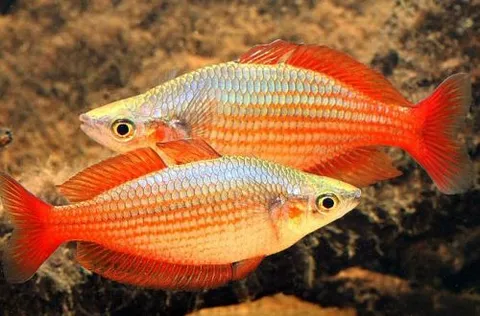
Melanotaenia splendida splendida
The Eastern Rainbowfish (scientific name – Melanotaenia splendida splendida) belongs to the family Melanotaeniidae. These fish are known for their beauty, peaceful nature, and hardiness. Thanks to their excellent…
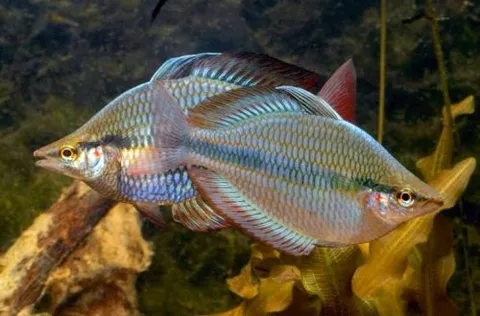
Melanotaenia trifasciata
The three-striped rainbowfish, scientifically known as Melanotaenia trifasciata, belongs to the family Melanotaeniidae. This species was first discovered by Norwegian zoologist Knut Dahl in June 1895. The description…
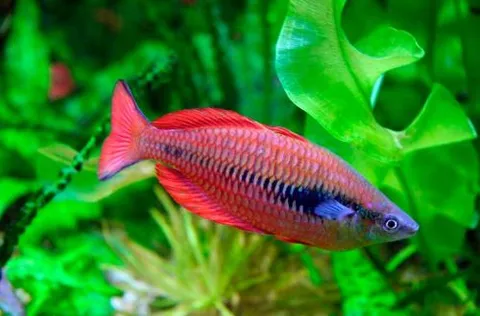
Melanotaenia parva
The scientific name Melanotaenia parva belongs to the family Melanotaeniidae, commonly known as Rainbowfishes. This fish is also known as the Kurumoi Lake Rainbowfish, named after Lake Kurumoi on the Cenderawasih…
Glossolepis incisa
This fish is known by several common names. Most often, it is called the Red Rainbowfish or Glossolepis incisa. Its scientific name is Glossolepis incisa, and it belongs to the family Melanotaeniidae, or Rainbowfishes.