Temperature22 – 27 °C
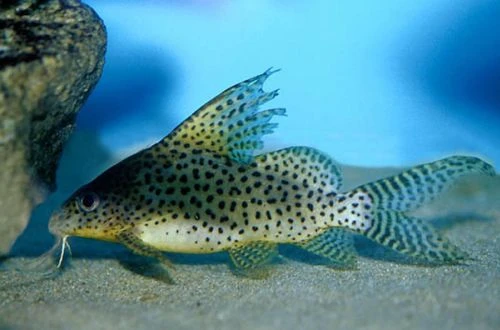
The Featherfin Synodontis, also known as Synodontis eupterus, belongs to the category of catfish that sometimes adopt an unusual upside-down swimming position. It is important to note that this behavior is not constant, and there is no cause for concern if you observe it in your fish. Another characteristic feature of this catfish is its ability to produce creaking sounds, which serve to warn predators or interact with partners during spawning.
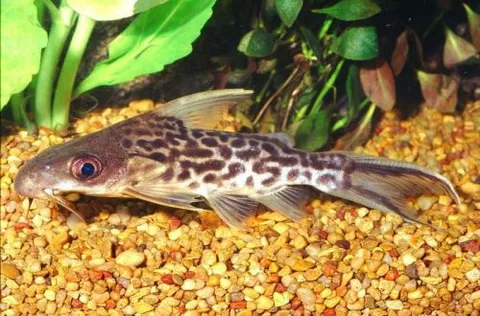
The Featherfin Synodontis is a rather large fish: adults can reach 30 cm, although in aquarium conditions they rarely grow larger than 20 cm. Given favorable conditions, this catfish can live for about 10 years, and in some specialized hatcheries, individual specimens have been recorded to live for over 25 years. Their body shape is flattened laterally, with a distinct triangle where the highest point is the tall dorsal fin. Long, sensitive barbels help them explore the bottom and feel objects in search of food. The body coloration varies from light gray to dark, almost black, with clearly defined spots resembling “polka dots.” One of the distinguishing features of the Featherfin Synodontis is its large fins. Young individuals are outwardly similar to adults, but they lack the characteristic broad dorsal fin.
The scientific description of the Featherfin Synodontis (Synodontis eupterus) dates back to 1901. These fish inhabit vast territories of Central Africa, including Nigeria, Chad, Sudan, Ghana, Mali, Niger, and Cameroon; they can also be found in the White Nile. In their natural habitat, this species prefers murky rivers with bottoms formed by silty or rocky deposits, where there is a fast current. The synodontis' diet is omnivorous — it consumes any edible food, including algae, but particularly favors insect larvae. Like other Synodontis, this is a shoaling species that lives in groups of changeable composition in the wild. Keeping a single specimen in the aquarium reflects not its way of life but its territoriality: a group needs a considerably larger tank and a separate refuge for each fish.
The Featherfin Synodontis is not aggressive, but it cannot be called entirely peaceful either; it can pose a threat to small fish, so it is better to choose tank mates of a similar size. Problems may also arise for slow-moving fish, as the synodontis can quickly consume a large amount of food in one sitting, thereby depriving other aquarium inhabitants of food. This species has a complex hierarchical system directly dependent on fish size: the largest individuals occupy the best hiding places, pushing others to the periphery. Furthermore, it is one of the few species that perfectly complement African cichlids.
This fish species does not exhibit special requirements for keeping conditions and can withstand significant fluctuations in water parameters. Since the water in an aquarium is not flowing, there is a risk of waste accumulation and the appearance of free ammonia in the bottom layer. Therefore, it is recommended to siphon the gravel and perform water changes weekly, replacing 20–25% of the total volume. Successful keeping requires a spacious aquarium of at least 180 L, equipped with many hiding places, particularly driftwood. The catfish enjoy chasing each other through underwater passages, while simultaneously feeling secure. Once a hiding place is chosen, the fish spends most of its life there. When decorating the aquarium, preference should be given to porous rocks, such as tufa, often used in cichlid tanks. For substrate, coarse sand and smooth gravel are recommended to minimize the risk of damage to their sensitive barbels. Floating plants will help create shaded areas, and only plants with strong root systems should be planted in the substrate, as other plants can be easily uprooted by the catfish.
The synodontis' diet is very diverse: it consumes almost any food, from algae to insects. Thus, if the Featherfin Synodontis is kept in an aquarium with other fish species, there is no need to select specialized food for it. Unlike some of its relatives, this catfish does not require the feeder to be placed strictly above its hiding place; if necessary, it will find food on its own even during the day. Its diet can include various types of food: commercial plant-based foods, dry flakes, pellets, wafers, as well as meat products, including frozen, and live food, such as small earthworms (once a week is sufficient).
Sexual dimorphism in these catfish is practically imperceptible and is limited only to size: females are generally larger than males. In home aquariums, these fish usually do not breed; offspring are obtained in specialized fish farms using hormonal stimulants.
This fish is highly resilient. In aquariums where the necessary living conditions are provided, cases of disease are not recorded. Nevertheless, the possibility of an epidemic cannot be ruled out.
When choosing a Synodontis eupterus, preference should be given to active individuals with clean skin, free from visible damage, ulcers, or white film. It is important to pay attention to the condition of the fins: they should be intact, without signs of splitting or erosion, and the barbels should be long and undamaged. A healthy fish displays cautious curiosity and should not appear emaciated or apathetic. In the store, catfish often hide in shelters, so it is worth asking the seller to gently disturb them to assess the fish's reaction and coordination of movement. Avoid purchasing individuals that constantly lie on their side or have an unnaturally bloated abdomen, as this may indicate internal diseases.
The essentials: size, tank volume, water parameters and care
An adult reaches 20 cm in length. Plan the tank around the maximum size: the fish quickly outgrows a cramped setup.
The recommended volume is 180 L. A smaller tank speeds up nitrate build-up and raises stress levels.
Temperature 22–27 °C, pH 6–7.5, hardness 8–15 dGH. Stability matters more than exact values: sudden swings are harder on the fish than a small deviation from the ideal.
Around 15 years when kept properly. Lifespan depends directly on tank volume, water quality and a varied diet.
Temperament: semi-peaceful (dangerous to smaller ones). Not a predatory species, but small fish that fit in its mouth will eventually be eaten.
Recommended setup: mixed (solitary / pair / group). Ignoring this is a common cause of stress and disease.
Diet type: any (universal). Feed small portions that are finished within a couple of minutes — overfeeding does more harm than underfeeding.
The scientific name of the species is Synodontis eupterus, family Mochokidae. It also appears in the literature as: Synodontis galinae, Synodontis macrepipterus.
The water suits 33 of 208 plants in the catalogue — the easiest ones are shown first.
African Water FernAmazon FrogbitAnubiasAsian WatermossBlue BuceBuceChristmas MossDwarf African FernFloating CrystalwortFloating Water SpriteGiant VallisneriaGlobefruit LudwigiaGreater DuckweedJapanese RushJava FernJava MossJungle ValNair's LagenandraPelliaSchismatoglottisStringy MossSüsswassertangTaiwan MossWater Spangles
This fish digs through the substrate and pulls rooted plants out.
African Onion PlantAfzelius's AnubiasAmazon SwordAnacharisArrowhead CryptBalansa Water TrumpetBanana PlantBarth's SwordBeckett's Water TrumpetBladderwort CarpetBog MossBoivin's AponogetonBolivian Chain SwordBrazilian PennywortBroad-leaf Water SpriteBrookweedBrown's LimnophilaCardinal PlantCaribbean MintCarolina Micro SwordCognac AmmanniaCongo AnubiasCreeping JennyCreeping RushCreeping SpotflowerCreeping StaurogyneCrinkled AponogetonCupheaCutleaf WatermilfoilCylindricfruit LudwigiaDark SwordDelta ArrowheadDense MayacaDitch StonecropDwarf AmbuliaDwarf Baby TearsDwarf CloverDwarf CloverDwarf HairgrassDwarf Hygrophila
Matched by family, categories and overlapping keeping conditions
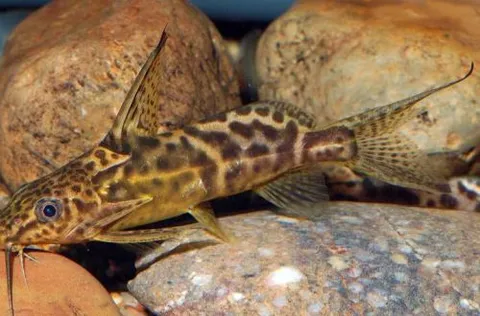
Synodontis greshoffi
Synodontis greshoffi, also known as Synodontis Congo, belongs to the family Mochokidae. This catfish is undemanding, hardy and does not bully its tankmates, and its distinctive body pattern is eye-catching. It will,…
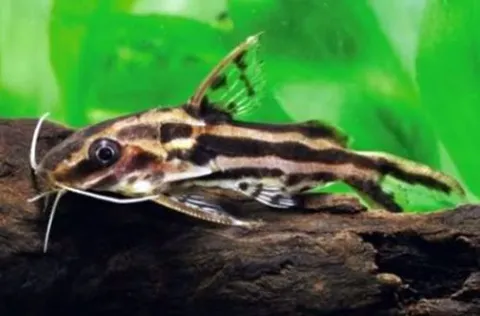
Synodontis flavitaeniatus
Belonging to the Mochokidae family, the Striped Synodontis, also known as the Orange Synodontis (Synodontis flavitaeniatus), easily adapts to various water conditions. This peaceful and undemanding species makes an…
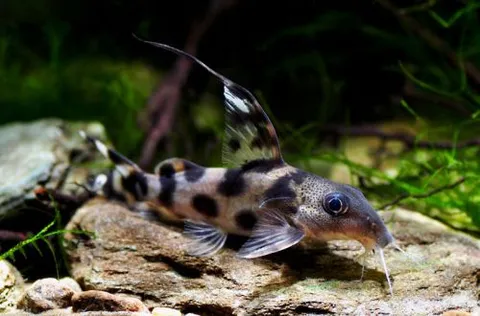
Synodontis decorus
Synodontis decorus, known as the Flag Synodontis or Clown Synodontis, belongs to the family Mochokidae. This species is one of the most striking representatives of the Synodontis genus and can adorn almost any large…
Synodontis pleurops
The scientific name Synodontis pleurops belongs to the family Mochokidae, known as upside-down catfish, and the species itself is known as Synodontis pleurops. Its homeland is Central Africa, although, contrary to its…