Temperature22 – 26 °C
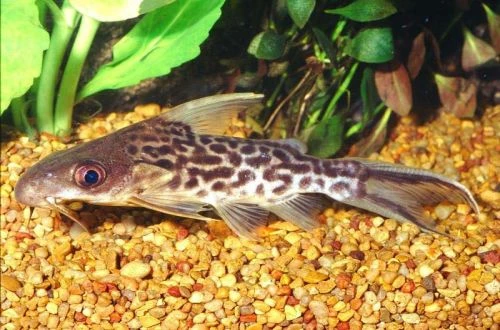
The scientific name Synodontis pleurops belongs to the family Mochokidae, known as upside-down catfish, and the species itself is known as Synodontis pleurops. Its homeland is Central Africa, although, contrary to its name, it does not inhabit Kenya. This catfish lives in the upper and middle parts of the Congo River basin, flowing through the territory of the Democratic Republic of Congo.
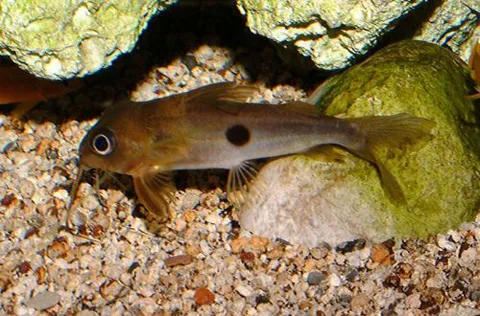
Adults of this fish reach a length of over 30 cm. The catfish has reliable protection from predators: its head is covered with fused bony plates resembling a helmet, and the first rays of the dorsal and pectoral fins are transformed into sharp spines. The body pattern of young fish is distinguished by large, rounded brown spots located on a light, silvery background. As they grow, this light background gradually darkens, first taking on a yellowish tint, and then becoming dark gray.
The species inhabits the upper reaches of the Congo River basin in the Democratic Republic of Congo and Cameroon. It prefers sections of rivers with moderate currents, sandy-silty bottoms, and an abundance of shelters in the form of snags, tree roots, and rock formations. The fish are predominantly nocturnal, hiding in shaded areas during daylight hours.
Despite its somewhat timid nature, this peaceful catfish can comfortably coexist with more active and boisterous species. It can live both alone and in a group of its own kind. The catfish's life is characterized by a nocturnal and secretive lifestyle. It shows the greatest activity at dusk, and during the day, in daylight, it seeks shelter.
For one adult specimen, the optimal aquarium volume should be at least 300–350 L. Unlike other representatives of its genus, Synodontis pleurops prefers shelters on vertical surfaces rather than in caves or on the bottom. The aquarium decor is recommended to include tall snags, as well as dense Vallisneria, which should be placed both among the snags and along the aquarium walls. The most comfortable habitat for this catfish is slightly acidic, soft water. The presence of tannins in the water will be beneficial, as this mimics the natural conditions of swampy river areas. Sources of such substances can be natural snags, leaves, and bark of some trees. Aquarium maintenance is standard: it includes weekly partial water changes combined with the removal of organic waste, as well as a prophylactic inspection of equipment.
The diet of this fish mainly consists of vegetation. Therefore, when feeding, it is recommended to use foods with a high content of plant components.
Natural breeding has not been recorded in aquarium conditions. For commercial purposes, reproduction is carried out on specialized farms using hormonal injections. In nature, the fish are egg-laying, spawning occurs in groups during seasonal floods, and there is no parental care for the offspring.
The species does not have a specific predisposition to rare diseases, however, like other members of the family, it is sensitive to water quality and substrate cleanliness. If maintenance conditions are violated, organic matter accumulates, or environmental parameters fluctuate sharply, fish may develop bacterial infections affecting the skin and fins. The main preventive measures are regular partial water changes, effective filtration, and maintaining hygiene in the aquarium. Catfish of this species have sensitive barbels, so the use of sharp or coarse gravel as a substrate is unacceptable, as this leads to injuries and subsequent development of fungal or bacterial lesions of the oral cavity.
When purchasing, active fish with clean skin without visible damage, ulcers, or plaque should be chosen. It is important to assess the condition of the fins: they should be intact, without signs of edge erosion. Since the species is nocturnal, the fish in the store may appear sluggish, but they should react to external stimuli and show no signs of emaciation.
The essentials: size, tank volume, water parameters and care
An adult reaches 32 cm in length. Plan the tank around the maximum size: the fish quickly outgrows a cramped setup.
The recommended volume is 300 L. A smaller tank speeds up nitrate build-up and raises stress levels.
Temperature 22–26 °C, pH 6–7, hardness 3–12 dGH. Stability matters more than exact values: sudden swings are harder on the fish than a small deviation from the ideal.
Around 15 years when kept properly. Lifespan depends directly on tank volume, water quality and a varied diet.
Temperament: semi-peaceful (dangerous to smaller ones). Not a predatory species, but small fish that fit in its mouth will eventually be eaten.
Recommended setup: both solitary and in group (flexible). Ignoring this is a common cause of stress and disease.
Diet type: plant-based (algae, vegetables). Feed small portions that are finished within a couple of minutes — overfeeding does more harm than underfeeding.
The scientific name of the species is Synodontis pleurops, family Mochokidae.
The water suits 197 of 208 plants in the catalogue — the easiest ones are shown first.
Afzelius's AnubiasAnacharisAnubiasBrazilian PennywortDwarf CloverDwarf CloverDwarf HygrophilaDwarf SagittariaDwarf ValGuppy GrassHornwortJava FernJava MossMoneywortMud SwordNair's LagenandraNarrow Leaf AnacharisNarrow-leaf CloverStringy MossSüsswassertangTaiwan MossTape GrassTemple PlantUssuri Watermilfoil
Matched by family, categories and overlapping keeping conditions
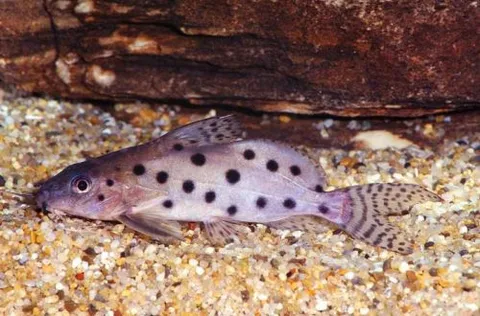
Synodontis ocellifer
The Spotted Synodontis, scientifically known as Synodontis ocellifer, is a member of the Mochokidae family. Its distinguishing feature is large spots that strikingly contrast with its main body coloration. This catfish…
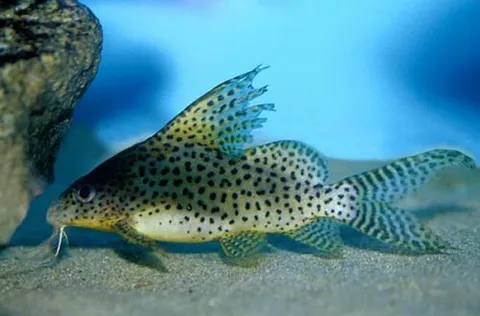
Synodontis eupterus
The Featherfin Synodontis, also known as Synodontis eupterus, belongs to the category of catfish that sometimes adopt an unusual upside-down swimming position. It is important to note that this behavior is not constant,…
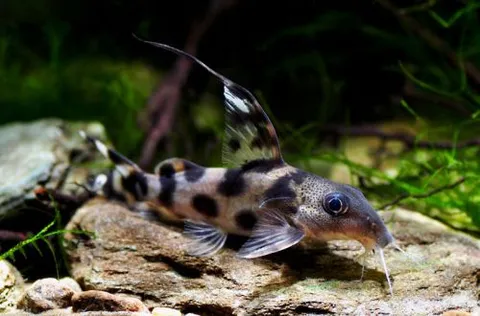
Synodontis decorus
Synodontis decorus, known as the Flag Synodontis or Clown Synodontis, belongs to the family Mochokidae. This species is one of the most striking representatives of the Synodontis genus and can adorn almost any large…
Synodontis notatus
Synodontis notatus, known as the Domino Synodontis or One-Spot Synodontis, belongs to the family Mochokidae. Interestingly, despite the name "one-spot" in one of its common names, the fish can have up to 6 round spots…