Temperature22 – 25 °C
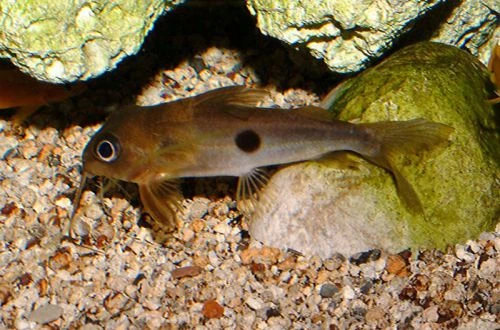
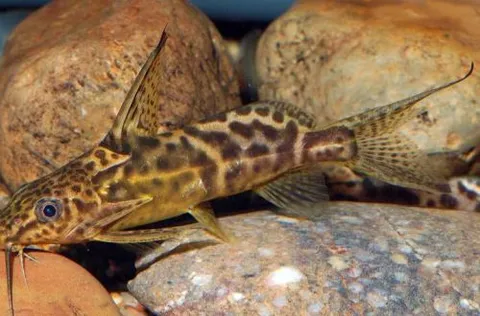
Synodontis notatus, known as the Domino Synodontis or One-Spot Synodontis, belongs to the family Mochokidae. Interestingly, despite the name "one-spot" in one of its common names, the fish can have up to 6 round spots on its body. This species does not require special care and is quite easy to keep, coexisting well with various other aquarium inhabitants except the very small ones, which it may swallow; aggression is directed at its own kind. Therefore, it is recommended to keep only one such catfish in a home aquarium.
Adults can reach approximately 27 cm in length. The fish's coloration is usually gray, and one of its distinctive features is large, rounded spots. Their number can vary, but most often there are no more than three – this particular feature served as the basis for the species' name, Domino Synodontis, or Domino Catfish. Distinguishing males from females is quite difficult, as sexual dimorphism is weakly expressed.
Its widespread distribution is the Congo River basin, covering the territories of the modern states of the Democratic Republic of Congo and the Republic of Congo. The Domino Synodontis is found in various biotopes, but it particularly prefers areas with slow currents and backwaters where there are many natural shelters.
This fish species is conditionally peaceful and coexists well with many other aquarium inhabitants, with the exception of very small fish, which can accidentally become food for such a large catfish. Such behavior is not a manifestation of aggression, but rather a common indiscriminate eating habit typical of most catfishes. Intraspecific relationships, however, are quite complex. Adults are distinctly territorial and can engage in serious conflicts if the aquarium is not spacious enough or lacks sufficient hiding places. Choose tankmates too large to fit in its mouth: very small fish are treated as food.
For the comfortable existence of a single fish, a tank with a volume of at least 150 L will be optimal. When decorating the aquarium, it is recommended to use soft sandy substrate, as well as driftwood and roots that form cozy shelters. The addition of rock fragments and stones is also welcome. The presence of aquatic vegetation is not mandatory but beneficial; for example, floating plants on the water surface can provide additional shading. Dimmed light is preferred for the Domino Synodontis, although it will not experience discomfort in a general aquarium with moderate lighting. A wide habitat range has led this species to adapt to various hydrochemical water parameters, so water preparation during maintenance and cleaning of the aquarium will not pose significant difficulties. Despite its unpretentiousness, regular cleaning of the substrate from organic debris and partial water changes with fresh water remain important aspects of care.
This species is considered omnivorous and undemanding in terms of food, readily accepting a variety of feeds: dry mixes, frozen, live, and plant-based products. Its diet can even include vegetables such as shelled peas, cucumbers, or spinach. A varied diet helps maintain the fish's good condition and reduces the likelihood of digestive problems. It is worth noting that the quality of dry foods matters, as poor-quality products can negatively affect the health of the catfish.
Breeding this species in home aquariums is extremely difficult, so reliable data on its spawning in artificial conditions are practically non-existent. In commercial aquaculture farms, breeding is well-established, which has led to a situation where there are practically no Synodontis available for sale that have been caught from their natural habitat.
The main cause of most diseases is unsuitable living conditions and poor-quality food. If you notice the first symptoms, you should immediately check the water parameters and ensure there are no high concentrations of dangerous substances (ammonia, nitrites, nitrates, etc.). The parameters must be brought back to normal, and only then can treatment measures begin.
When purchasing, choose active specimens with clean skin without visible damage, sores, or white spots. It is important to inspect the condition of the barbels: they should be intact, without signs of erosion, which indicates proper care of the fish in the store. Avoid specimens with a severely sunken abdomen or an unnaturally bloated body. Keep in mind that sharp spines on the pectoral and dorsal fins can easily get tangled in a net, so caution should be exercised when catching them to avoid injuring the fish or damaging the net. In the store, catfish often hide in shelters, so ask the seller to demonstrate their activity during feeding to ensure a normal appetite and lack of timidity.
The essentials: size, tank volume, water parameters and care
An adult reaches 27 cm in length. Plan the tank around the maximum size: the fish quickly outgrows a cramped setup.
The recommended volume is 150 L. A smaller tank speeds up nitrate build-up and raises stress levels.
Temperature 22–25 °C, pH 6.5–7.5, hardness 8–18 dGH. Stability matters more than exact values: sudden swings are harder on the fish than a small deviation from the ideal.
Around 10 years when kept properly. Lifespan depends directly on tank volume, water quality and a varied diet.
Temperament: semi-peaceful (dangerous to smaller ones). Not a predatory species, but small fish that fit in its mouth will eventually be eaten.
Recommended setup: solitary. Ignoring this is a common cause of stress and disease.
Diet type: sinking (any). Feed small portions that are finished within a couple of minutes — overfeeding does more harm than underfeeding.
The scientific name of the species is Synodontis notatus, family Mochokidae. It also appears in the literature as: Synodontis maculatus.
The water suits 196 of 208 plants in the catalogue — the easiest ones are shown first.
Afzelius's AnubiasAnacharisAnubiasBrazilian PennywortDwarf CloverDwarf CloverDwarf HygrophilaDwarf SagittariaDwarf ValGuppy GrassHornwortJava FernJava MossMoneywortMud SwordNarrow Leaf AnacharisNarrow-leaf CloverStringy MossSüsswassertangTaiwan MossTape GrassTemple PlantUssuri WatermilfoilWater Wisteria
Matched by family, categories and overlapping keeping conditions
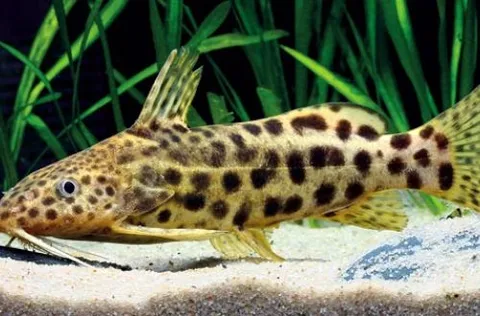
Synodontis waterloti
The catfish Synodontis waterloti, also known as the Waterlot Synodontis, belongs to the family Mochokidae. It is relatively peaceful and does well alongside other non-aggressive species, but it will swallow any fish…
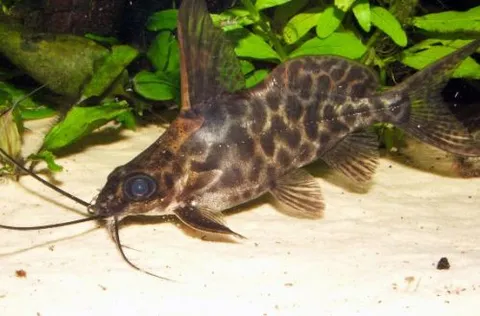
Synodontis alberti
The scientific name Synodontis alberti belongs to the family Mochokidae, and this fish is also known as Albert's Synodontis, High-fin Synodontis, or Big-eyed Synodontis. Since it is most active in the dark, during the…
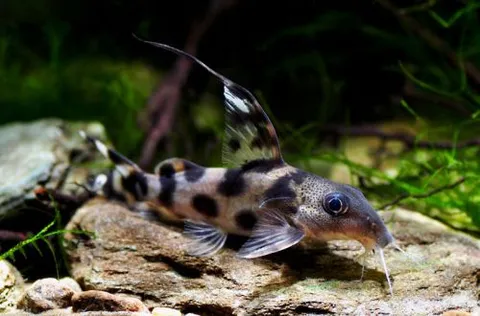
Synodontis decorus
Synodontis decorus, known as the Flag Synodontis or Clown Synodontis, belongs to the family Mochokidae. This species is one of the most striking representatives of the Synodontis genus and can adorn almost any large…
Synodontis greshoffi
Synodontis greshoffi, also known as Synodontis Congo, belongs to the family Mochokidae. This catfish is undemanding, hardy and does not bully its tankmates, and its distinctive body pattern is eye-catching. It will,…