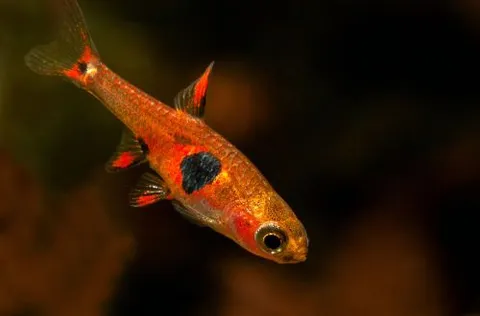
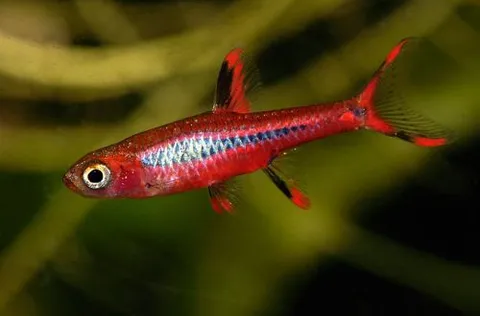
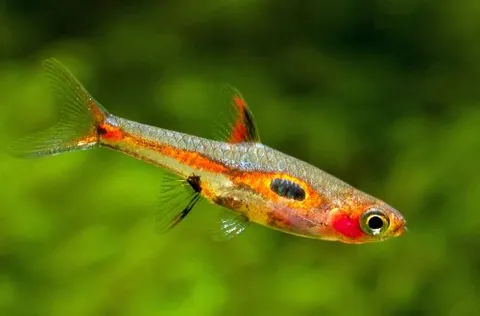
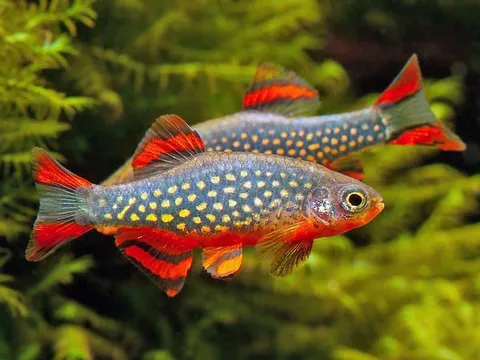
The Firefly Rasbora is an egg-laying species: females scatter eggs among plant thickets, and males fertilize them. Parental instincts in these fish are weakly expressed; immediately after spawning, they may eat both eggs and hatched fry. Despite their ability to breed year-round without much intervention from the aquarist, the survival rate of fry remains very low due to this. To increase the chances of fry survival and protect them from adults, it is recommended to breed them in a separate tank — a breeding aquarium. The setup of such an aquarium should be simple, with an emphasis on egg preservation. Low-growing, fine-leaved plants or mosses, such as Riccia fluitans and Java moss, are used, planted over most of the substrate surface. Dense plant thickets serve as reliable cover for eggs, no worse than special substrates or nets. A breeding aquarium for this species is usually about 10 liters in volume and filled halfway. Equipment includes an aerator, heater, and a simple, low-power sponge air-driven filter to prevent accidental suction of eggs and fry. Spawning occurs under dim lighting, so a light source is not required initially. To systematize the breeding process, experienced breeders regulate the hydrochemical composition of the water. In particular, the stimulus for spawning is the inclusion of protein (meat) food in the daily diet, as well as setting pH values at 5.0–6.5 with dGH around 1–5° and a temperature of 26–27°C. The beginning of the breeding period can be determined by the noticeably rounded abdomen of the females, while the males choose an area of the aquarium and begin to actively attract females. By this point, a separate tank should be prepared, filled with water from the main aquarium, then several females and the brightest males should be transferred there, where they will spend several days. Spawning can be initiated by adding cool water, lowering the temperature by several degrees. If this is done in the evening, offspring may appear by morning. The end of spawning is easiest to determine by the females — they will become noticeably slimmer. After this, the fish are returned to the main aquarium. Fry appear after 18–48 hours, and after another day, they begin to swim freely. They are fed specialized microscopic food for aquarium fish fry.