Temperature22 – 28 °C
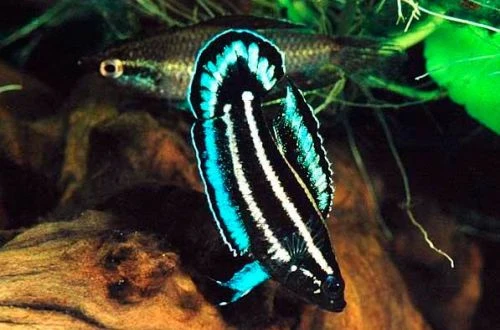
The Harvey's Licorice Gourami, or Parosphromenus harveyi, known scientifically as Parosphromenus harveyi, is a member of the family Osphronemidae. The species is named after the researcher Willy Harvey. In aquaristics, it is not among the most common species, which is largely due to the complexity of its keeping and the extremely limited export possibilities from its natural habitats.
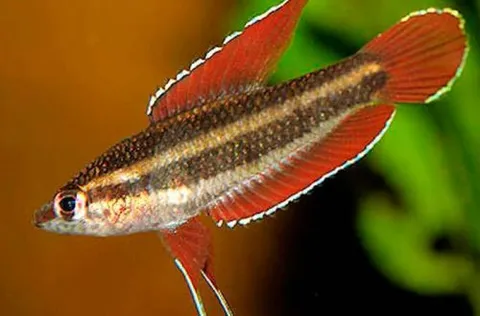
Adults reach a length of about 3 cm. Their bodies are adorned with alternating dark and light horizontal stripes. Males are distinguished by a black stripe on their fins and tail, bordered on both sides by turquoise stripes, with the inner stripe being noticeably thicker. During the breeding season, the intensity of the males' coloration significantly increases. Females, in contrast, appear less vibrant; they lack blue stripes on their fins, and the main body color of sexually mature individuals is characterized by pale yellow hues.
Its natural range is located in the peninsular part of Malaysia, in Southeast Asia, approximately coinciding with the territory of Selangor state. There, this species inhabits peat swamps hidden deep within tropical forests. A typical biotope is a deeply shaded body of water, surrounded by dense riparian vegetation, with very dark water. The bottom of such waters is covered with a thick layer of fallen leaves, branches, grass, and other organic materials. The intense color of the water is due to high concentrations of humic acids and tannins, which are released during the decomposition of plant organic matter. Selangor state is one of the most densely populated regions of Malaysia. Active human economic activity has led to large-scale deforestation and serious pollution of the remaining water bodies, which significantly affects the wild population of these fish, pushing them to the brink of extinction.
Males compete with each other for the attention of females. The degree of this competition intensifies during the spawning season, but, as a rule, conflict is limited to a "show of strength." It is recommended to keep them in pairs or groups. When choosing tank mates for Harvey's Licorice Gouramis, given their modest size, preference should be given to equally small fish, for example, representatives of barbs, rasboras, and similar species.
For keeping a pair of these fish, aquariums with a volume of 20–30 L will be optimal. Parosphromenus harveyi looks particularly harmonious in an environment that mimics its natural habitat. When decorating, it is important to provide various shelters, for example, snags in combination with thickets of plants or specially stylized artificial decor. It is recommended to use dark substrate, over which a layer of dried leaves from certain tree species can be laid. Lighting should be subdued, or shading should be created using floating plants. However, more arbitrary design options are also acceptable. Many aquarists, for ease of maintenance, completely forgo substrate, using PVC pipe fragments, ceramic pots turned on their side, or other hollow vessels as shelters. Maintaining very low pH and dGH values is one of the most challenging tasks in caring for this species; a reverse osmosis system or other methods for obtaining soft, acidic water may be required. It is important that filtration is not too intense to avoid excessive internal currents. In some cases, a simple air-driven sponge filter is sufficient. The stability of the aquarium's biological balance will depend on the uninterrupted operation of the necessary equipment and regular maintenance procedures: removal of waste (food residues, excrement) and partial water changes (5–10% of the total volume) with fresh water.
This species is carnivorous. In natural conditions, its diet consists of small aquatic insects, their larvae, and other invertebrates. In a home aquarium, it is recommended to offer live or frozen foods, such as Artemia, Daphnia, bloodworms, mosquito larvae, Drosophila flies, and similar.
Under favorable conditions, spawning occurs quite frequently. With the onset of the breeding period, males occupy a specific area on the bottom of the aquarium, in the center of which is a shelter – this can be a cave or simply a secluded spot among snags and plant thickets. Sometimes, inside this shelter, the male builds a bubble nest. Once the location is determined, the male begins courtship. When the female expresses consent, the spawning process begins, accompanied by a peculiar "dance" where the male wraps around the female's body. At the moment of embrace, a portion of eggs appears, which are immediately fertilized. Each egg is carefully placed inside the shelter. Females usually leave the spawning site, while the male remains to guard the clutch. The incubation period lasts from 24 to 36 hours. After approximately one week, the fry begin to swim freely. If there are no other fish species in the aquarium, the fry can grow up with their parents without fear of being eaten. Otherwise, they should be transferred to a separate aquarium.
Maintaining a stable biological system, providing a balanced diet, and eliminating stress factors (e.g., harassment by aggressive tank mates) are the best guarantees for preserving fish health. If the first signs of illness appear, the first thing to pay attention to is precisely these three aspects, as deviations have likely occurred in one of them. As a rule, eliminating the problem leads to self-recovery. However, if the immune system proves to be insufficiently strong, medicinal treatment may be required.
The species is extremely rare in trade, so when purchasing, it is important to ensure correct identification, as there is a risk of confusion with other members of the genus, particularly with the P. bintan group. Healthy individuals should be active, have clean fins without signs of erosion or film, and not show emaciation. Avoid purchasing fish that appear lethargic or have skin lesions. Given the high sensitivity of the species to transport conditions, direct contact with air, which causes mucous membrane burns, must be avoided.
The essentials: size, tank volume, water parameters and care
An adult reaches 3–3.5 cm in length. Plan the tank around the maximum size: the fish quickly outgrows a cramped setup.
The recommended volume is 30 L. A smaller tank speeds up nitrate build-up and raises stress levels.
Temperature 22–28 °C, pH 3–6.5, hardness 1–5 dGH. Stability matters more than exact values: sudden swings are harder on the fish than a small deviation from the ideal.
Around 4 years when kept properly. Lifespan depends directly on tank volume, water quality and a varied diet.
Temperament: peaceful (regular). Keep this in mind when choosing tank mates.
Recommended setup: schooling (usually from 5–6 individuals and more). Ignoring this is a common cause of stress and disease.
Diet type: high protein (predominantly meat). Feed small portions that are finished within a couple of minutes — overfeeding does more harm than underfeeding.
The scientific name of the species is Parosphromenus harveyi, family Osphronemidae.
The water suits 197 of 208 plants in the catalogue — the easiest ones are shown first.
Afzelius's AnubiasAnacharisAnubiasBrazilian PennywortDwarf CloverDwarf CloverDwarf HygrophilaDwarf SagittariaDwarf ValGuppy GrassHornwortJava FernJava MossMoneywortMud SwordNair's LagenandraNarrow Leaf AnacharisNarrow-leaf CloverStringy MossSüsswassertangTaiwan MossTape GrassTemple PlantUssuri Watermilfoil
Matched by family, categories and overlapping keeping conditions
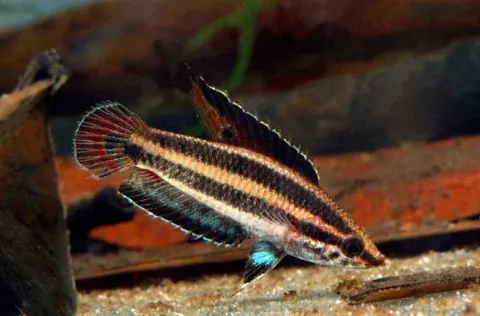
Parosphromenus allani
Parosphromenus allani, known as Allan's Licorice Gourami or Allan's Betta, belongs to the family Osphronemidae. It was named in honour of Allan Brown, who collected these fish in Sarawak, Borneo, in 1986; the species…
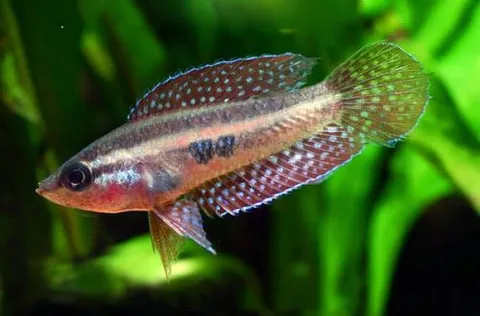
Parosphromenus linkei
Parosphromenus linkei, also known as Linke's Licorice Gourami, belongs to the family Osphronemidae. This vibrant and attractive fish appears quite regularly in the trade. Among other Parosphromenus species, its keeping…
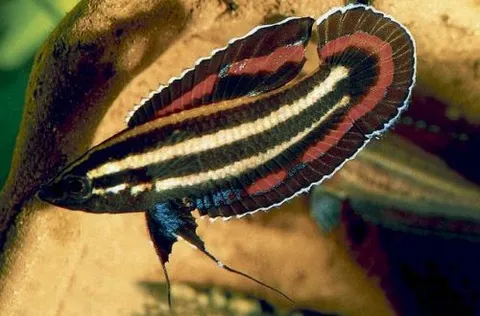
Parosphromenus tweediei
The fish Parosphromenus tweediei, also known as Tweedie's Licorice Gourami, is a member of the family Osphronemidae. Its name was given in honour of Michael W. F. Tweedie (1907–1993), a naturalist and archaeologist who…
Parosphromenus anjunganensis
Inhabiting waters near the city of Anjungan, Parosphromenus anjunganensis, or Anjungan Licorice Gourami, belongs to the family Osphronemidae, receiving its scientific name from this locality. Keeping this fish is…