Temperature22 – 26 °C
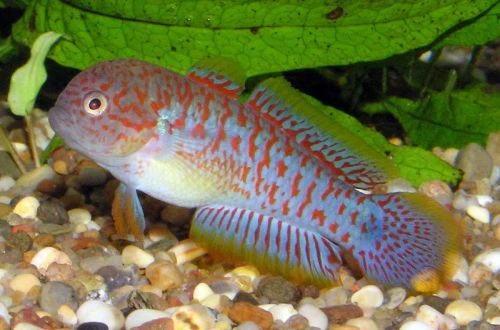
The scientific name Tateurndina ocellicauda belongs to the family Eleotridae. This fish is known as the Peacock Gudgeon or "Peacock goby." It is important to note that, despite the presence of the word "goby" in its name, it is not related to the freshwater gobies common on the Eurasian continent. This beautiful and undemanding fish coexists well with many inhabitants of freshwater aquariums. It can be safely recommended to aquarists who are just starting to explore this hobby.
Adults typically reach about 7 cm in length. Sexual dimorphism in this species is weakly expressed. Differences between males and females become noticeable mainly during the spawning period. At this time, males develop a characteristic nuchal hump, which gives them an unusual appearance, reflected in the name "Goby." Another distinguishing feature is the structure of the dorsal fin, which is divided into two parts. This feature indicates their kinship with Rainbowfish, also found in the Australian region. The body coloration is blue, with yellow hues and a pattern of irregular red strokes and stripes.
Its natural habitat is the island of New Guinea, located near Australia. The Peacock Gudgeon is found in lowland rivers and small lakes in the eastern part of the island, among tropical forests. It prefers shallow areas of water bodies with a soft substrate.
This species is territorial but coexists perfectly with various peaceful fish of comparable size. Excellent tank mates include Rainbowfish, Tetras, Rasboras, as well as Corydoras catfish and other similar species. The Peacock Gudgeon can be kept alone or in a group. When kept in a group, it is important to provide enough hiding places for each individual.
For keeping one or two Peacock Gudgeons, an aquarium of at least 40 liters will be required. The fish feel comfortable in soft water with a slightly acidic reaction and an abundance of aquatic plants. A dark substrate, floating plants on the surface, and subdued lighting will help create a favorable habitat. It is important to provide enough hiding places, which can be snags or dense thickets of plants. If suitable secluded spots are not available, the fish will seek refuge near aquarium equipment or in corners. Since gudgeons are known for their jumping ability, the aquarium must be equipped with a reliable lid to prevent accidental jumps. Regular aquarium care includes standard procedures: weekly partial water changes with fresh water and cleaning the substrate and decorations from organic waste.
Although these fish can eat dry foods, they prefer live and frozen foods such as bloodworms, daphnia, and brine shrimp. A high protein content in their diet contributes to a brighter display of their coloration.
Breeding Peacock Gudgeons is not particularly difficult. The main task is to select a suitable pair. These fish are demanding in their choice of partner. A solution can be to acquire an already formed pair or to purchase a group of young individuals who will choose their own partners as they mature. The beginning of the breeding period is easily noticed by males, who develop a characteristic nuchal hump. The male occupies one of the shelters and begins courting. Noticing a ready-to-spawn female swimming by, he tries to attract her into his shelter, sometimes showing persistence. When the female is ready to reproduce, she accepts the courtship and lays dozens of eggs in the chosen shelter. After this, the female leaves the shelter, and the male takes on the care and protection of the future offspring. His role is limited to a short incubation period, lasting up to 2 days. After another couple of days, the fry begin to swim freely. From this moment, they should be transferred to a separate tank to avoid being eaten by other inhabitants.
Health problems usually arise only as a result of injuries or keeping in unsuitable conditions, which leads to a weakening of the immune system and, as a rule, provokes the development of various diseases. At the first signs of illness, the primary task is to check the water parameters for excesses or dangerous concentrations of toxic substances (nitrates, nitrites, ammonia, etc.). After bringing all indicators back to normal, treatment can begin.
When choosing a Peacock Gudgeon, pay attention to the fish's overall activity and appearance. Healthy individuals should show curiosity, swim in the water column or inspect the bottom, rather than constantly hiding in the corners of the aquarium. Avoid specimens with signs of emaciation, fin damage, spots on the body, or heavy breathing. It is advisable to observe feeding: healthy fish show interest in food and actively eat it. — choose individuals with bright, rich coloration characteristic of the species — check for the absence of cloudy eyes or signs of skin parasites — prefer fish that do not appear intimidated or suppressed by tank mates — if possible, purchase a group of 6–8 young individuals to ensure natural pair formation and social behavior.
The essentials: size, tank volume, water parameters and care
An adult reaches 7 cm in length. Plan the tank around the maximum size: the fish quickly outgrows a cramped setup.
The recommended volume is 40 L. A smaller tank speeds up nitrate build-up and raises stress levels.
Temperature 22–26 °C, pH 6.5–7.5, hardness 5–10 dGH. Stability matters more than exact values: sudden swings are harder on the fish than a small deviation from the ideal.
Around 4 years when kept properly. Lifespan depends directly on tank volume, water quality and a varied diet.
Temperament: peaceful (regular). Keep this in mind when choosing tank mates.
Recommended setup: both solitary and in group (flexible). Ignoring this is a common cause of stress and disease.
Diet type: any (universal). Feed small portions that are finished within a couple of minutes — overfeeding does more harm than underfeeding.
The scientific name of the species is Tateurndina ocellicauda, family Sleepers (Eleotridae).
The water suits 197 of 208 plants in the catalogue — the easiest ones are shown first.
Afzelius's AnubiasAnacharisAnubiasBrazilian PennywortDwarf CloverDwarf CloverDwarf HygrophilaDwarf SagittariaDwarf ValGuppy GrassHornwortJava FernJava MossMoneywortMud SwordNair's LagenandraNarrow Leaf AnacharisNarrow-leaf CloverStringy MossSüsswassertangTaiwan MossTape GrassTemple PlantUssuri Watermilfoil
Matched by family, categories and overlapping keeping conditions
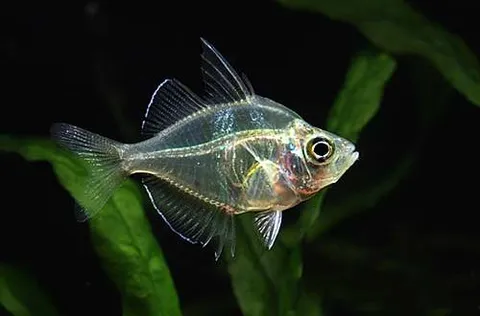
Parambassis lala
The Lala Glassfish, known scientifically as Parambassis lala, belongs to the Ambassidae family, or Glassfish. This species originates from Asia; it can be found in the territories of modern India, Bangladesh, and…
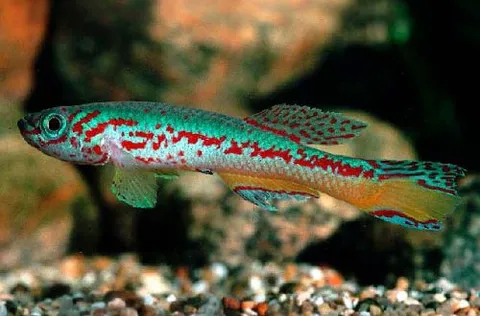
Fundulopanchax amieti
Aphyosemion Amieti, known scientifically as Fundulopanchax amieti, belongs to the family Nothobranchiidae. These fish originate from the central regions of Africa, predominantly inhabiting the Sanaga River basin in…
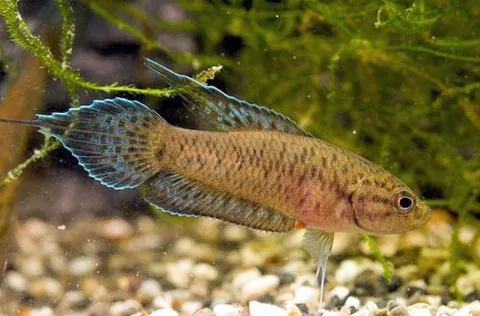
Malpulutta kretseri
Malpulutta kretseri, also known as Kretser's Paradise Fish, bears the scientific name Malpulutta kretseri and belongs to the family Osphronemidae. It was named in honour of the Sri Lankan lawyer De Kretser, who…
Aphyosemion gabunense
The Gabon Killifish, or Aphyosemion gabunense, belongs to the family Nothobranchiidae. This miniature fish boasts iridescent, vibrant coloration, which varies depending on its region of origin. Accordingly, three…