Temperature23 – 33 °C
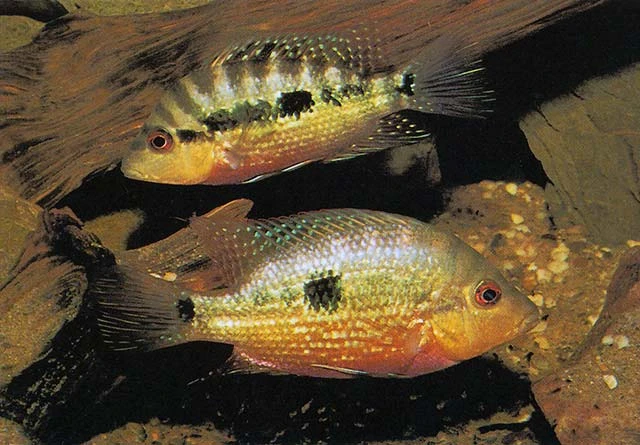
Cribroheros longimanus, known as the Redbelly Cichlid, belongs to the family Cichlidae. These fish originate from Central America, with their range extending from Guatemala to Costa Rica. They primarily inhabit lakes and rivers with weak currents or still water, although they are found in other biotopes as well.
Adults of this fish reach a length of approximately 13 cm. Their body is stocky and deep-bodied, with a rather large head. The main coloration is light silvery, often with a noticeable blue or yellow sheen; sometimes blue hues dominate. The pattern consists of dark vertical stripes and large black spots arranged along the body. The scales are adorned with numerous bright speckles. A distinctive feature of males is a reddish belly, the color of which intensifies significantly during spawning.
The species is widespread in Central America, found on both the Atlantic and Pacific slopes from Guatemala to Costa Rica. It inhabits diverse biotopes, including lakes and sections of rivers with still water or slow currents. In its natural environment, it prefers waters with pH values of 6.7–8.2, general hardness of 10–25 dGH, and water temperatures of 24–29°C.
This is a territorial fish, showing aggression towards conspecifics, especially males. They occupy specific bottom areas and actively defend them from competitors. When young, Redbelly Cichlids live in large groups, but their behavior changes with age. During this period, pairs form, a male and a female, who often remain faithful to each other throughout their lives. The Redbelly Cichlid is more tolerant of other fish species, except during breeding and fry protection. To avoid conflicts, it is recommended to choose fish that inhabit the water column or surface and avoid cohabitation with other Central American cichlids or bottom-dwelling fish, such as catfish.
For keeping a single pair of Redbelly Cichlids and a few additional species, the aquarium should have a volume of at least 500 liters. Since these fish tend to dig in the substrate in search of food, the choice of decor requires consideration of this characteristic. A soft sandy substrate would be ideal; it is better to avoid rooted plants, as they may be uprooted. The aquarium can be decorated with driftwood, large stones, and boulders, as well as other natural elements. Mosses and ferns are suitable for planting, as they can be attached to stones or driftwood and grow on such surfaces. Water of medium hardness with a pH close to neutral is optimal for the fish. For healthy long-term keeping, water purity and the prevention of excessive organic waste accumulation are extremely important. In their natural habitat, they feed on small aquatic insects and other invertebrates, which they find by digging through the bottom. In the aquarium, high-protein sinking foods should be offered, such as fresh, freeze-dried, or frozen bloodworms, Artemia, Daphnia, etc.
The diet of Redbelly Cichlids in their natural environment includes small aquatic insects and other invertebrates, which they find on the bottom by actively digging through the substrate. In aquarium conditions, they should be offered sinking foods rich in protein. These include, for example, fresh, freeze-dried, or frozen bloodworms, Artemia, Daphnia, and similar products.
The fish form stable pairs that remain together for a long time. Spawning occurs on an open substrate, where the female lays 400 to 800 eggs. Both parents actively guard the clutch and offspring. The incubation period lasts 2–3 days, after which the fry begin to swim freely and feed after 6–7 days. Artemia nauplii or specialized crushed dry foods are suitable as first foods.
The species has a strong immune system when kept under proper conditions, but it is sensitive to the accumulation of organic compounds in the water. The main risks are associated with injuries sustained during intraspecific conflicts, which can lead to the development of secondary bacterial or fungal infections. Prevention includes regular water changes, effective filtration, and maintaining substrate cleanliness.
When selecting individuals, attention should be paid to the fish's activity and the cleanliness of its skin, without signs of wounds, ulcers, or unnatural coatings. Healthy cichlids should show curiosity and react to a person's approach. It is recommended to avoid purchasing fish from overcrowded aquariums with signs of aggression or emaciation, and to check that the size and coloration match the species characteristics.
The essentials: size, tank volume, water parameters and care
An adult reaches 13 cm in length. Plan the tank around the maximum size: the fish quickly outgrows a cramped setup.
The recommended volume is 500 L. A smaller tank speeds up nitrate build-up and raises stress levels.
Temperature 23–33 °C, pH 7–8, hardness 5–20 dGH. Stability matters more than exact values: sudden swings are harder on the fish than a small deviation from the ideal.
Around 8 years when kept properly. Lifespan depends directly on tank volume, water quality and a varied diet.
Temperament: aggressive / incompatible / unfriendly. Keep this in mind when choosing tank mates.
Recommended setup: pair (male/female). Ignoring this is a common cause of stress and disease.
Diet type: high protein (predominantly meat). Feed small portions that are finished within a couple of minutes — overfeeding does more harm than underfeeding.
The scientific name of the species is Cribroheros longimanus, family Cichlids (Cichlidae). It also appears in the literature as: Amphilophus longimanus, Astatheros longimanus, Cichlasoma longimanus.
The water suits 19 of 208 plants in the catalogue.
Amazon FrogbitAnubiasAsian WatermossBlue BuceChristmas MossFloating Water SpriteGiant VallisneriaGreater DuckweedJapanese RushJava MossJungle ValNair's LagenandraNoble FissidensPinnate HygrophilaRed Root FloaterStringy MossTaiwan MossWater LettuceWater Spangles
This fish digs through the substrate and pulls rooted plants out.
African Onion PlantAfzelius's AnubiasAmazon SwordAnacharisArrowhead CryptBalansa Water TrumpetBanana PlantBarth's SwordBeckett's Water TrumpetBoivin's AponogetonBroad-leaf Water SpriteBrookweedCognac AmmanniaCongo AnubiasCreeping JennyCreeping SpotflowerCrinkled AponogetonDark SwordDelta ArrowheadDense MayacaDitch StonecropDwarf AmbuliaDwarf CloverDwarf CloverDwarf HairgrassDwarf HygrophilaDwarf RanalismaDwarf RotalaDwarf SagittariaDwarf ValDwarf Water TrumpetEelgrassFanwortFeathered LimnophilaFloating AponogetonFloating SpikerushFragrant HygrophilaGardner's Water LilyGiant CryptGolden Ammannia
Matched by family, categories and overlapping keeping conditions
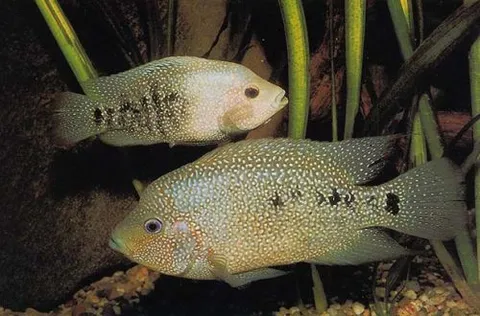
Herichthys cyanoguttatus
Herichthys cyanoguttatus, known as the diamond cichlid, belongs to the family Cichlidae. It is an energetic and temperamental fish, exhibiting complex behaviors, especially concerning parental care. Keeping this species…
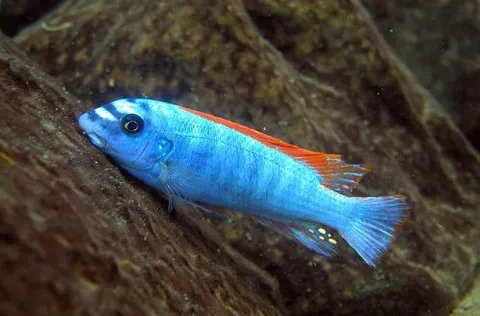
Labeotropheus trewavasae
Labeotropheus trewavasae, also known as the Labeotropheus cichlid, is a member of the Cichlidae family. This African cichlid belongs to the Mbuna group, characterized by territorial aggression. Despite this, its vibrant…
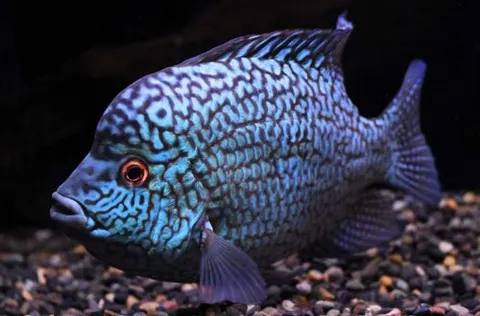
Herichthys carpintis
The Pearl Cichlid, scientifically known as Herichthys carpintis, is a member of the Cichlidae family. This vibrant fish possesses a rather expressive temperament. Keeping it is not particularly difficult, but selecting…
Wallaciia compressiceps
Crenicichla, scientifically known as Wallaciia compressiceps, belongs to the family Cichlidae. This species originates from South America, specifically found in the lower Tocantins River basin, located in eastern Brazil.