Temperature23 – 28 °C
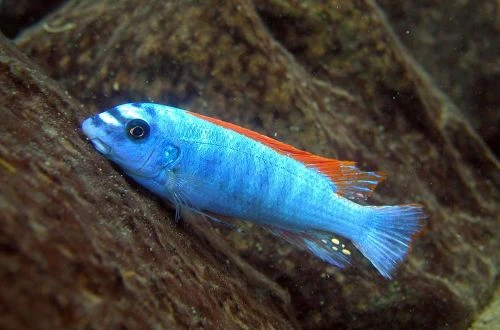
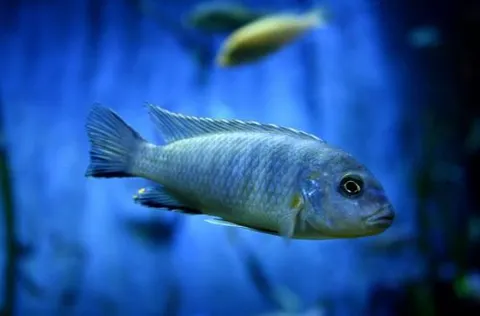
Labeotropheus trewavasae, also known as the Labeotropheus cichlid, is a member of the Cichlidae family. This African cichlid belongs to the Mbuna group, characterized by territorial aggression. Despite this, its vibrant and attractive appearance makes it highly valued by many aquarium enthusiasts.
Labeotropheus has a massive head with a characteristically protruding mouth, which resembles a "humped" or "hooked" nose. This mouth structure, combined with sharp teeth, allows the fish to effectively scrape tough algae from rocky surfaces and thrive in strong currents. Several color morphs of this species exist. The most common and beloved by aquarists is the form with a blue body adorned with a bright orange or red dorsal fin. The caudal fin usually has a reddish edge. Males have a unique pattern of several yellow circular spots on their anal fin.
This species is endemic to Lake Malawi in Africa, meaning it is found nowhere else in the world. It prefers to inhabit rocky coastal zones where strong turbulent currents form among numerous stones. The fish has successfully adapted to these conditions, primarily staying in the upper water layers.
Due to pronounced aggression towards members of its own species, especially between males, and active defense of its territory from other fish, these cichlids are best kept in a harem – one male to three or four females. In spacious aquariums, cohabitation with several other Mbuna species, such as the Hummingbird Cichlid, is permissible, provided that each male has sufficient space for himself.
For a small group of Labeotropheus, an aquarium of at least 200 liters is recommended, decorated to mimic a rocky section of Lake Malawi's coast. The design includes a sandy substrate and an abundance of large stones or rock pieces rising almost to the water surface. These elements can be placed along one of the side walls or serve as a background. When creating such a structure, it is crucial to use aquarium-safe silicone adhesive to firmly secure the stones together and prevent their collapse. The rock fragments should be large enough to form artificial crevices and caves, which will serve as reliable shelters. Plants are not needed in such an aquarium, as they will be quickly destroyed by the fish. The main task when keeping these fish is water preparation. In Lake Malawi, the hydrochemical composition of the water is stable (pH around 8.0, dH 10–25), and these parameters must be replicated in the aquarium. More detailed information on water parameters and adjustment methods can be found in the "Water Hydrochemical Composition" section. In addition to the specific composition, it is important to maintain a low level of pollution, which requires weekly renewal of 10–20% of the water volume, as well as regular cleaning of the substrate from organic waste – excrement and uneaten food remains. The minimum set of equipment includes filtration, lighting, heating, and aeration systems. Each of these systems is crucial and mandatory. It is worth noting that installing a high-performance filter system will allow increasing the intervals between water changes to two weeks, which will significantly simplify aquarium maintenance.
In their natural habitat, these fish feed on algae they scrape from rocks, and sometimes small crustaceans living among these algae. Therefore, in aquarium conditions, their diet (approximately 95%) should consist of algae, supplemented with a small amount of protein food – this can be bloodworms, daphnia, or artemia. Specialized flakes and granules from pet stores, as well as homemade products such as chopped spinach, broccoli, or lettuce leaves, are suitable as plant-based food. Labeotropheus should be fed 2–3 times a day, offering a portion that will be completely eaten within 5 minutes.
Successful breeding of Labeotropheus in aquarium conditions is common; spawning proceeds so rapidly that an aquarist may sometimes not notice its beginning, only discovering the offspring that have already appeared. During courtship, the male displays the brightest shades of his coloration, carefully selects an area on the bottom, usually a flat stone, and cleans it, preparing the future nest. Subsequently, he invites the female to this spot, where she lays up to ten large eggs and immediately collects them into her mouth. This behavior evolved as a way to protect offspring from external dangers, especially when eggs cannot be reliably hidden among open rock formations. The male remains nearby during spawning and actively displays his anal fin, which has a pattern resembling eggs. When the female, attempting to retrieve these "eggs," makes a false bite at the fin, the male releases milt, thereby ensuring fertilization. The incubation period is approximately three weeks, during which the eggs remain in the female's mouth. Initially, the fry prefer to stay near the bottom, but soon they begin to move freely throughout the aquarium. Chopped flakes with a high content of vegetable ingredients are recommended as food. It is advisable to move the grown fry to a separate tank.
Representatives from Lake Malawi often suffer from a specific disease known as "Malawi Bloat. The main cause of this ailment is often a violation of keeping conditions, including unsuitable parameters or insufficient water purity, as well as poor-quality food. In a favorable habitat, health problems in fish usually do not occur.
When purchasing, choose active individuals with clean fins and no visible damage or sores on the body. Avoid fish with sunken bellies or signs of apathy, as this may indicate chronic diseases or stress. In the store, fish should exhibit territorial behavior or actively explore the space, rather than hiding in the corners of the aquarium. Given the high level of aggression within the species, it is important to assess the condition of all individuals in the common aquarium to exclude the presence of severely beaten or injured fish. It is recommended to acquire young individuals to form a group, as adult fish adapt more poorly to a change of territory.
The essentials: size, tank volume, water parameters and care
An adult reaches 15 cm in length. Plan the tank around the maximum size: the fish quickly outgrows a cramped setup.
The recommended volume is 200 L. A smaller tank speeds up nitrate build-up and raises stress levels.
Temperature 23–28 °C, pH 7.6–8.8, hardness 10–25 dGH. Stability matters more than exact values: sudden swings are harder on the fish than a small deviation from the ideal.
Around 8 years when kept properly. Lifespan depends directly on tank volume, water quality and a varied diet.
Temperament: aggressive / incompatible / unfriendly. Keep this in mind when choosing tank mates.
Recommended setup: harem (1 male and several females). Ignoring this is a common cause of stress and disease.
Diet type: high protein (predominantly meat). Feed small portions that are finished within a couple of minutes — overfeeding does more harm than underfeeding.
The scientific name of the species is Labeotropheus trewavasae, family Cichlids (Cichlidae).
The water suits 114 of 208 plants in the catalogue — the easiest ones are shown first.
African Onion PlantAfzelius's AnubiasAmazon FrogbitAmazon SwordAnacharisAnubiasArrowhead CryptDwarf CloverDwarf CloverDwarf HygrophilaDwarf SagittariaDwarf ValGuppy GrassHornwortJava MossMoneywortMud SwordNair's LagenandraNarrow Leaf AnacharisNarrow-leaf CloverStringy MossTaiwan MossTape GrassUssuri Watermilfoil
Matched by family, categories and overlapping keeping conditions
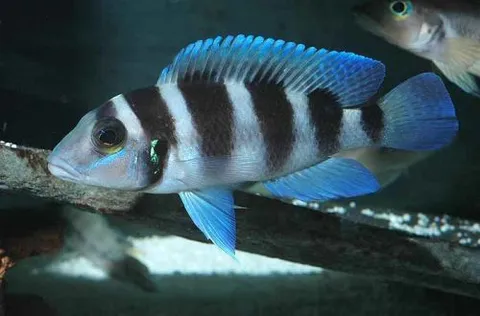
Neolamprologus tretocephalus
Neolamprologus tretocephalus, also known as the Blue Lamprologus or Five-striped Zebra Cichlid, belongs to the Cichlidae family. Despite its vibrant coloration, activity, and relative ease of keeping, the fish exhibits…
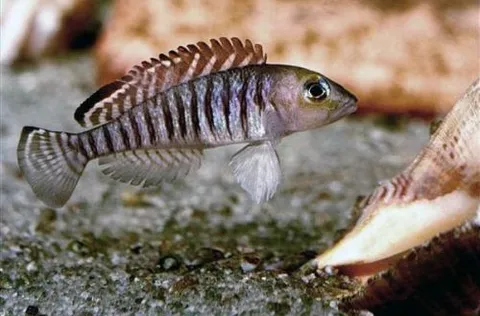
Lamprologus signatus
Lamprologus signatus, also known as Signatus, is a member of the Cichlidae family. Its natural habitat is Lake Tanganyika, located in East Africa, where this species is endemic. Signatus individuals are most commonly…
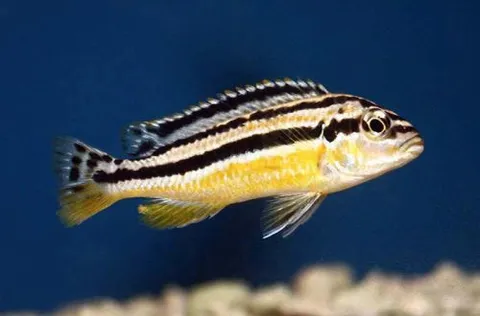
Melanochromis auratus
Melanochromis auratus, also known as the Golden Cichlid (scientific name Melanochromis auratus), belongs to the Cichlidae family. These fish are characterized by their striking golden coloration, adorned with large…
Maylandia zebra
Maylandia zebra, known as Zebra Mbuna or Blue Pseudotropheus zebra, belongs to the family Cichlidae. Although previously classified under the genus Pseudotropheus, the outdated name is still actively used. This fish is…