Temperature23 – 27 °C
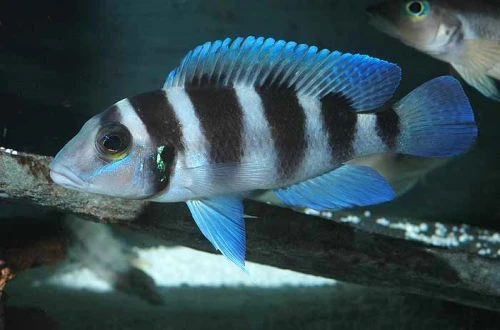
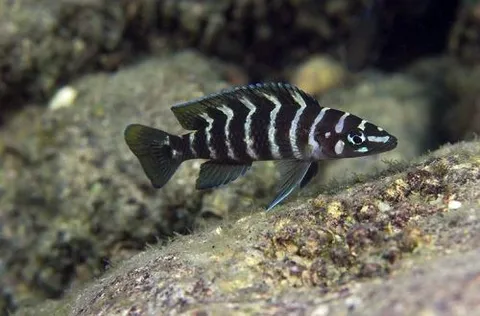
Neolamprologus tretocephalus, also known as the Blue Lamprologus or Five-striped Zebra Cichlid, belongs to the Cichlidae family. Despite its vibrant coloration, activity, and relative ease of keeping, the fish exhibits significant aggression, especially during the breeding season. This circumstance makes it not entirely suitable for aquarium beginners.
Adults reach approximately 15 cm in length. Distinguishing between male and female by external signs is quite difficult for an inexperienced eye, as sexual dimorphism is weakly expressed. The body pattern is characterized by wide black vertical stripes on a light blue background. The fins and caudal fin have bluish hues.
This species is endemic to Lake Tanganyika, located in Africa and bordering the Democratic Republic of Congo, Tanzania, Burundi, and partially Zambia. The lake, formed in the rift valley, has a unique ecosystem comparable in nature to Lake Baikal. These fish prefer shallow coastal areas of the reservoir, where rocky and sandy substrates alternate.
The species exhibits aggression and territoriality, so the choice of tank mates requires special care. In smaller aquariums, it is recommended to keep either a single established pair of Blue Lamprologus or individual specimens. If the aquarium is large enough, cohabitation with species occupying different water levels, such as Julidochromis and Cyprichromis, is possible. With sufficient space at the bottom, several conspecifics or Mbuna cichlids can be kept, provided that each fish can establish its own territory. The main thing is to ensure enough space for everyone to avoid conflicts.
For a single pair of these fish, the minimum aquarium volume is 100 L. The decor should replicate natural habitat conditions. For this, it is sufficient to use sandy substrate and create shelters from large stones or rocks, forming caves, grottoes, and crevices. Maintaining stable water parameters, corresponding to the hydrochemical composition of Lake Tanganyika, especially high pH and dGH values, is crucial for the well-being of the Five-striped Zebra Cichlid. In addition, proper aquarium maintenance is critically important. This includes installing a powerful filter, regular cleaning of organic waste, and weekly partial water changes.
The diet should consist of live or frozen foods, such as Daphnia, Artemia, and bloodworms. Dry granulated foods enriched with protein are also acceptable.
Breeding in a home aquarium is possible, although it involves certain difficulties. The main challenge is finding a suitable pair. Five-striped Zebra Cichlids form pairs as they mature, which then proceed to breed. Simply introducing an adult male to an adult female usually does not yield the expected result; moreover, it can lead to the death of the female. Even if an already established pair is found, the female will still be at risk. During courtship, the male becomes overly aggressive and persistent in his advances, forcing the female to seek reliable shelters if she is not yet ready to spawn. Eggs are usually laid in a cave or a small pit in the substrate. The parents stay near the clutch until the fry appear. As soon as the offspring begin to swim freely, the male takes on the protective function. At this point, it is advisable to move the female to a separate aquarium, as even she can be perceived as a potential threat. Based on the above, it becomes clear that a separate aquarium is desirable for spawning, and one should be prepared to quickly move one of the fish if the situation begins to develop unfavorably.
The main cause of most diseases in Lake Tanganyika cichlids is unsuitable keeping conditions and poor-quality food, which often leads, for example, to African Bloat. At the first symptoms, it is necessary first to check the water parameters and ensure there are no high concentrations of dangerous substances such as ammonia, nitrites, and nitrates. If the readings deviate from the norm, they should be brought into order, and only then should treatment begin.
When choosing Neolamprologus tretocephalus in a store, pay attention to the fish's activity and the condition of its skin. Healthy specimens should be active, curious, and free of visible damage, ulcers, white film, or frayed scales. Pay special attention to behavior: avoid buying fish that constantly hide in a corner, breathe heavily, or show signs of emaciation, as this species is extremely sensitive to water quality and transport stress. — Check for a sunken belly, which may indicate internal parasitic infections. — Make sure the fish's eyes are clear, without cloudiness, and the fins are spread out and not torn. — Ask the seller what the fish are fed, as adaptation to new feeding conditions can be difficult for this species with an incorrect diet.
The essentials: size, tank volume, water parameters and care
An adult reaches 15 cm in length. Plan the tank around the maximum size: the fish quickly outgrows a cramped setup.
The recommended volume is 100 L. A smaller tank speeds up nitrate build-up and raises stress levels.
Temperature 23–27 °C, pH 7.5–9, hardness 10–25 dGH. Stability matters more than exact values: sudden swings are harder on the fish than a small deviation from the ideal.
Around 8 years when kept properly. Lifespan depends directly on tank volume, water quality and a varied diet.
Temperament: aggressive / incompatible / unfriendly. Keep this in mind when choosing tank mates.
Recommended setup: pair (male/female). Ignoring this is a common cause of stress and disease.
Diet type: high protein (predominantly meat). Feed small portions that are finished within a couple of minutes — overfeeding does more harm than underfeeding.
The scientific name of the species is Neolamprologus tretocephalus, family Cichlids (Cichlidae). It also appears in the literature as: Lamprologus tretocephalus, Neolamprologus tetrocephalus.
The water suits 114 of 208 plants in the catalogue — the easiest ones are shown first.
African Onion PlantAfzelius's AnubiasAmazon FrogbitAmazon SwordAnacharisAnubiasArrowhead CryptDwarf CloverDwarf CloverDwarf HygrophilaDwarf SagittariaDwarf ValGuppy GrassHornwortJava MossMoneywortMud SwordNair's LagenandraNarrow Leaf AnacharisNarrow-leaf CloverStringy MossTaiwan MossTape GrassUssuri Watermilfoil
Matched by family, categories and overlapping keeping conditions
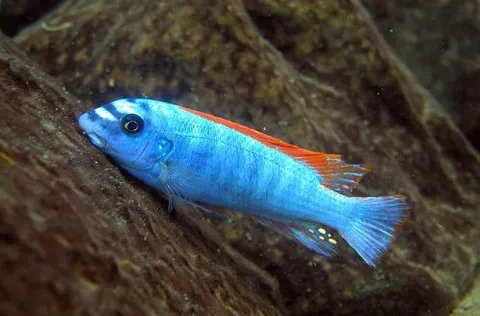
Labeotropheus trewavasae
Labeotropheus trewavasae, also known as the Labeotropheus cichlid, is a member of the Cichlidae family. This African cichlid belongs to the Mbuna group, characterized by territorial aggression. Despite this, its vibrant…
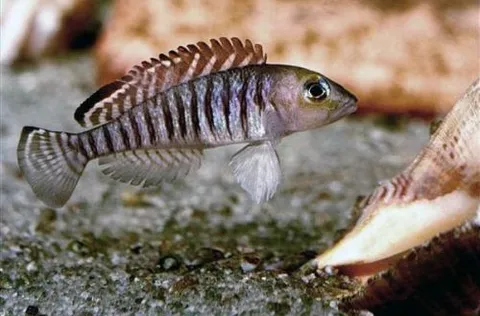
Lamprologus signatus
Lamprologus signatus, also known as Signatus, is a member of the Cichlidae family. Its natural habitat is Lake Tanganyika, located in East Africa, where this species is endemic. Signatus individuals are most commonly…
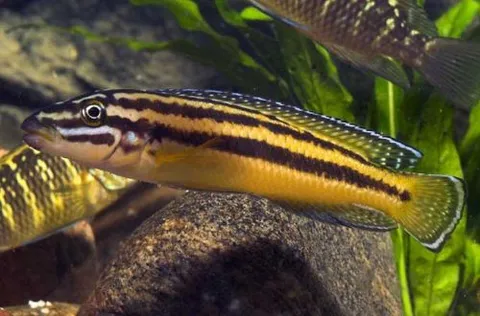
Julidochromis regani
Julidochromis regani, with the scientific name Julidochromis regani, belongs to the family Cichlidae. This cichlid is quite popular among aquarists. Like many members of its family, it can show aggression towards…
Neolamprologus cylindricus
Lamprologus cylindricus, or Neolamprologus cylindricus, belongs to the family Cichlidae. It is an unpretentious fish to keep and is easy to breed. Nevertheless, its aggressive nature seriously limits the choice of…