Temperature25 – 28 °C
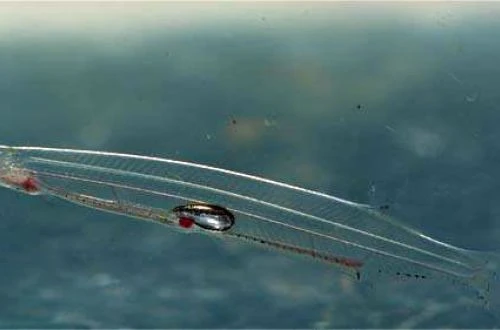
The Sundasalanx fish, known scientifically as Sundasalanx microps, belongs to the family Ehiravidae. This fish is exotic for several reasons: it is rarely found in aquariums, and its appearance is unusual. Keeping these fish involves various difficulties, especially regarding their adaptation, as they are caught from their natural environment. They do not breed in aquarium conditions. They can only be recommended to experienced aquarists.
This fish is strikingly miniature, even tiny. Adults grow to only 2 cm in length. Sexual dimorphism is weakly expressed, and it is almost impossible to distinguish males from females externally. Sundasalanx has an elongated body and a very small head. Its main distinguishing feature is not so much its coloration as its absence, as the fish is almost completely transparent. Through the body, the skeleton and internal organs are clearly visible, gathered in a small, silvery “sac.”
Its natural habitat is the island of Borneo: the type locality lies in the Kapuas River basin, and the species is known from both the Indonesian and Malaysian parts of the island. These fish prefer murky waters with slow currents or stagnant water. During the day, they usually stay near the silty bottom, and at night and dusk, they may rise closer to the surface.
These peaceful schooling fish, however, due to their tiny size, have a very limited choice of aquarium mates. It is advisable to keep them separately from other fish species.
Thanks to their modest size, adult Sundasalanx fish can feel comfortable in nano-aquariums of about 20 liters. When decorating such an aquarium, it is recommended to use a soft sandy substrate, driftwood, and low-growing aquatic plants that can thrive in low light. It is important to provide an efficient filtration system to maintain high water quality, and to regularly clean the aquarium. When choosing a filter, opt for models that do not create excessive current and whose water intake openings are reliably protected to prevent accidental suction of the fish into the cleaning system. Weekly partial water changes (20–30% of the total volume) are also an essential procedure to prevent the accumulation of organic waste.
In natural conditions, the diet of these fish consists mainly of microorganisms such as invertebrates, crustaceans, and annelids. In a home aquarium, they should be offered similar products, for example, Artemia nauplii or Daphnia. It is also possible that they will accept specialized foods developed for fry.
Breeding has not been described. No sexual differences have been recorded for this species; in the related S. malleti and S. megalops males are told by a more intense dark marking on the lower lobe of the caudal fin. The species has essentially not appeared in the aquarium trade and seems to travel extremely badly.
No diseases that affect only this species have been described. Under suitable conditions — clean water, a balanced diet and calm tank mates — health problems usually do not arise. The most common cause of illness is a decline in conditions: it weakens the immune system, and the fish becomes vulnerable to infections that are always present in an aquarium. At the first signs of trouble — lethargy, wasting, refusal of food or clamped fins — check the basic water parameters and the levels of ammonia, nitrite and nitrate first. Restoring acceptable conditions often lets the fish recover on its own.
This species is extremely rare in retail and is practically not represented in the aquarium trade. When purchasing, it should be noted that the fish are very sensitive to transportation and keeping conditions, so it is extremely important to assess their general condition in the store. Healthy individuals should be active, exhibit schooling behavior, and show no visible damage or signs of emaciation. Due to their small size and specific dietary requirements, it is recommended to check with the seller in advance what the fish are fed and how they have been adapted to captivity.
The essentials: size, tank volume, water parameters and care
An adult reaches 1.5–2 cm in length. Plan the tank around the maximum size: the fish quickly outgrows a cramped setup.
The recommended volume is 40 L. A smaller tank speeds up nitrate build-up and raises stress levels.
Temperature 25–28 °C, pH 6–8, hardness 3–12 dGH. Stability matters more than exact values: sudden swings are harder on the fish than a small deviation from the ideal.
Around 1 years when kept properly. Lifespan depends directly on tank volume, water quality and a varied diet.
Temperament: peaceful (regular). Keep this in mind when choosing tank mates.
Recommended setup: schooling (usually from 5–6 individuals and more). Ignoring this is a common cause of stress and disease.
Diet type: small / appropriate size / pieces. Feed small portions that are finished within a couple of minutes — overfeeding does more harm than underfeeding.
The scientific name of the species is Sundasalanx microps, family Ehiravidae.
The water suits 185 of 208 plants in the catalogue — the easiest ones are shown first.
Afzelius's AnubiasAnacharisAnubiasBrazilian PennywortDwarf CloverDwarf CloverDwarf HygrophilaDwarf SagittariaDwarf ValGuppy GrassHornwortJava FernJava MossMoneywortMud SwordNair's LagenandraNarrow Leaf AnacharisNarrow-leaf CloverSüsswassertangTaiwan MossTape GrassTemple PlantUssuri WatermilfoilWater Wisteria
Matched by family, categories and overlapping keeping conditions
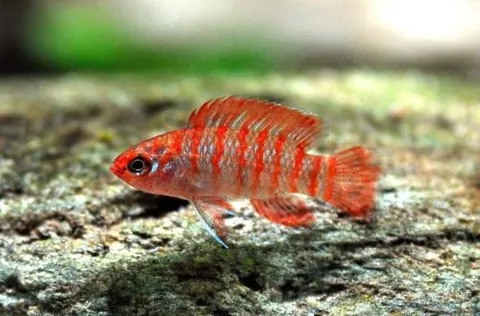
Dario dario
The Scarlet Badis, also known as Dario dario (its scientific name), belongs to the Badidae family. On this website, the species is classified into the Labyrinth Fish group (which includes the Gourami and Betta families)…
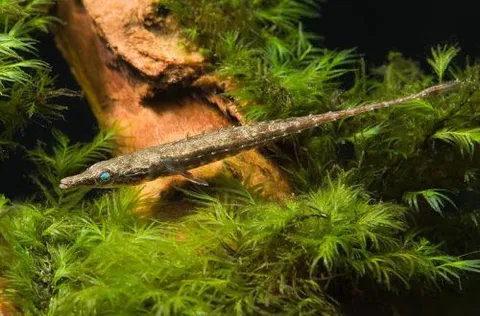
Indostomus crocodilus
Indostomus crocodilus, or Indostomus, belongs to the Indostomidae family. Its unusual appearance is due to the practical necessity of camouflaging itself from potential predators. In a home aquarium it needs careful…
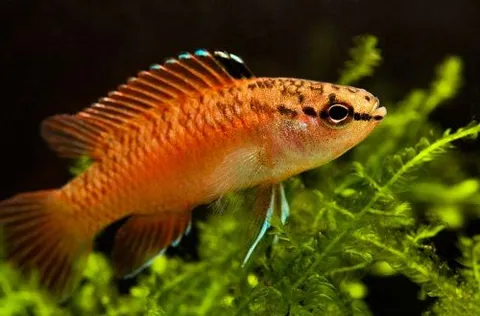
Dario kajal
Dario kajal is the scientific name for this species, which belongs to the Badidae family, or Badis. This fish was first recognized as a distinct species in 2013, and before that, it was known as Dario "Bangladesh."
Hyphessobrycon heliacus
The Kitty Tetra, scientifically known as Hyphessobrycon heliacus, belongs to the family Acestrorhamphidae. This fish originates from South America, where it is found in the Telis Pires River basin. This river, in turn,…