Temperature24 – 28 °C
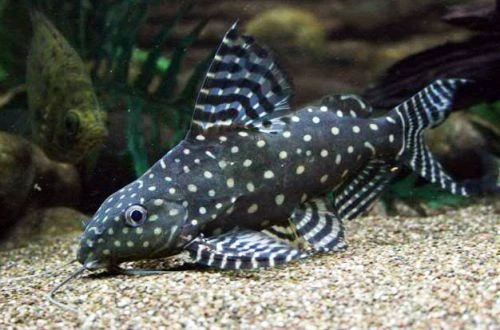
The Angel Squeaker Catfish, also known by its scientific name Synodontis angelicus, or Synodontis Angel, belongs to the family Mochokidae. This medium-sized catfish species easily adapts to most community tanks, coexisting with many tropical fish species. It is unpretentious and easy to care for, making it attractive to aquarists.
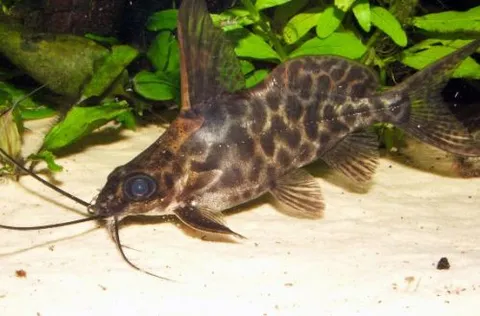
Adults can reach approximately 25 cm in length, although in aquarium conditions they are usually slightly smaller. Their coloration is dark, adorned with white, pea-like spots all over the body. The fins and tail are characterized by a striped pattern. It is worth noting that young catfish have a richer and more contrasting coloration, which gradually fades with age, turning from dark shades to more grayish tones.
The origin of this species is linked to the African continent, specifically the Congo River basin, located in the territories of modern-day Cameroon, the Democratic Republic of Congo, and the Republic of Congo. It prefers areas with slow currents in the main riverbed and tributaries, as well as backwaters, where it usually stays among snags and sunken trees.
This peaceful and calm species coexists perfectly with other aquarium inhabitants. However, given the catfish's rather large size and omnivorous diet, it is recommended to avoid keeping them with very small fish (less than 4–5 cm in length), as they may be eaten. This is not a manifestation of predation, but rather a natural behavioral reflex inherent in most catfishes – to swallow anything that fits in their mouth. Intraspecific relationships can be harmonious if there are enough hiding places; otherwise, territorial skirmishes are possible.
For one adult specimen, an aquarium of at least 200 liters is recommended. When decorating, use a soft sandy substrate and large hiding places created from snags, roots, and tree branches. Floating plants can provide additional shading for the aquarium. It is advisable to install subdued lighting, as under bright light, the catfish will spend most of its time in hiding, only emerging in the evening and at night. Rooted plants at the bottom are not a necessity and may even suffer, as the catfish digs the substrate in search of food. If you wish to have vegetation at the bottom, you can use pots or attachable ferns and mosses to decor elements. Water quality does not impose strict requirements for pH and dGH, which greatly simplifies its preparation. However, it is critically important to maintain water cleanliness with minimal pollution. For this, in addition to an effective filtration system, regular cleaning of the substrate from organic waste and partial water changes (15–20% of the total volume) with fresh water are necessary.
The diet of Synodontis Angel is quite varied and includes almost all popular types of food, such as dry, frozen, and live. It is important to supplement them with plant components, such as peeled peas or cucumber. Sinking foods are preferred for this species.
In its natural environment, Synodontis Angel reproduces during the rainy season, scattering eggs near the bottom, with no parental care. Initiating spawning in aquarium conditions presents significant difficulties. At present, no reliable information has been found about the successful breeding of this species in home aquariums. Fry are usually obtained from specialized commercial fish farms.
The main cause of most diseases in these fish is unsuitable keeping conditions and poor-quality nutrition. If initial symptoms are observed, it is first necessary to check water parameters and the concentration of dangerous substances such as ammonia, nitrites, and nitrates. If the indicators deviate from the norm, they should be brought back into order, and only then should treatment begin.
When choosing a Synodontis angel, first pay attention to the integrity of its skin and fins. A healthy fish should not have open wounds, ulcers, film, or signs of fungal infections, and its barbels should be intact, without signs of erosion or damage. Avoid specimens with sunken bellies, which may indicate emaciation or internal parasitic diseases. Behavior in the store is an important indicator of health. A healthy fish shows caution but should not be overly timid or in a state of constant stress. Given the nocturnal lifestyle of the species, it is acceptable for the fish to be in hiding during the day, but it should show activity during feeding. Refrain from purchasing if dead fish or specimens with clear signs of illness are observed in the aquarium with the Synodontis.
The essentials: size, tank volume, water parameters and care
An adult reaches 25 cm in length. Plan the tank around the maximum size: the fish quickly outgrows a cramped setup.
The recommended volume is 200 L. A smaller tank speeds up nitrate build-up and raises stress levels.
Temperature 24–28 °C, pH 6–8, hardness 3–20 dGH. Stability matters more than exact values: sudden swings are harder on the fish than a small deviation from the ideal.
Around 15 years when kept properly. Lifespan depends directly on tank volume, water quality and a varied diet.
Temperament: semi-peaceful (dangerous to smaller ones). Not a predatory species, but small fish that fit in its mouth will eventually be eaten.
Recommended setup: both solitary and in group (flexible). Ignoring this is a common cause of stress and disease.
Diet type: sinking (any). Feed small portions that are finished within a couple of minutes — overfeeding does more harm than underfeeding.
The scientific name of the species is Synodontis angelicus, family Mochokidae. It also appears in the literature as: Synodontis tholloni, Synodontis werneri.
The water suits 196 of 208 plants in the catalogue — the easiest ones are shown first.
Afzelius's AnubiasAnacharisAnubiasBrazilian PennywortDwarf CloverDwarf CloverDwarf HygrophilaDwarf SagittariaDwarf ValGuppy GrassHornwortJava FernJava MossMoneywortMud SwordNair's LagenandraNarrow Leaf AnacharisNarrow-leaf CloverStringy MossSüsswassertangTaiwan MossTape GrassTemple PlantUssuri Watermilfoil
Matched by family, categories and overlapping keeping conditions
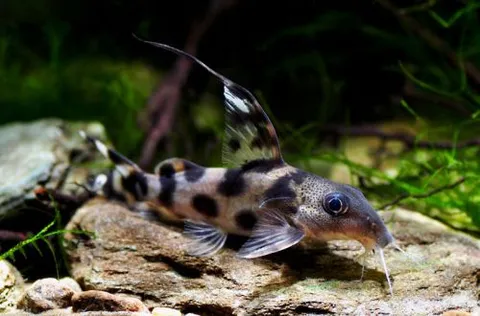
Synodontis decorus
Synodontis decorus, known as the Flag Synodontis or Clown Synodontis, belongs to the family Mochokidae. This species is one of the most striking representatives of the Synodontis genus and can adorn almost any large…
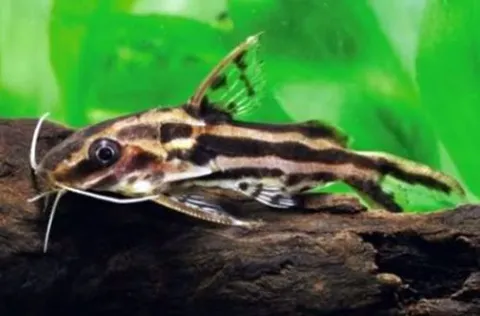
Synodontis flavitaeniatus
Belonging to the Mochokidae family, the Striped Synodontis, also known as the Orange Synodontis (Synodontis flavitaeniatus), easily adapts to various water conditions. This peaceful and undemanding species makes an…
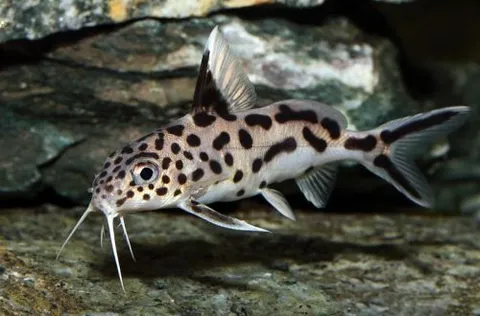
Synodontis multipunctatus
The Cuckoo Catfish, scientifically known as Synodontis multipunctatus, belongs to the family Mochokidae. This species is unique both in its habitat — a single lake in Africa — and its unusual breeding method. The…
Synodontis alberti
The scientific name Synodontis alberti belongs to the family Mochokidae, and this fish is also known as Albert's Synodontis, High-fin Synodontis, or Big-eyed Synodontis. Since it is most active in the dark, during the…