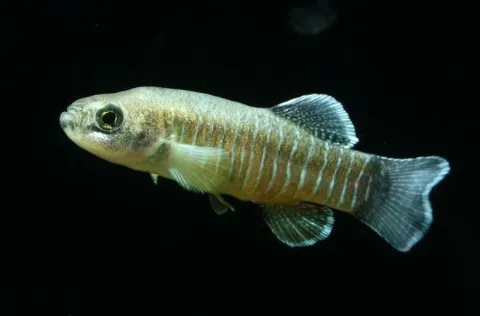
Arak Killifish
Esmaeilius arakensis
Esmaeilius arakensis, or the Arak Killifish, belongs to the family Cyprinodontidae. This fish is not frequently encountered in aquariums, partly due to its modest coloration and not always docile temperament.…
Aphaniops sirhani, known as the Azraq killifish, belongs to the family Cyprinodontidae. This attractive fish has had a difficult history in its natural habitat: by the early 1990s its native range had almost disappeared due to human activity. Fortunately, coordinated efforts by international conservation organizations have stabilized the situation.
This tiny fish has a slightly elongated body. Females are larger, reaching about 5 cm; they are pale silvery with a few black spots. Males are smaller and more brightly coloured, with alternating dark and light vertical stripes on the body. Their fins are yellow with a broad black edge and positioned toward the tail.
The Azraq killifish comes from the ancient oasis of Azraq in the Syrian desert, in present-day Jordan. For many centuries this oasis was the only source of fresh water in the region and a key point on caravan routes. Until the 1980s it covered over 12 km² of wetland rich in vegetation and diverse wildlife. Large mammals such as lions, cheetahs, rhinoceroses, hippopotamuses and elephants inhabited these lands, though some had died out long before the 80s. The oasis was fed by two major underground springs. From the 1960s onward, however, deep wells were installed to supply water to Amman, which lowered the water table. By 1992 the springs had run dry completely, and the wetland shrank to a fraction of its former size, causing most of the flora and fauna to vanish. After international conservation organizations raised the alarm, a rescue programme for the surviving species and partial restoration of the oasis began in the 2000s, aiming to recover at least 10% of its original area through artificial water injection. Today a protected Azraq Nature Reserve operates at this site.
Because of specific water chemistry requirements and aggressive spawning behaviour, this fish is not ideal for a community aquarium. The best option is to keep it only with its own species. Males are highly aggressive toward each other, especially during breeding season, with a dominant individual quickly emerging while the rest must avoid it. To prevent intraspecific conflict, keep one male with 2–3 females.
These fish are not difficult to keep, and in warm climates they breed successfully in open ponds. For a home aquarium, basic equipment is enough: lighting and a low-flow filter, since this fish cannot tolerate strong or even moderate flow. A heater is not required. A small group will be comfortable in a tank of 100 litres or more. Decorate the aquarium with plenty of hiding places: stone piles, driftwood, or decorative elements like artificial castles or sunken ships. These refuges are especially important for females and subordinate males during spawning. The substrate can be anything, but coarse sand or fine pebbles are preferred. Good plants include various mosses, ferns and some hardy species such as coontail. Maintenance consists of a weekly water change of about 10% and periodic substrate cleaning as organic waste accumulates. The Azraq killifish prefers slightly alkaline or neutral water with a high dGH; soft, weakly acidic water can be fatal. The optimal temperature range is 10 to 30°C. In winter months, temperature should not exceed 20°C, as higher temperatures significantly shorten lifespan and prevent breeding.
This omnivorous species feeds in nature on small aquatic crustaceans, worms, insects and their larvae, and other zooplankton. Its diet also includes algae and other vegetation. In the aquarium, combine dry and meat foods such as live or frozen daphnia, brine shrimp, bloodworm, and add plant matter like spirulina flakes. Proper nutrition is crucial for successful breeding, as a lack of protein and plant components can have serious negative consequences.
Creating suitable conditions and maintaining proper water parameters make home breeding quite feasible. Spawning peaks in summer and early autumn. At this time the male becomes more brightly coloured, claims a territory and invites females to spawn. Any rival that ventures near his boundaries will be driven off at once. Sometimes the male is overly active, forcing females to hide if they are not yet ready to spawn. Spawning occurs gradually: females lay eggs one at a time or in small bunches, attaching them to plants with thin threads. After spawning, parents show no care for the eggs and may even eat them. The eggs should be carefully moved together with the plant to a separate tank with identical water conditions. The incubation period lasts 6 to 14 days, depending on water temperature. The fry feed on brine shrimp nauplii and other fine food such as crushed flakes or granules.
No diseases specific to this species have been recorded. Like other cyprinodonts, it is sensitive to water quality and organic waste buildup. Kept in unsuitable conditions, especially without seasonal temperature variation over a long period, the fish's immune system weakens, raising the risk of bacterial infection and parasites. Prevention involves regular water changes, stable water parameters and a proper rest period at lower temperatures.
This species is extremely rare and endangered, so finding it in ordinary shops is almost impossible. Search through specialized killifish societies or professional breeders. When buying, check that the fish have no visible damage, sores, white spots or signs of emaciation. A healthy individual should be active, have clean fins and show the species' characteristic colours.
There are no pair reviews for this species yet — check tankmates in the matcher.
All tankmatesThe water suits 114 of 208 plants in the catalogue — the easiest ones are shown first.
African Onion PlantAfzelius's AnubiasAmazon FrogbitAmazon SwordAnacharisAnubiasArrowhead CryptDwarf CloverDwarf CloverDwarf HygrophilaDwarf SagittariaDwarf ValGuppy GrassHornwortJava MossMoneywortMud SwordNair's LagenandraNarrow Leaf AnacharisNarrow-leaf CloverStringy MossTaiwan MossTape GrassUssuri Watermilfoil
Matching water does not mean the plant will stay intact.
The essentials: size, tank volume, water parameters and care
An adult reaches 5 cm in length. Plan the tank around the maximum size: the fish quickly outgrows a cramped setup.
The recommended volume is 100 L. A smaller tank speeds up nitrate build-up and raises stress levels.
Temperature 10–35 °C, pH 7.5–8.5, hardness 10–26 dGH. Stability matters more than exact values: sudden swings are harder on the fish than a small deviation from the ideal.
Around 3 years when kept properly. Lifespan depends directly on tank volume, water quality and a varied diet.
Temperament: territorial (often aggressive). Keep this in mind when choosing tank mates.
Recommended setup: pair (male/female). Ignoring this is a common cause of stress and disease.
Diet type: any (universal). Feed small portions that are finished within a couple of minutes — overfeeding does more harm than underfeeding.
The scientific name of the species is Aphaniops sirhani, family Killifish (Cyprinodontidae). It also appears in the literature as: Aphaniops sirhani, Lebias sirhani.
Matched by family, categories and overlapping keeping conditions
Esmaeilius arakensis
Esmaeilius arakensis, or the Arak Killifish, belongs to the family Cyprinodontidae. This fish is not frequently encountered in aquariums, partly due to its modest coloration and not always docile temperament.…
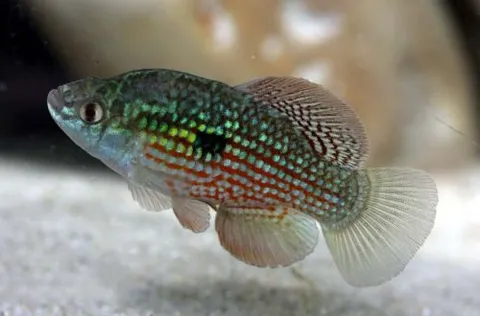
Jordanella floridae
Jordanella floridae, commonly known as the flagfish, belongs to the family Cyprinodontidae. This attractive fish is native to Florida in the southern United States; its common name comes from the striking resemblance of…
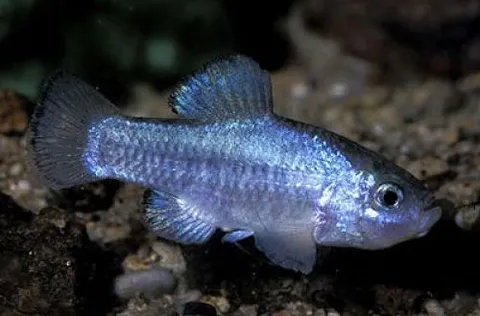
Cyprinodon macularius
The desert pupfish, scientifically known as Cyprinodon macularius, belongs to the family Cyprinodontidae. This species is remarkable as a "living fossil", representing one of the oldest members of bony fishes. Its…
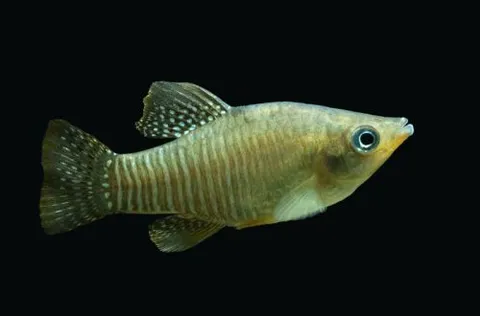
Fundulus xenicus
Fundulus xenicus, or the Diamond Killifish, belongs to the family Fundulidae. Despite its outstanding hardiness and high endurance, this species is not suitable for a community tank, as its habitat is exclusively…