Temperature18 – 30 °C
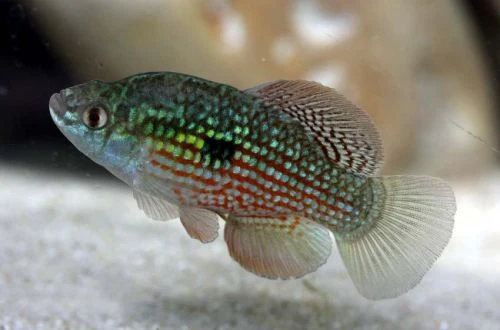
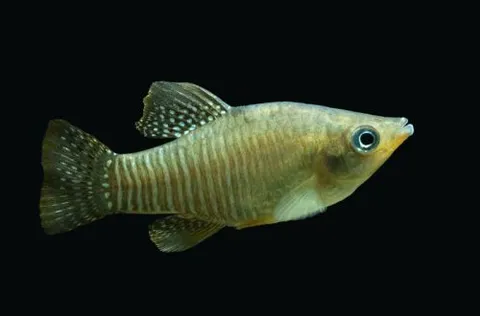
Jordanella floridae, also known as the Florida Flagfish or American Flagfish, belongs to the family Cyprinodontidae. This beautiful fish originates from the southern US state of Florida; its second name comes from the striking resemblance of its coloration to the American flag – horizontal red and white stripes.
The fish has an elongated body and rounded fins. In adult males, the dorsal and anal fins are larger and the coloration is brighter than in females. The body pattern consists of alternating horizontal stripes of reddish-brown/red and silvery/blue-green colors. Behind the head, on the back, there is a yellow tint, and a dark rounded spot can often be seen in the center of the body.
This species is endemic to the Florida peninsula. It inhabits numerous small lakes, backwaters, swamps, as well as ordinary ditches and agricultural water canals.
During the breeding season, males display pronounced territoriality and belligerence towards each other. This is why, for keeping a single pair in an aquarium of about 50 L, it is desirable to provide each male with its own territory. However, in more spacious aquariums, from 100 L and above, it is possible to form communities of several males, provided that each of them has its own section. Regarding other species of aquarium inhabitants, caution should be exercised: small fish can become targets of aggression from Florida Flagfish males, and large but peaceful tankmates can also suffer. The optimal option is to keep these fish in a species-only tank or with certain types of catfish.
A spacious aquarium of about 100 L will be required for a group of fish, although a 50 L tank is sufficient for a single pair. In terms of aquarium decor, key attention is paid to plants: there should be many of them, both rooted and floating. The latter can cover almost the entire water surface. Hard-leaved plant species will be preferred. Sand is typically used as substrate, and various snags and tree root fragments can be installed for decoration. Florida Flagfish adapt well to various water parameters and feel comfortable even in brackish water, which often enters their natural habitats during typhoons and hurricanes. This feature significantly simplifies water preparation for the aquarium. It is sufficient to use regular tap water, pre-settled for a couple of days to remove chlorine. The minimum equipment set includes a filter, aerator, lighting system, and heater. The latter may not be installed if the room temperature does not drop below 20–22 °C. Weekly maintenance involves partial water changes (10–20%) with fresh water. If necessary, clean the substrate of organic debris (excrement, uneaten food, fallen plants) and remove algae from the glass.
Although they prefer live meaty foods such as bloodworms, daphnia, and small worms, these fish also readily accept high-quality dry foods (granules, flakes) if they contain protein components. It is recommended to combine dry foods with live or frozen ones. Vegetable supplements, such as spirulina flakes or other algae, are also essential. Feed 2–3 times a day; the amount of food should be such that it is eaten within a few minutes. Uneaten leftovers must be removed to avoid water pollution.
There is a widespread misconception, including in some scientific works, that Florida Flagfish reproduce by creating pit-nests in the substrate and guarding their offspring. However, the reality is somewhat different. Spawning usually occurs in spring or late summer. During this time, the male occupies a temporary territory, which he carefully defends from rivals, and attracts females with his bright coloration. The female, having chosen a partner, lays eggs on the leaves or stems of rooted plants, after which the male immediately fertilizes them. Parental care ends there. The eggs are left unattended. Often, the parents eat their offspring, so it is advisable to move them to a separate tank, for example, a three-liter jar. The incubation period lasts from 7 to 14 days, depending on the water temperature. The hatched fry feed on Artemia nauplii, microworms, and other micro-foods.
The Florida Flagfish has a strong immune system and, with basic maintenance conditions, rarely suffers from specific diseases. The main threat to health is improper diet, where the predominance of protein food over plant-based food leads to obesity and metabolic disorders. Fish are also sensitive to water quality, so with the accumulation of organic waste and high nitrate levels, bacterial infections are possible, manifesting as fin damage or cloudy mucous membranes. Prevention involves weekly water changes and maintaining a stable temperature regime.
When purchasing, choose active individuals with clean fins and no visible body damage. A healthy fish should show natural curiosity and a characteristic jerky swimming motion. It is recommended to avoid specimens with signs of emaciation, sunken bellies, or unnaturally clamped fins. It is important to consider that fish may be stressed in a store environment, so it is worth observing their behavior for a few minutes: healthy individuals should not show signs of apathy or constantly hide in the corners of the aquarium.
The essentials: size, tank volume, water parameters and care
An adult reaches 5 cm in length. Plan the tank around the maximum size: the fish quickly outgrows a cramped setup.
The recommended volume is 100 L. A smaller tank speeds up nitrate build-up and raises stress levels.
Temperature 18–30 °C, pH 6.5–8.5, hardness 2–20 dGH. Stability matters more than exact values: sudden swings are harder on the fish than a small deviation from the ideal.
Around 4 years when kept properly. Lifespan depends directly on tank volume, water quality and a varied diet.
Temperament: territorial (often aggressive). Keep this in mind when choosing tank mates.
Recommended setup: harem (1 male and several females). Ignoring this is a common cause of stress and disease.
Diet type: floating (protein). Feed small portions that are finished within a couple of minutes — overfeeding does more harm than underfeeding.
The scientific name of the species is Jordanella floridae, family Killifish (Cyprinodontidae). It also appears in the literature as: Cyprinodon floridae.
The water suits 197 of 208 plants in the catalogue — the easiest ones are shown first.
Afzelius's AnubiasAnacharisAnubiasBrazilian PennywortDwarf CloverDwarf CloverDwarf HygrophilaDwarf SagittariaDwarf ValGuppy GrassHornwortJava FernJava MossMoneywortMud SwordNair's LagenandraNarrow Leaf AnacharisNarrow-leaf CloverStringy MossSüsswassertangTaiwan MossTape GrassTemple PlantUssuri Watermilfoil
Matched by family, categories and overlapping keeping conditions
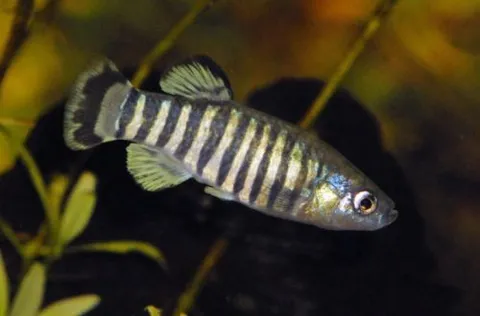
Aphaniops sirhani
Aphaniops sirhani, also known as the Azraq killifish, belongs to the family Cyprinodontidae. This attractive fish has a complicated history in its natural habitat: its natural range had almost disappeared by the early…
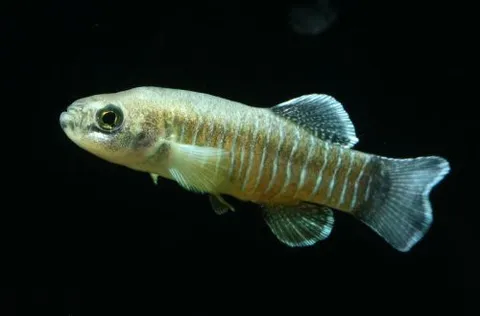
Esmaeilius arakensis
Esmaeilius arakensis, or the Arak Killifish, belongs to the family Cyprinodontidae. This fish is not frequently encountered in aquariums, partly due to its modest coloration and not always docile temperament.…
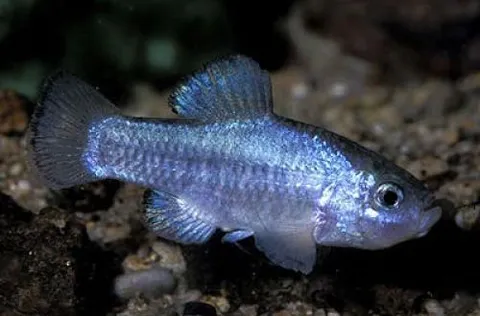
Cyprinodon macularius
The Desert Pupfish, scientifically known as Cyprinodon macularius, belongs to the family Cyprinodontidae. This species is unique as a "living fossil," representing one of the oldest known bony fish. Its exceptional…
Fundulus xenicus
Fundulus xenicus, or the Diamond Killifish, belongs to the family Fundulidae. Despite its outstanding hardiness and high endurance, this species is not suitable for a community tank, as its habitat is exclusively…