Temperature15 – 26 °C
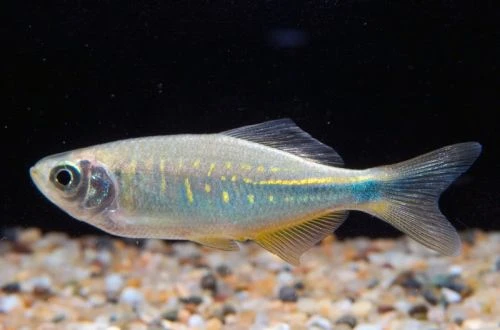
The scientific name Devario devario is given to the Bengal Danio, a member of the Cyprinidae family. This interesting schooling fish, with its understated but original body pattern, is easy to keep and breed, provided that proper water quality is carefully maintained.
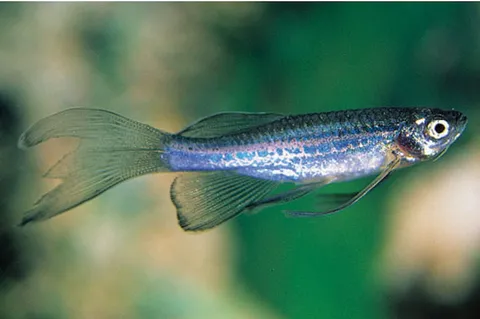
Adults can reach up to 8 cm in length. Males are noted to be smaller than females but have brighter coloration. Their main body color is blue, adorned with yellow strokes. The maximum contrast and striking effect of this pattern are evident under dim lighting against a dark substrate.
The Ganges River basin, flowing through the northeastern regions of India, as well as Nepal and Bangladesh, is the habitat of this species. The hydrochemical characteristics and water temperature in these regions are subject to seasonal fluctuations. The water here is often turbid, with an abundance of suspended particles, and the substrate consists mainly of sandy-clay deposits mixed with stones of various sizes.
These active schooling fish thrive best in groups of 8–10 individuals. In smaller numbers, they may exhibit excessive shyness towards larger species or, conversely, aggression towards very small ones. It is advisable to choose tank mates of similar size and temperament, for example, from other cyprinids or characins.
To keep a school of these fish, an aquarium of at least 200 liters will be required. For decoration, it is recommended to use a substrate of coarse sand, gravel, stones, and boulders. Provide several shelters, such as snags, roots, or tree branches. Plants should be selected with a strong root system, capable of growing well in conditions of moderate current. Although these fish live in natural conditions with rather murky water, they are quite sensitive to pollution in the aquarium. Therefore, the main emphasis in equipment should be on an effective filtration system. Weekly water changes of 35–50% of the volume with fresh water also play a key role in maintaining cleanliness. In addition to filtration, the system provides the necessary internal current, which keeps the fish in good condition and is an important factor for their successful keeping. Other recommended equipment includes a heater, air pump, and lighting fixtures. The aquarium must be equipped with a tight lid to prevent the fish from jumping out.
The Bengal Danio is not particularly finicky about food, readily accepting most offered feeds. High-quality dry foods can be used as the basis of their diet, which should be supplemented with protein additives such as live or frozen bloodworms, daphnia, artemia, and others. The fish should be fed 2–3 times a day, offering portions that are consumed within 5 minutes.
Like many small cyprinids, the Bengal Danio is an egg-laying species. Females scatter their eggs in the water column, and males immediately fertilize them. After this, there is no parental care, and the fish may even eat their own eggs, leading to an extremely low survival rate for fry in a community tank. To preserve offspring, a separate spawning tank must be prepared. It is usually small and equipped with a minimal set of devices: a simple sponge filter and a heater. A separate lighting system is not mandatory, as ambient room light will be sufficient. As a substrate, large pebbles can be used, or a fine-mesh net can be laid on the bottom, along with dense thickets of low, fine-leaved plants. The stimulus for spawning is maintaining the water temperature in the main tank at 25–26°C with a neutral pH. When you notice rounded bellies in the females and active courtship by the males, this will signal the start of the breeding period, and the fish should then be moved to a temporary spawning refuge. Spawning lasts no more than 24 hours, after which the pairs return to the main tank. Fry hatch after 24–36 hours, and by the end of the second day, they begin to swim freely. From this point, they can be started on special finely ground micro-food. More detailed information on Danio breeding can be found in relevant sources.
Bengal Danios have strong immunity provided they are kept in clean, oxygen-rich water. The fish are extremely sensitive to organic pollution in the aquarium and the accumulation of waste products, which, if care rules are not followed, often leads to the development of bacterial infections such as fin rot. Stress due to unsuitable water parameters or the absence of a school significantly weakens the body's defenses, making the fish vulnerable to parasitic diseases, for example, Ichthyophthirius. Key preventive measures include: — regular water changes of 30–50% weekly; — maintaining stable hydrochemical parameters without sharp fluctuations; — ensuring good filtration and moderate current; — quarantining new individuals before placing them in the main tank.
When choosing Bengal Danios, preference should be given to active, mobile individuals that stay in a school and display natural behavior. Avoid purchasing fish with signs of sluggishness, damaged fins, or unusual spots on the body. It is important to assess their overall plumpness: a sunken belly or, conversely, unnatural abdominal bloating may indicate emaciation or internal diseases. In the store, fish may appear pale due to stress, but their coloration should quickly recover in a calm environment.
The essentials: size, tank volume, water parameters and care
An adult reaches 8 cm in length. Plan the tank around the maximum size: the fish quickly outgrows a cramped setup.
The recommended volume is 200 L. A smaller tank speeds up nitrate build-up and raises stress levels.
Temperature 15–26 °C, pH 6–8, hardness 2–16 dGH. Stability matters more than exact values: sudden swings are harder on the fish than a small deviation from the ideal.
Around 4 years when kept properly. Lifespan depends directly on tank volume, water quality and a varied diet.
Temperament: peaceful, active/mobile. Keep this in mind when choosing tank mates.
Recommended setup: group (8–10 individuals). Ignoring this is a common cause of stress and disease.
Diet type: any (universal). Feed small portions that are finished within a couple of minutes — overfeeding does more harm than underfeeding.
The scientific name of the species is Devario devario, family Cyprinids (Cyprinidae). It also appears in the literature as: Cyprinus devario, Danio devario, Deuario deuario.
The water suits 197 of 208 plants in the catalogue — the easiest ones are shown first.
Afzelius's AnubiasAnacharisAnubiasBrazilian PennywortDwarf CloverDwarf CloverDwarf HygrophilaDwarf SagittariaDwarf ValGuppy GrassHornwortJava FernJava MossMoneywortMud SwordNair's LagenandraNarrow Leaf AnacharisNarrow-leaf CloverStringy MossSüsswassertangTaiwan MossTape GrassTemple PlantUssuri Watermilfoil
Matched by family, categories and overlapping keeping conditions
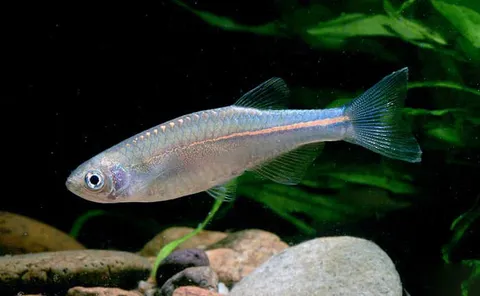
Danio albolineatus
The fish known as the Pearl Danio (scientific name Danio albolineatus) belongs to the family Cyprinidae. These are attractive, schooling fish, characterized by their unpretentiousness. They are rightly considered among…
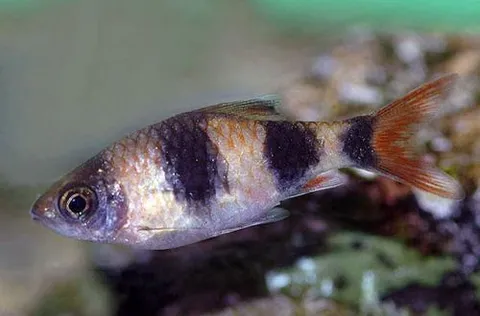
Dawkinsia arulius
The Arulius Barb, scientifically known as Dawkinsia arulius and belonging to the family Cyprinidae, does not impress with its bright coloration or unique body pattern. However, its lively activity and unpretentiousness…
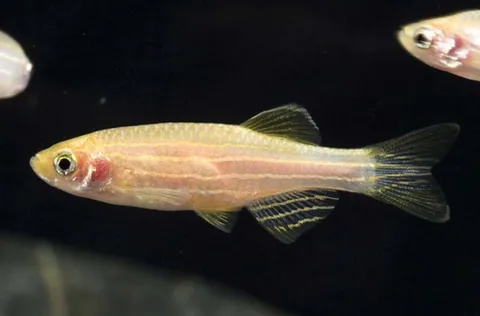
Danio rerio
The Albino Zebra Danio, scientifically known as Danio rerio, is a member of the Cyprinidae family. This fish is a natural morphological form of the Zebra Danio and is found in the wild. Its key difference from its…
Danio rerio
The Blue Danio, known by its scientific name Danio rerio, belongs to the carp family (Cyprinidae). This variation of the classic Danio rerio stands out for its silvery-blue coloration, consisting of numerous small…