Temperature20 – 23 °C
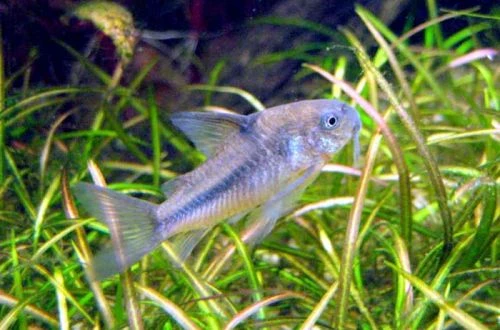
Natterer's Corydoras, also known as the Blue Cory, belongs to the family Callichthyidae (Armored Catfish) under the scientific name Corydoras nattereri. Its homeland is South America, where its natural habitat spans the coastal areas of river systems in southeastern Brazil. Specifically, this species is found in the states of Espírito Santo, Rio de Janeiro, São Paulo, and Paraná, preferring small streams, rivulets, and periodically flooded sections of tropical rainforest.
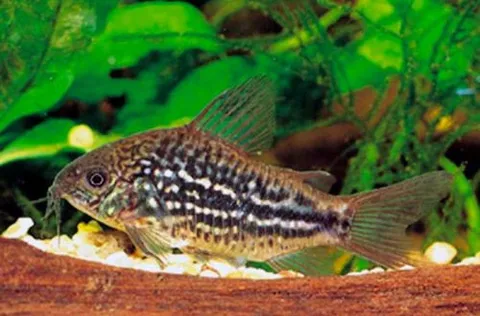
Adults of this species reach approximately 5 cm in length. A distinctive feature of the fish is its stocky body, characteristic of most Corydoras, covered in rows of bony plates. Their coloration is light gray, complemented by a broad black stripe that runs from the tail to the middle of the body. Under certain lighting, the bony plates can be seen to shimmer with greenish or bluish hues.
The habitat covers coastal river systems in southeastern Brazil, including the states of Espírito Santo, Rio de Janeiro, São Paulo, and Paraná. The fish inhabit small streams, rivers, and tropical forest areas subject to seasonal flooding. In their natural environment, they prefer slow-flowing waters with sandy or fine gravel substrate and an abundance of shelters in the form of snags and dense vegetation.
These peaceful and calm fish spend most of their time exploring the aquarium bottom or finding cozy hiding spots. Their activity increases in the evening hours or under dimmer lighting. They coexist well with many non-aggressive fish species of comparable size. However, it is worth noting that Natterer's Corydoras, unlike most other Corydoras, prefers relatively low water temperatures, which can significantly narrow the range of potential tank mates.
For a group of six corydoras, the optimal aquarium volume starts from 70 liters. When decorating, it is recommended to opt for dark, soft substrates. It is also important to provide several shelters, which can be created using dense plant thickets, snags, tree bark, or fallen leaves from certain trees. Lighting should preferably be subdued, although this is not a strict requirement. As already mentioned, maintaining a low water temperature is critically important. Otherwise, the Blue Cory is not demanding and successfully adapts to a wide range of basic hydrochemical parameters, such as pH and dGH.
In nature, they are omnivorous, feeding on small invertebrates, insect larvae, crustaceans, and plant detritus. In the aquarium, they accept any sinking foods: specialized tablets for bottom-dwelling fish, high-quality dry flakes, as well as frozen or live foods such as bloodworms, daphnia, and brine shrimp. Feeding is recommended in the evening or under subdued lighting, as the fish show the greatest activity in searching for food during this period.
Spawning is paired or group-based, stimulated by frequent water changes with cooler water. The female lays eggs on illuminated surfaces—plant leaves or aquarium glass. After the process is complete, it is recommended to remove the parents to prevent them from eating the eggs. The incubation period lasts from 6 to 10 days, depending on the temperature. Fry begin to feed independently after becoming free-swimming; initial food includes Artemia nauplii or micro-food.
The species is susceptible to diseases typical for armored catfish when kept in improper conditions. The main dangers are bacterial infections affecting the skin and fins, as well as fungal diseases of the eggs. They are sensitive to the accumulation of organic waste and sudden changes in water parameters. Prevention includes regular gravel vacuuming, maintaining substrate cleanliness, and using fungicidal preparations during egg incubation.
When purchasing, select active individuals with clean skin without visible spots, ulcers, or fin damage. It is important to check the condition of their barbels—they should be intact, without signs of erosion, which indicates proper care in the store. Avoid fish with sunken bellies or signs of apathy. It is recommended to acquire a group of 5–6 individuals, as fish kept alone become timid and prone to stress.
The essentials: size, tank volume, water parameters and care
An adult reaches 5–5.4 cm in length. Plan the tank around the maximum size: the fish quickly outgrows a cramped setup.
The recommended volume is 70 L. A smaller tank speeds up nitrate build-up and raises stress levels.
Temperature 20–23 °C, pH 6–8, hardness 1–15 dGH. Stability matters more than exact values: sudden swings are harder on the fish than a small deviation from the ideal.
Around 5 years when kept properly. Lifespan depends directly on tank volume, water quality and a varied diet.
Temperament: peaceful, calm/shy/inactive. Keep this in mind when choosing tank mates.
Recommended setup: small group (5–6 individuals). Ignoring this is a common cause of stress and disease.
Diet type: sinking (any). Feed small portions that are finished within a couple of minutes — overfeeding does more harm than underfeeding.
The scientific name of the species is Corydoras nattereri, family Armored Catfish (Callichthyidae). It also appears in the literature as: Corydoras juquiaae, Corydoras triseriatus.
The water suits 196 of 208 plants in the catalogue — the easiest ones are shown first.
Afzelius's AnubiasAnacharisAnubiasBrazilian PennywortDwarf CloverDwarf CloverDwarf HygrophilaDwarf SagittariaDwarf ValGuppy GrassHornwortJava FernJava MossMoneywortMud SwordNarrow Leaf AnacharisNarrow-leaf CloverStringy MossSüsswassertangTaiwan MossTape GrassTemple PlantUssuri WatermilfoilWater Wisteria
Matched by family, categories and overlapping keeping conditions
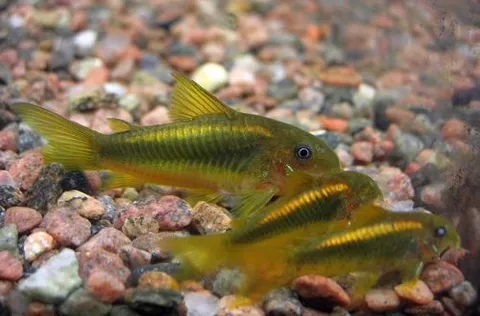
Corydoras melanotaenia
Corydoras melanotaenia, also known as the Rainbow Corydoras (scientific name Corydoras melanotaenia), belongs to the family Callichthyidae, or armored catfishes. This catfish is native to South America, where it…
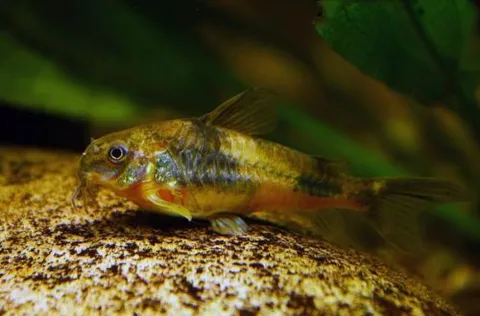
Corydoras ehrhardti
Ehrhardt's Corydoras, known by its scientific name Corydoras ehrhardti, is a member of the Armored Catfish or Callichthyidae family. The specific name honours Mr. W. Ehrhardt; the species itself was described in 1910 by…
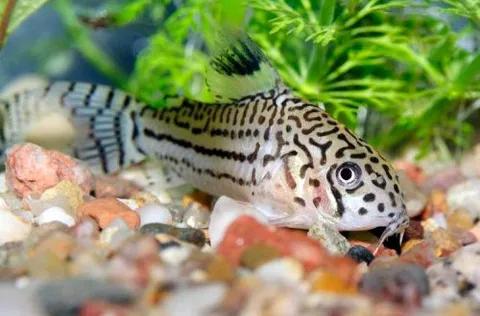
Corydoras reticulatus
The Reticulated Corydoras, scientifically known as Corydoras reticulatus, is a member of the family Callichthyidae, or Armored Catfishes. Its natural habitat is South America, where it is widely distributed in the lower…
Corydoras undulatus
Corydoras undulatus, or Wavy Corydoras (scientific name Corydoras undulatus), belongs to the family Callichthyidae, known as Armored Catfish. This small catfish originates from the waters of South America; specifically,…