Temperature22 – 26 °C
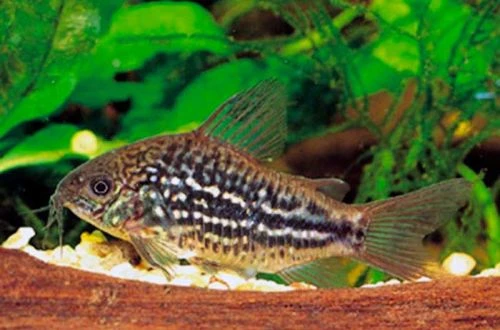
Corydoras undulatus, or Wavy Corydoras (scientific name Corydoras undulatus), belongs to the family Callichthyidae, known as Armored Catfish. This small catfish originates from the waters of South America; specifically, it can be found in the lower reaches of the Paraná River, as well as in some neighboring river systems in southern Brazil and adjacent areas of Argentina. Its preferred habitats are the bottom layers of water in small rivers, streams, and their tributaries.
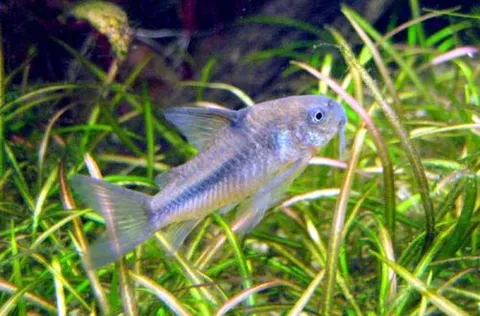
Adults of this catfish reach just over 4 cm in length. Its body appears stocky and robust, and its fins are short. In this species, the scales are transformed into rows of plates, which provide reliable protection against potential predators. Another protective feature is the first rays of the fins: they are thickened and pointed at the ends, forming a kind of spine. The fish's coloration is dark, complemented by light stripes and speckles that form a characteristic pattern.
The Wavy Corydoras inhabits South America, primarily in the basin of the lower Paraná River and coastal waters of southern Brazil and Argentina. It is a demersal fish, preferring to stay in the lower water layers among dense vegetation, where it finds shelter. In nature, the species is adapted to a tropical climate with water temperatures of 22–26 °C, a wide pH range from 6.0 to 8.0, and hardness of 2–25 dGH.
This catfish is known for its peaceful and friendly disposition. It prefers the company of its own kind rather than solitude. Corydoras undulatus coexists perfectly with other Corydoras species, as well as with non-aggressive fish of comparable size. Good tank mates for it include popular aquarium inhabitants such as Danios, Rasboras, and various small Tetras.
For a small group of six individuals, the optimal aquarium volume starts from 50 liters. When arranging decor, it is important to consider the need for a soft substrate and several shelters. These shelters can be natural materials, such as snags or dense plant thickets, or artificial decorative elements. The Wavy Corydoras originates from a tropical climate and does well in water of 22–26 °C. This allows it to be successfully kept even in aquariums without additional heating.
In its natural environment, this species feeds on small invertebrates, including worms, crustaceans, and insects, and also consumes organic plant matter. In aquarium conditions, Corydoras readily eat high-quality specialized dry foods in the form of sinking tablets or granules, as well as frozen foods such as bloodworms, daphnia, or brine shrimp. A varied diet is recommended to maintain the health and activity of the fish.
Breeding occurs in a spawning tank, where a pair or group of fish lays eggs on a substrate, such as plant leaves or glass. The spawning process is often stimulated by water changes. The female attaches the eggs to the chosen spot, after which fertilization is carried out by the male. The parents do not care for their offspring and may eat the eggs, so the adults should be removed after spawning is complete. Fry begin to feed independently after the yolk sac has been absorbed.
The species has a typical sensitivity for armored catfish to water quality, especially to the accumulation of organic waste in the substrate. If keeping conditions are violated, fin and skin lesions from bacterial infections are possible. The fish are extremely sensitive to certain chemical preparations and salts used in aquaristics, so treatment should be carried out with caution. Prevention involves maintaining a clean bottom and regular water changes.
When purchasing, choose active fish with clean skin, free of visible spots, sores, or fin damage. Healthy individuals should exhibit natural behavior for the species, actively exploring the substrate in search of food. Avoid purchasing fish from aquariums where dead individuals or specimens showing signs of emaciation have been observed, as this may indicate hidden infections or poor keeping conditions in the store.
The essentials: size, tank volume, water parameters and care
An adult reaches 4 cm in length. Plan the tank around the maximum size: the fish quickly outgrows a cramped setup.
The recommended volume is 50 L. A smaller tank speeds up nitrate build-up and raises stress levels.
Temperature 22–26 °C, pH 6–8, hardness 2–25 dGH. Stability matters more than exact values: sudden swings are harder on the fish than a small deviation from the ideal.
Around 5 years when kept properly. Lifespan depends directly on tank volume, water quality and a varied diet.
Temperament: peaceful, calm/shy/inactive. Keep this in mind when choosing tank mates.
Recommended setup: small group (3–4 individuals). Ignoring this is a common cause of stress and disease.
Diet type: sinking (any). Feed small portions that are finished within a couple of minutes — overfeeding does more harm than underfeeding.
The scientific name of the species is Corydoras undulatus, family Armored Catfish (Callichthyidae).
The water suits 197 of 208 plants in the catalogue — the easiest ones are shown first.
Afzelius's AnubiasAnacharisAnubiasBrazilian PennywortDwarf CloverDwarf CloverDwarf HygrophilaDwarf SagittariaDwarf ValGuppy GrassHornwortJava FernJava MossMoneywortMud SwordNair's LagenandraNarrow Leaf AnacharisNarrow-leaf CloverStringy MossSüsswassertangTaiwan MossTape GrassTemple PlantUssuri Watermilfoil
Matched by family, categories and overlapping keeping conditions
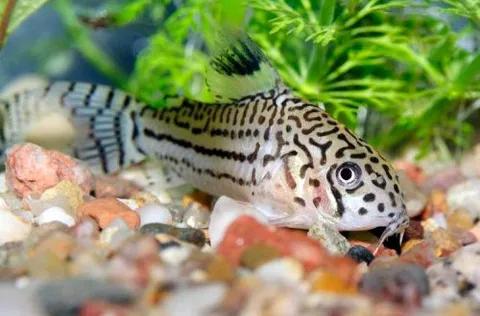
Corydoras reticulatus
The Reticulated Corydoras, scientifically known as Corydoras reticulatus, is a member of the family Callichthyidae, or Armored Catfishes. Its natural habitat is South America, where it is widely distributed in the lower…
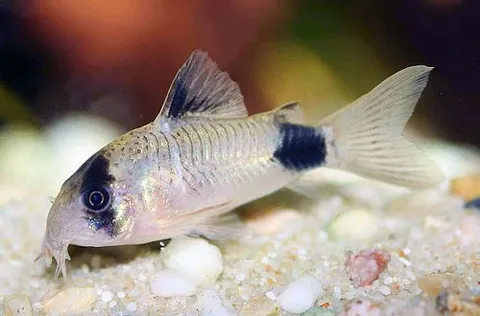
Corydoras panda
The Panda Corydoras, widely known as the Panda Catfish or Panda Cory (scientific name Corydoras panda), belongs to the family Callichthyidae. These fish originate from the upper Amazon River basin, where the foothills…
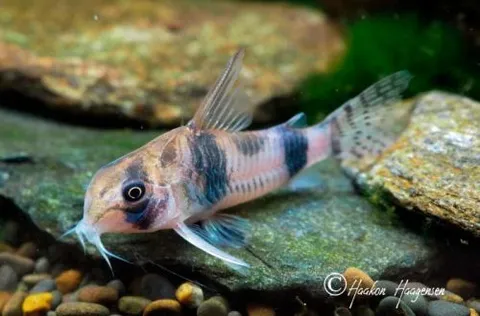
Corydoras tukano
Corydoras tukano, scientifically known as Corydoras tukano, belongs to the armored catfish family, Callichthyidae. This catfish received its name from the Tucano indigenous group, whose settlements are located in the…
Corydoras nattereri
Natterer's Corydoras, also known as the Blue Cory, belongs to the family Callichthyidae (Armored Catfish) under the scientific name Corydoras nattereri. Its homeland is South America, where its natural habitat spans the…