Temperature21 – 31 °C
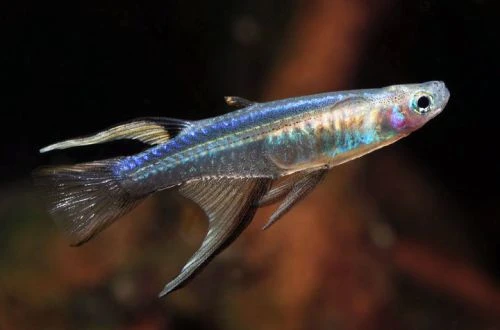
The Blue-eyed Neon (scientific name Pseudomugil cyanodorsalis), also known as the Blue-backed Pseudomugil, belongs to the family Pseudomugilidae. This unique tropical fish exhibits remarkable adaptability, allowing it to be kept even in marine aquariums. This is possible due to its ability to comfortably tolerate high salt concentrations. This species is characterized by its unpretentiousness, peaceful disposition, and beautiful coloration, but it is not suited to the ordinary community aquarium: it is timid and easily outcompeted for food by livelier tankmates.
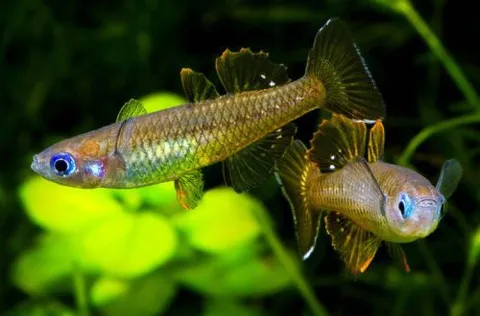
Adults of this fish reach a length of approximately 3.5 cm. Their bodies are colored in bluish-yellow tones, and their backs stand out with a bright blue color, which creates a beautiful neon effect under certain lighting. The anal and dorsal fins are noticeably elongated, with the latter located close to the caudal fin. When spread, their shape resembles a skirt. Males are usually larger than females and have longer fins.
The natural habitat of the Blue-backed Pseudomugil covers the northwestern and northern regions of the Australian continent. Some varieties have also been found in the southern part of New Guinea. These fish inhabit river deltas flowing into the ocean, coastal lagoons, mangrove thickets, and even marine waters near the coastline, which explains their ability to withstand significant changes in water salinity. In their natural habitats, aquatic vegetation is typically absent, giving way to areas of mangrove thickets with muddy bottoms.
These fish are characterized by a calm and peaceful disposition. Given their small size, they are only compatible with species of comparable size. If the aquarium contains brackish water, the choice of tank mates will be significantly limited. It is recommended to keep them in a group of at least 8–10 individuals of both sexes for optimal well-being.
The aquarium size for a small group of Blue-eyed Neons should start from 40 liters. The decor can be arbitrary, according to the aquarist's personal preferences. However, it is recommended to use a sandy substrate where a few sticks can be inserted to imitate mangrove thickets. There are differing opinions regarding water parameters, especially concerning the addition of salt. Long-term observations show that in brackish conditions, the fish exhibit greater activity, their lifespan increases, and they breed more easily. Therefore, a salt concentration of 1 to 10 grams per 1 liter of water is considered optimal. Sufficient oxygen saturation of the water and moderate internal current, mimicking tidal waves, are important during keeping. The aquarium must also be equipped with a lid to prevent the fish from jumping out.
The diet of Blue-backed Pseudomugils includes all types of appropriately sized foods – dry, live, and frozen; they prefer to feed closer to the water surface. If possible, it is recommended to prioritize products such as small bloodworms, Artemia, and Daphnia to provide them with a complete diet.
The breeding process for these fish is quite simple and does not require specialized preparation. Spawning can occur year-round, and it is stimulated by increasing the water temperature to the upper permissible limits, i.e., 28–30°C. Females lay their eggs among plant thickets, attaching them with sticky threads. In a freshwater aquarium, fine-leaved and low-growing plant species, such as Java moss, are ideal for this purpose. In brackish water conditions, it is advisable to use artificial spawning substrates, including homemade ones. The dominant male usually fertilizes several clutches from different females. Parental instincts are not developed in these fish, and after spawning, they may eat their own eggs. To preserve the offspring, fertilized eggs should be promptly moved to a separate tank with identical water conditions. In this tank, the fry will remain until they reach a sufficiently large size, usually about six months. Such a separate tank should be equipped with the same equipment as the main aquarium, with the exception of the filtration system. Here, it is recommended to use a simple air-driven sponge filter, which will provide sufficient cleaning and prevent accidental suction of the fry. The incubation period lasts approximately 10 days, depending on the temperature. In the first days of life, the fry will need powdered micro-food, and after a week, Artemia nauplii can be introduced.
Health problems usually arise only as a result of injuries or keeping in unsuitable conditions, which leads to a weakening of the immune system and, as a rule, provokes the development of various diseases. At the first signs of illness, the primary task is to check the water parameters for excesses or dangerous concentrations of toxic substances (nitrates, nitrites, ammonia, etc.). After bringing all indicators back to normal, treatment can begin.
When choosing individuals, pay attention to their activity and clarity of coloration. Healthy fish should be active, without visible fin damage, ulcers, or white film on the body. Avoid purchasing fish that appear sluggish, stay at the water surface, or have clamped fins, as this may indicate stress or hidden diseases. Given that the species is schooling, acquire a group of 8–10 individuals at once to reduce stress during adaptation to new conditions.
The essentials: size, tank volume, water parameters and care
An adult reaches 3.5 cm in length. Plan the tank around the maximum size: the fish quickly outgrows a cramped setup.
The recommended volume is 40 L. A smaller tank speeds up nitrate build-up and raises stress levels.
Temperature 21–31 °C, pH 7–8, hardness 10–26 dGH. Stability matters more than exact values: sudden swings are harder on the fish than a small deviation from the ideal.
Around 2 years when kept properly. Lifespan depends directly on tank volume, water quality and a varied diet.
Temperament: peaceful (regular). Keep this in mind when choosing tank mates.
Recommended setup: group (8–10 individuals). Ignoring this is a common cause of stress and disease.
Diet type: high protein (predominantly meat). Feed small portions that are finished within a couple of minutes — overfeeding does more harm than underfeeding.
The scientific name of the species is Pseudomugil cyanodorsalis, family Pseudomugilidae.
The water suits 114 of 208 plants in the catalogue — the easiest ones are shown first.
African Onion PlantAfzelius's AnubiasAmazon FrogbitAmazon SwordAnacharisAnubiasArrowhead CryptDwarf CloverDwarf CloverDwarf HygrophilaDwarf SagittariaDwarf ValGuppy GrassHornwortJava MossMoneywortMud SwordNair's LagenandraNarrow Leaf AnacharisNarrow-leaf CloverStringy MossTaiwan MossTape GrassUssuri Watermilfoil
Matched by family, categories and overlapping keeping conditions
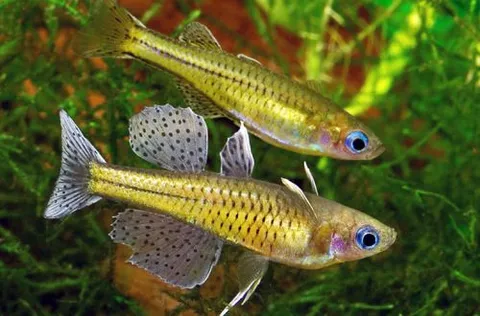
Pseudomugil gertrudae
Pseudomugil gertrudae, also known as the Spotted Blue-eye, belongs to the family Pseudomugilidae. This species was named in honor of Gertrude, the wife of Dr. Hugo Merton, a German naturalist who first discovered it in…
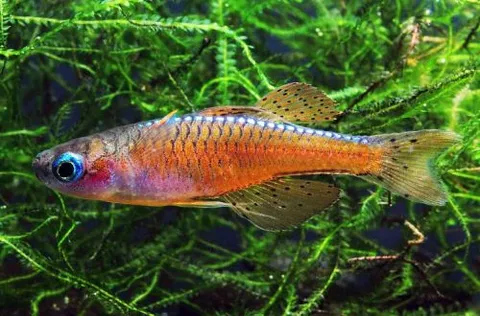
Pseudomugil sp. «Red neon»
Pseudomugil sp. "Red neon", or Red Neon Blue-eye, belongs to the family Pseudomugilidae. This species, which appeared on the market in 2011, has relatively recently attracted the attention of aquarists. A distinctive…
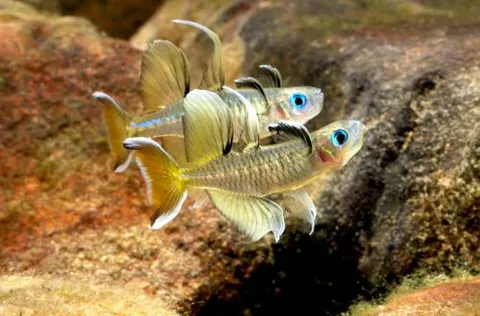
Pseudomugil signifer
Pseudomugil signifer, or the Australian blue-eye (scientific name Pseudomugil signifer), is a member of the family Pseudomugilidae. This remarkable fish is captivating not only for its unusual appearance but also for…
Pseudomugil tenellus
Pseudomugil tenellus, known as the Delicate Blue-eye or Slender Blue-eye, belongs to the family Pseudomugilidae. This beautiful and slender fish fully lives up to its name. It is easy to keep and breed, and it can adapt…