Temperature23 – 27 °C
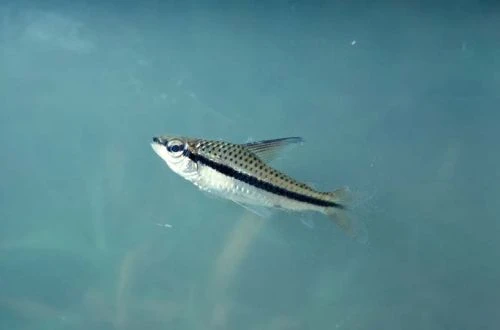
A member of the Chilodontidae family, Caenotropus, scientifically known as Caenotropus labyrinthicus, originates from South America. Its presence is notable throughout the vast Amazon River basin, as well as in the Orinoco, Rupununi, and Suriname basins. These fish prefer to inhabit the main river channels, forming large, cohesive schools.
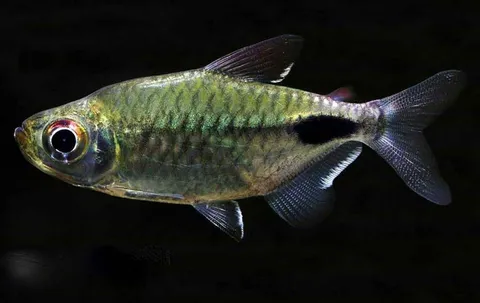
Adults of this fish can reach up to 18 cm in length. Their body appears somewhat stocky, and the head is notably large. The primary coloration is silver, complemented by a black stripe that runs from head to tail, against which a prominent spot stands out. At a young age, the body of Caenotropus is dotted with numerous small black specks, which, combined with the overall coloration, gives it a resemblance to the related species Chilodus. As they mature, these spots either fade or disappear entirely.
Caenotropus inhabits tropical freshwater bodies in South America. The species is widespread in the Amazon, Orinoco, Rupununi, Suriname, Saramacca, and Parnaíba river basins. In nature, the fish populate the main river channels, preferring areas with flowing water, and stay in large schools.
These are active and mobile fish that prefer to stay in a school. One interesting feature can be observed in their behavior: Caenotropus swim not horizontally, but at a characteristic angle, head-down. They get along well with most other peaceful species of comparable size.
Given their size and inherent need to be in a group with conspecifics, this species requires a spacious aquarium of at least 200–250 liters for keeping 4–5 individuals. In terms of decor, it is important to provide ample open swimming spaces, harmoniously combined with hiding places created from driftwood and dense plant thickets. The choice of substrate is not critical. The approach to keeping them is similar to that used for other South American species. Optimal conditions are achieved in warm, soft, and slightly acidic water. These fish, being inhabitants of flowing waters, are sensitive to the accumulation of organic waste. Thus, water quality directly depends on the uninterrupted functioning of the filtration system and regular aquarium maintenance. The diet should be based on high-protein foods, supplemented with live foods such as small invertebrates (insect larvae, various worms, and so on).
The diet of these fish should be rich in protein and also include live foods in the form of small invertebrates, such as insect larvae or various worms. Caenotropus are active and mobile aquarium inhabitants that prefer to stay in a school. Their behavior is distinguished by a curious feature: they swim at an angle, pointing their head downwards, rather than horizontally. These fish are well compatible with most other peaceful species of similar size.
Breeding is not documented. The fish keeps to the bottom, feeding on invertebrates, sponges and detritus; there is no information on its reproduction either from the wild or from aquaria. No characters that would separate males from females have been described.
No diseases that affect only this species have been described. Under suitable conditions — clean water, a balanced diet and calm tank mates — health problems usually do not arise. The most common cause of illness is a decline in conditions: it weakens the immune system, and the fish becomes vulnerable to infections that are always present in an aquarium. At the first signs of trouble — lethargy, wasting, refusal of food or clamped fins — check the basic water parameters and the levels of ammonia, nitrite and nitrate first. Restoring acceptable conditions often lets the fish recover on its own.
When selecting individuals, attention should be paid to their activity and the absence of visible damage to the body. Healthy fish should show interest in food and stay in a group with conspecifics. Avoid acquiring specimens with signs of emaciation, damaged fins, or unnatural behavior, as the species is sensitive to water quality and the accumulation of organic waste.
The essentials: size, tank volume, water parameters and care
An adult reaches 15–18 cm in length. Plan the tank around the maximum size: the fish quickly outgrows a cramped setup.
The recommended volume is 200 L. A smaller tank speeds up nitrate build-up and raises stress levels.
Temperature 23–27 °C, pH 6–7, hardness 2–10 dGH. Stability matters more than exact values: sudden swings are harder on the fish than a small deviation from the ideal.
Around 5 years when kept properly. Lifespan depends directly on tank volume, water quality and a varied diet.
Temperament: peaceful, active/mobile. Keep this in mind when choosing tank mates.
Recommended setup: group (8–10 individuals). Ignoring this is a common cause of stress and disease.
Diet type: mixed diet (meat + plant-based). Feed small portions that are finished within a couple of minutes — overfeeding does more harm than underfeeding.
The scientific name of the species is Caenotropus labyrinthicus, family Chilodontidae. It also appears in the literature as: Chilodus labyrinthicus, Microdus labyrinthicus.
The water suits 197 of 208 plants in the catalogue — the easiest ones are shown first.
Afzelius's AnubiasAnacharisAnubiasBrazilian PennywortDwarf CloverDwarf CloverDwarf HygrophilaDwarf SagittariaDwarf ValGuppy GrassHornwortJava FernJava MossMoneywortMud SwordNair's LagenandraNarrow Leaf AnacharisNarrow-leaf CloverStringy MossSüsswassertangTaiwan MossTape GrassTemple PlantUssuri Watermilfoil
Matched by family, categories and overlapping keeping conditions
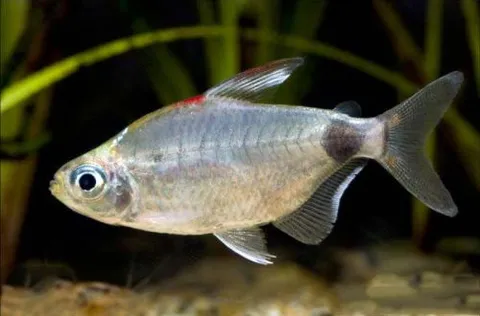
Bathyaethiops breuseghemi
Breuseghem's Tetra, scientifically known as Bathyaethiops breuseghemi, is a member of the family Alestidae, or African Tetras. Its homeland is the African continent, where it is found in the middle Congo River basin, in…
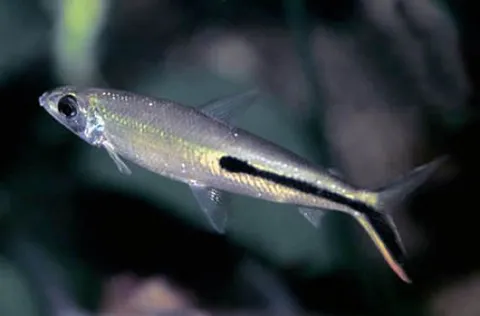
Hemiodus gracilis
The Slender Hemiodopsis (Hemiodus gracilis), belonging to the Hemiodontidae family, is a beautiful and graceful fish with a unique body pattern. It is highly active, which allows it to bring dynamism to any freshwater…
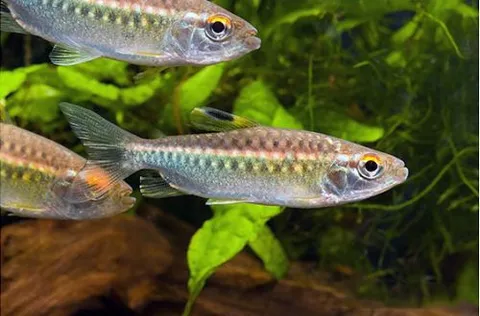
Arnoldichthys spilopterus
The African Red-Eyed Tetra, scientifically known as Arnoldichthys spilopterus, belongs to the family Alestidae (African Tetras). This hardy and undemanding fish, both in terms of care and breeding, is distinguished by…
Brachypetersius altus
The Alestes Tetra (Brachypetersius altus), a member of the Alestidae family (African Tetras), is native to the waters of West Africa. It can be found in the middle Congo River basin, as well as in numerous tributaries…