Temperature24 – 27 °C
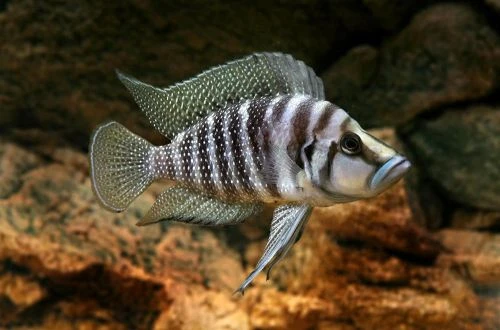
The Calvus Cichlid, scientifically known as Altolamprologus calvus, belongs to the family Cichlidae. Despite its predatory nature, this fish exhibits a peaceful and calm temperament. It only preys on tankmates that can easily fit into its mouth, making it suitable for community tanks. Keeping and breeding this cichlid are not particularly difficult, but the need to maintain stable water parameters means it is not recommended for inexperienced aquarists.
Adults grow up to 14 cm in length. Sexual dimorphism is weakly expressed, with males only slightly larger than females. Body coloration varies from gray to dark tones, adorned with dark vertical stripes. One of the most striking characteristics of the species is its laterally compressed body and elongated head. This structure allows the fish to hunt effectively among rocks, penetrating the narrowest crevices.
This species is endemic to Lake Tanganyika in Africa and occurs only in the south-western part of the lake, between Kapampa in the Democratic Republic of Congo and Cape Chaitika in Zambia. Its natural habitat consists exclusively of rocky shorelines.
This species is territorial and predatory, yet relatively peaceful. It coexists well with other peaceful inhabitants of Lake Tanganyika. It is advisable to avoid housing them with Mbuna cichlids and other aggressive fish, as well as any fish that could become prey for the Calvus. They can be kept in pairs or small groups.
To achieve optimal keeping conditions, a biotope aquarium replicating the natural habitat of Lake Tanganyika is recommended. For a group of Calvus cichlids, the tank volume should be at least 150 liters. Decorations should include rock formations and stone fragments that create crevices and caves. It has been observed that using a dark substrate enhances the fish's coloration, while light substrates can make it duller. Maintaining stable water parameters with appropriate hydrochemical indicators is crucial for successful keeping. A powerful filtration system is essential, as is weekly partial water changes with fresh water. Regular aquarium cleaning also plays a significant role.
Being a predator, this species is carnivorous. In a home aquarium, its diet can include both fresh and frozen meat products. These include fish meat, shrimp, mussels, and other invertebrates such as large bloodworms and Artemia.
During the breeding season, Calvus cichlids form pairs, but this only happens if the fish have grown up together. If one tries to combine adult individuals raised in different conditions, breeding becomes unlikely. These fish can breed in a community tank, but raising offspring there often fails, as they risk becoming prey for other inhabitants or even the males. More favorable conditions are created in a separate spawning tank. During the mating period, the male chooses a crevice or grotto and attracts the female there. The eggs are laid inside the shelter, after which the male, while outside, releases milt, which is then directed by fins towards the eggs for fertilization. The pair guards the clutch alternately. Fry appear after 8–10 days and begin to swim freely after just a couple of days. At this stage, it is advisable to remove the male to avoid him eating his own offspring; females, as a rule, are indifferent to the fry. The young can be fed with Artemia nauplii and small bloodworms. It is important to note that fry grow unevenly. As they mature, smaller individuals should be separated, otherwise they may be eaten.
The main cause of most diseases in Lake Tanganyika cichlids is unsuitable keeping conditions and poor-quality food, which often leads, for example, to African Bloat. At the first symptoms, it is necessary first to check the water parameters and ensure there are no high concentrations of dangerous substances such as ammonia, nitrites, and nitrates. If the readings deviate from the norm, they should be brought into order, and only then should treatment begin.
When choosing Altolamprologus calvus, preference should be given to individuals that show activity and curiosity, but it is important to remember that these fish are naturally cautious and may hide in shelters. A healthy fish should have clean fins without signs of erosion or plaque, clear eyes, and even breathing without rapid gill cover movements. Avoid specimens with sunken bellies, which may indicate emaciation or internal diseases, as well as individuals with visible skin damage, as due to their specific body structure, they are prone to injuries during improper transportation. Since Calvus are territorial predators, in the store they may show signs of stress, expressed as darkening coloration and the appearance of contrasting stripes on the body. When purchasing, it is recommended to: — carefully inspect the scales for the absence of spots, ulcers, or white plaque; — ensure there are no jaw or spinal deformities, which are sometimes found in individuals raised in unsuitable conditions; — inquire about the keeping conditions and diet, as these fish are sensitive to water quality and the quality of protein feeds.
The essentials: size, tank volume, water parameters and care
An adult reaches 12–14 cm in length. Plan the tank around the maximum size: the fish quickly outgrows a cramped setup.
The recommended volume is 150 L. A smaller tank speeds up nitrate build-up and raises stress levels.
Temperature 24–27 °C, pH 7.5–9, hardness 8–21 dGH. Stability matters more than exact values: sudden swings are harder on the fish than a small deviation from the ideal.
Around 10 years when kept properly. Lifespan depends directly on tank volume, water quality and a varied diet.
Temperament: predator, but semi-peaceful (gets along with large ones). This is a predatory species — any fish small enough to fit in its mouth will eventually be eaten.
Recommended setup: harem (1 male and several females). Ignoring this is a common cause of stress and disease.
Diet type: meat / protein (live, frozen, fresh). Feed small portions that are finished within a couple of minutes — overfeeding does more harm than underfeeding.
The scientific name of the species is Altolamprologus calvus, family Cichlids (Cichlidae). It also appears in the literature as: Lamprologus calvus, Neolamprologus calvus.
The water suits 113 of 208 plants in the catalogue — the easiest ones are shown first.
African Onion PlantAfzelius's AnubiasAmazon FrogbitAmazon SwordAnacharisAnubiasArrowhead CryptDwarf CloverDwarf CloverDwarf HygrophilaDwarf SagittariaDwarf ValGuppy GrassHornwortJava MossMoneywortMud SwordNair's LagenandraNarrow Leaf AnacharisNarrow-leaf CloverStringy MossTaiwan MossTape GrassUssuri Watermilfoil
Matched by family, categories and overlapping keeping conditions
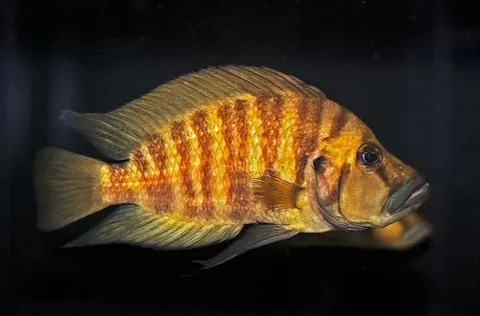
Altolamprologus compressiceps
Altolamprologus compressiceps, also known as the Compressed Humphead or Kigoma Red, is a member of the Cichlidae family. It is a peaceful predator that only shows aggression towards very small fish. It coexists well…
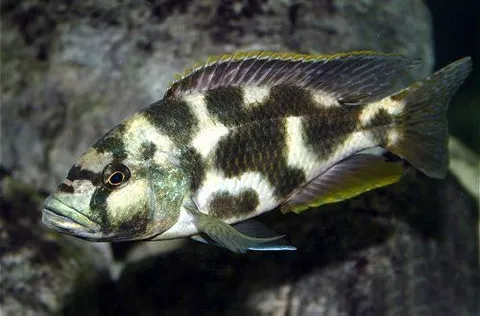
Nimbochromis livingstonii
Nimbochromis livingstonii, the scientific name for Livingston's Cichlid, belongs to the family Cichlidae. Haplochromis livingstonii is considered an older name, as this fish is now classified under the genus…
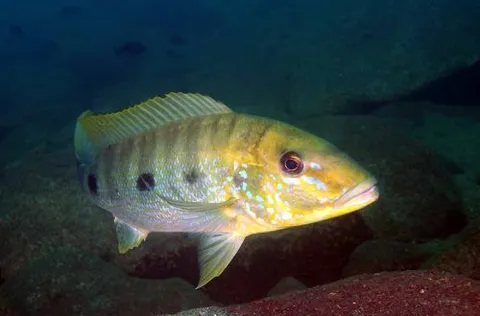
Boulengerochromis microlepis
Boulengerochromis microlepis, known as the Giant Cichlid, is a member of the Cichlidae family. This name is well-deserved, as the species can reach over half a meter in length, making it one of the largest cichlids…
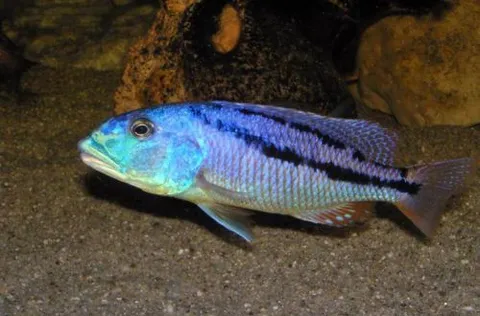
Aristochromis christyi
Aristochromis christyi, scientifically named Aristochromis christyi, is a representative of the Cichlidae family. Despite its predatory lifestyle, this fish is known for its peaceful disposition, posing a threat only to…