Temperature24 – 28 °C
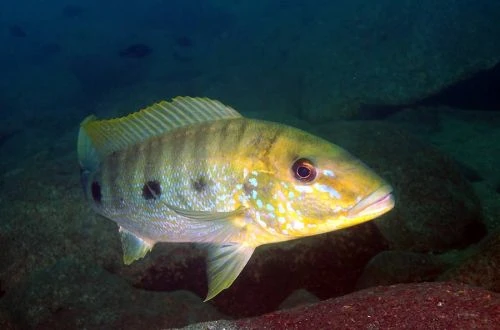
Boulengerochromis microlepis, known as the Giant Cichlid, is a member of the Cichlidae family. This name is well-deserved, as the species can reach over half a meter in length, making it one of the largest cichlids inhabiting the African rift lakes. It serves as an important food fish for local communities, while in aquaristics, it only became known in the early 2000s. Due to their impressive size, these fish are extremely rare in home aquariums.
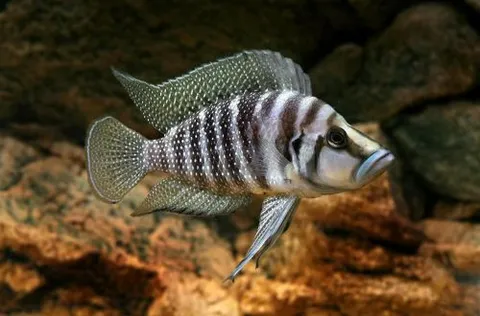
These fish typically reach 45–55 cm in length, although local fishermen report encountering individuals up to a meter. The Giant Cichlid is characterized by a large head with a big mouth and an elongated, torpedo-shaped body. The dorsal fin extends from the head to the tail, and the anal fin is located closer to the powerful caudal peduncle. Its coloration is dominated by yellow and silvery tones, with rows of vertical dark stripes running along the body, complemented by three large spots from the mid-body to the tail.
Boulengerochromis microlepis is endemic to Lake Tanganyika, which is one of the largest lakes in Africa, situated on the borders of Tanzania, Zambia, the Democratic Republic of Congo, and Burundi. The uniqueness of this lake's ecosystem lies in the fact that most of its inhabitants are found nowhere else in the world. Adult Giant Cichlids prefer depths of up to 100 meters, choosing benthic areas where rocky debris is combined with open sandy zones. Juveniles, in contrast, inhabit shallower coastal waters with sandy substrates.
Despite its predatory nature, this species exhibits peaceful behavior towards fish of comparable size, such as Frontosa and Aristochromis christyi. Any other, smaller species will inevitably become their prey. Intraspecific relationships also have their peculiarities. Juveniles stay in groups, but as they mature, they become intolerant of each other. Adult fish prefer a solitary lifestyle or live in established pairs (male/female), each of which forms and actively defends its territory from conspecifics.
Giant Cichlids require exceptionally spacious aquariums. A single adult pair, consisting of a male and a female, will need a bottom area of at least 5 m². The aquarium setup should be simple, including a sandy substrate and large piles of rocks or rock formations. As a result, the total weight of such a filled aquarium, intended for just two fish, can exceed several tons! Such installations are very expensive and require significant resources (both time and money) to maintain. They are difficult to classify as amateur aquaristics, so their maintenance is best carried out by professionals.
This species is a predatory carnivore. Juveniles in nature are omnivorous, but as they mature, their diet shifts entirely to other fish. During the day, Giant Cichlids stay in the bottom layers of the water, rising to the surface in coastal areas at dusk in search of prey. In aquarium conditions, they feed on live fish as well as pieces of meat, such as mussels and freshwater shrimp.
The Giant Cichlid is a substrate-spawning species. Sexual maturity is reached after two years of age at a body length of about 40 cm. In nature and in spacious aquariums, a pair forms a nest in a depression in the sandy substrate or on an open rock surface. Spawning involves the female laying eggs in rows, which the male fertilizes incrementally. A clutch may contain up to 10,000 eggs. Both parents show pronounced care for the offspring, actively guarding the territory and the eggs, which incubate for about 72 hours. After hatching, larvae begin swimming freely after about a week, after which they can be fed Artemia nauplii and other small protein-rich foods.
The main cause of diseases often lies in the keeping conditions: if they go beyond acceptable limits, immunity decreases, making the fish vulnerable to various infections inevitably present in the environment. At the first suspicion of illness, it is important first of all to check the water parameters and ensure there are no dangerous concentrations of nitrogen cycle products. Often, restoring normal, suitable conditions promotes recovery. However, in some cases, medication may be required.
When purchasing, it should be noted that this species requires extremely large volumes of water and is not suitable for most home aquariums. Healthy individuals should be active, have clean scales without visible damage, ulcers, or white spots, and demonstrate a good appetite. It is important to avoid fish with sunken bellies or signs of lethargy, as this may indicate infectious diseases. Since juveniles may appear peaceful, it is necessary to remember their potential aggressive behavior as they mature, which is why it is recommended to acquire them for species-specific tanks or alongside similarly sized, stress-resistant species.
The essentials: size, tank volume, water parameters and care
An adult reaches 45–55 cm in length. Plan the tank around the maximum size: the fish quickly outgrows a cramped setup.
The recommended volume is 500 L. A smaller tank speeds up nitrate build-up and raises stress levels.
Temperature 24–28 °C, pH 7.5–9, hardness 8–26 dGH. Stability matters more than exact values: sudden swings are harder on the fish than a small deviation from the ideal.
Around 10 years when kept properly. Lifespan depends directly on tank volume, water quality and a varied diet.
Temperament: predator, but semi-peaceful (gets along with large ones). This is a predatory species — any fish small enough to fit in its mouth will eventually be eaten.
Recommended setup: pair (male/female). Ignoring this is a common cause of stress and disease.
Diet type: high protein (predominantly meat). Feed small portions that are finished within a couple of minutes — overfeeding does more harm than underfeeding.
The scientific name of the species is Boulengerochromis microlepis, family Cichlids (Cichlidae). It also appears in the literature as: Boulengerochromis microlepsis, Paratilapia microlepis, Tilapia microlepis.
The water suits 113 of 208 plants in the catalogue — the easiest ones are shown first.
African Onion PlantAfzelius's AnubiasAmazon FrogbitAmazon SwordAnacharisAnubiasArrowhead CryptDwarf CloverDwarf CloverDwarf HygrophilaDwarf SagittariaDwarf ValGuppy GrassHornwortJava MossMoneywortMud SwordNair's LagenandraNarrow Leaf AnacharisNarrow-leaf CloverStringy MossTaiwan MossTape GrassUssuri Watermilfoil
Matched by family, categories and overlapping keeping conditions
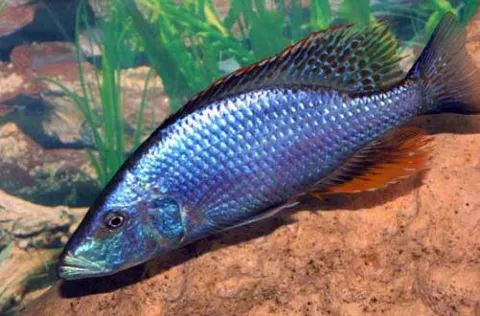
Dimidiochromis compressiceps
Dimidiochromis compressiceps is the scientific name for this species, which belongs to the Cichlidae family. This fish is one of the most striking predators, its body adorned with dominant blue and orange hues. It…
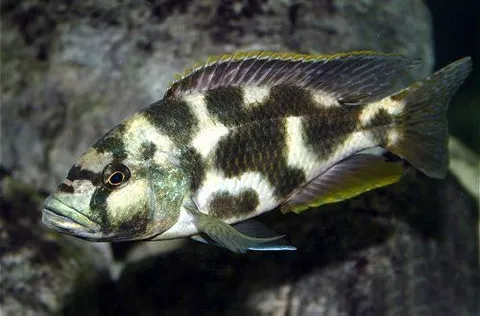
Nimbochromis livingstonii
Nimbochromis livingstonii, the scientific name for Livingston's Cichlid, belongs to the family Cichlidae. Haplochromis livingstonii is considered an older name, as this fish is now classified under the genus…
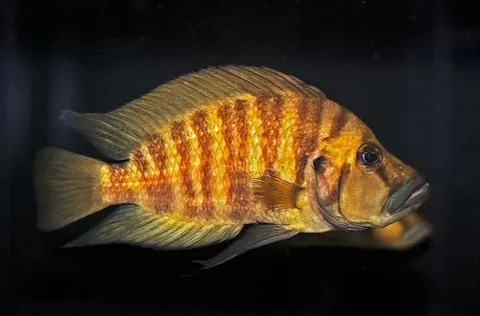
Altolamprologus compressiceps
Altolamprologus compressiceps, also known as the Compressed Humphead or Kigoma Red, is a member of the Cichlidae family. It is a peaceful predator that only shows aggression towards very small fish. It coexists well…
Altolamprologus calvus
The Calvus Cichlid, scientifically known as Altolamprologus calvus, belongs to the family Cichlidae. Despite its predatory nature, this fish exhibits a peaceful and calm temperament. It only preys on tankmates that can…