Temperature23 – 30 °C
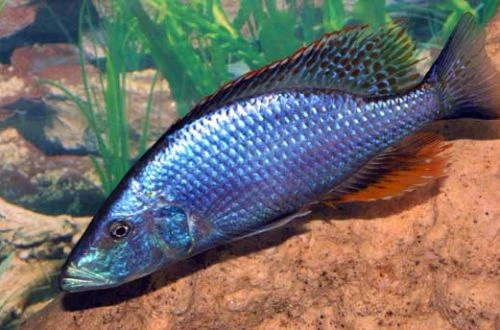
Dimidiochromis compressiceps is the scientific name for this species, which belongs to the Cichlidae family. This fish is one of the most striking predators, its body adorned with dominant blue and orange hues. It possesses astonishing speed and powerful jaws, posing a serious threat to any small fish.
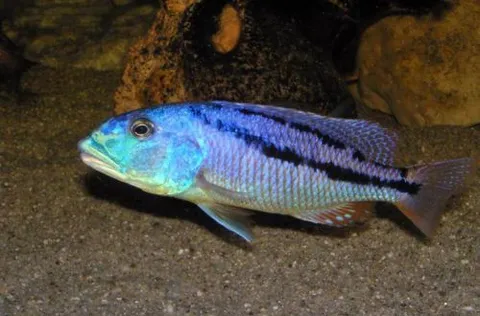
This fish grows to a rather impressive size, reaching 25 cm as an adult. The body of Dimidiochromis compressiceps is noticeably flattened laterally, making it the "flattest" cichlid in the lake. The back has rounded contours, while the ventral part is almost straight. The dorsal and anal fins are located closer to the caudal peduncle. The fish's mouth is equipped with powerful jaws studded with many sharp teeth. Males' coloration resembles metallic blue, sometimes with a slight greenish tint, and their orange fins are speckled with characteristic colored spots. Females and juveniles typically have a silvery hue.
Endemic to Lake Malawi in Africa, Dimidiochromis compressiceps is found in many areas of the lake. Its preferred habitat is shallow, open areas with sandy bottoms, where Vallisneria thickets are present. Sometimes these fish can also be found among rocky formations. They prefer calm waters with barely noticeable currents. In their natural environment, their diet consists of small fish.
The fish's behavior is characterized by moderate aggression; it does not attack other aquarium inhabitants of similar size, except for its own kind — males of the same species can engage in deadly skirmishes. The optimal keeping option is a harem, with one male for several females. It should be remembered: any smaller fish automatically becomes potential prey.
For such a large fish, an aquarium of at least 500 liters will be required. Such spacious conditions are necessary to provide Dimidiochromis with enough room to accelerate; in cramped spaces, it quickly loses vitality. The aquarium decor can be quite simple: a substrate of sand or fine gravel, supplemented by a small zone of Vallisneria thickets. It is important not to spread the vegetation over the entire area, but to group it. The quality and composition of the water are crucial for the fish's well-being. Optimal parameters are considered to be: slightly alkaline pH and medium water hardness (dH). Detailed information on parameters and methods for their correction is available in the "Hydrochemical composition of water" section. Given the large size of the fish and its carnivorous diet, a significant amount of waste is produced, leading to rapid pollution. Therefore, weekly gravel vacuuming and 20–50% water changes are necessary. The volume of water replaced depends on the tank size, fish population, and filtration system efficiency: the more productive the filter, the less water replacement will be required. The minimum equipment set must also include heating, aeration, and lighting systems.
Small fish will, of course, become prey for this impressive predator. However, in a home aquarium, there is no need to feed it exclusively live organisms. Fish meat, shrimp, mollusks, and mussels can be included in the diet. It is also important to provide some plant-based food by offering pieces of green vegetables. Juveniles can be fed bloodworms or earthworms.
Cases of successful Dimidiochromis breeding in artificial environments are known. Females show a preference for laying eggs on hard, flat surfaces, such as flat stones. After laying, the eggs are immediately taken into the female's mouth — this is a protective mechanism characteristic of most cichlids. Throughout the entire incubation period, which lasts from 21 to 28 days, the eggs remain in the female's mouth. During this time, she cannot eat, and if feeding before spawning was irregular or insufficient, the female may release the eggs prematurely. The fertilization process is no less fascinating. On the male's anal fin, there is a characteristic pattern of several bright spots that resemble eggs in shape and color. The female, mistakenly taking these spots for real eggs, tries to collect them; at this moment, the male releases seminal fluid, and fertilization occurs.
A characteristic disease for this and other cichlid species is "Malawi bloat. The main causes of its occurrence lie in suboptimal keeping conditions and an unbalanced diet. Changes in water parameters or the absence of plant additives in the food can provoke this disease.
When choosing a healthy specimen, pay attention to the fish's activity and the cleanliness of its skin. Avoid purchasing individuals with signs of emaciation, sunken bellies, or scale damage. It is important to assess behavior: a healthy fish should show natural curiosity and not have signs of apathy or unnatural swimming. Make sure the fish has no film, ulcers, or signs of fin rot. — prefer individuals with clear eyes, without cloudiness — observe the fish's reaction to food in the store to ensure there are no appetite problems — avoid fish that stay near the water surface or breathe heavily, as this may indicate gill problems or poor water quality in the aquarium.
The essentials: size, tank volume, water parameters and care
An adult reaches 25 cm in length. Plan the tank around the maximum size: the fish quickly outgrows a cramped setup.
The recommended volume is 470 L. A smaller tank speeds up nitrate build-up and raises stress levels.
Temperature 23–30 °C, pH 7.6–8.6, hardness 10–18 dGH. Stability matters more than exact values: sudden swings are harder on the fish than a small deviation from the ideal.
Around 10 years when kept properly. Lifespan depends directly on tank volume, water quality and a varied diet.
Temperament: predator, but semi-peaceful (gets along with large ones). This is a predatory species — any fish small enough to fit in its mouth will eventually be eaten.
Recommended setup: harem (1 male and several females). Ignoring this is a common cause of stress and disease.
Diet type: high protein (predominantly meat). Feed small portions that are finished within a couple of minutes — overfeeding does more harm than underfeeding.
The scientific name of the species is Dimidiochromis compressiceps, family Cichlids (Cichlidae). It also appears in the literature as: Cyrtocara compressiceps, Paratilapia compressiceps.
The water suits 114 of 208 plants in the catalogue — the easiest ones are shown first.
African Onion PlantAfzelius's AnubiasAmazon FrogbitAmazon SwordAnacharisAnubiasArrowhead CryptDwarf CloverDwarf CloverDwarf HygrophilaDwarf SagittariaDwarf ValGuppy GrassHornwortJava MossMoneywortMud SwordNair's LagenandraNarrow Leaf AnacharisNarrow-leaf CloverStringy MossTaiwan MossTape GrassUssuri Watermilfoil
Matched by family, categories and overlapping keeping conditions
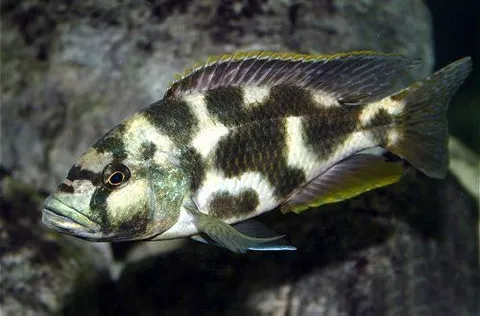
Nimbochromis livingstonii
Nimbochromis livingstonii, the scientific name for Livingston's Cichlid, belongs to the family Cichlidae. Haplochromis livingstonii is considered an older name, as this fish is now classified under the genus…
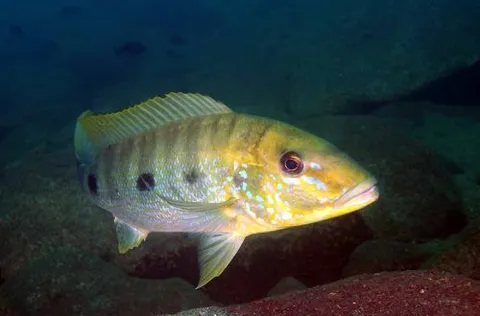
Boulengerochromis microlepis
Boulengerochromis microlepis, known as the Giant Cichlid, is a member of the Cichlidae family. This name is well-deserved, as the species can reach over half a meter in length, making it one of the largest cichlids…
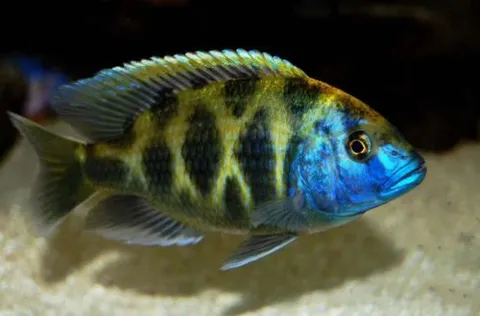
Nimbochromis venustus
Nimbochromis venustus, also known as the Golden Leopard, belongs to the Cichlidae family. This species is part of a group of ambush predators inhabiting Lake Malawi in Africa. It has developed a unique hunting strategy…
Aristochromis christyi
Aristochromis christyi, scientifically named Aristochromis christyi, is a representative of the Cichlidae family. Despite its predatory lifestyle, this fish is known for its peaceful disposition, posing a threat only to…