Temperature20 – 25 °C
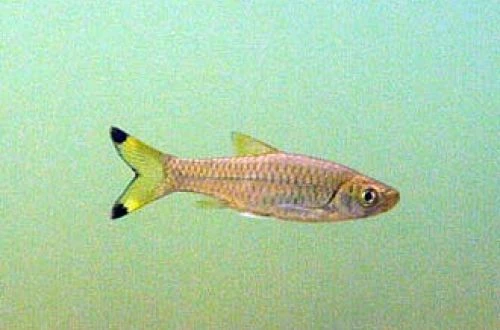
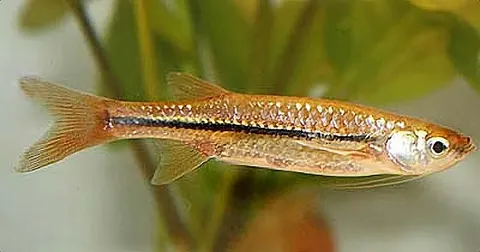
The Common Rasbora, known scientifically as Rasbora rasbora, belongs to the family Cyprinidae, or carps. As the name suggests, the coloration of this fish is quite modest when compared to its more brightly colored relatives. This circumstance largely explains why it is not as widespread among amateur aquarists.
Adults can reach a length of approximately 13 cm. Their main body color is grey, but due to their extensive natural habitat, other color forms likely exist. Differences between sexes are subtle: males appear somewhat slimmer than females, which is especially noticeable during spawning.
Its natural habitat is presumed to cover South and Southeast Asia, extending into modern-day Pakistan, India, Bangladesh, Myanmar, and Thailand. These fish inhabit small streams and rivers characterized by moderate currents. These bodies of water are typically located in hilly or mountainous terrain.
This peaceful fish prefers to live in schools, so it should not be kept alone. It coexists well with most non-aggressive species. However, its activity level should be considered: it might not be the best neighbor for slower aquarium inhabitants.
For a school of 8–10 Common Rasboras, an aquarium of at least 250 liters will be required. In terms of aquarium design, details are less important than maintaining high water quality. It is recommended to create hiding places using natural snags, rock formations, or dense plant thickets, while also leaving ample open swimming space. Since these fish inhabit flowing waters, they are sensitive to water conditions. It is important to prevent the accumulation of organic waste; for this, regular aquarium maintenance and weekly partial water changes with fresh water are necessary. Consistently high-quality filtration will also play a key role. This is an omnivorous species that readily accepts most dry, frozen, and live foods used for feeding other Rasboras.
The Common Rasbora is an omnivorous species and readily accepts a variety of foods—dry, frozen, and live—typically used for other Rasboras. Due to its rarity in home aquariums, unfortunately, there is no reliable data on successful breeding of this species. However, it is hypothesized that the reproductive processes of this fish are very similar to those of other members of its genus.
Due to the rarity of the Common Rasbora in home aquariums, there is very little reliable information on successful breeding of this species. It is assumed that the reproductive characteristics are similar to other members of the genus. In nature, spawning usually occurs in dense thickets of coastal plants, where females and males simultaneously release eggs and milt. Fertilized eggs sink to the bottom, scattering among plant roots. Parental instincts are not developed in these fish, so the eggs often become prey for adult specimens. When attempting breeding in home conditions, two main strategies are used to protect the offspring. The first involves temporarily moving the fish to a separate spawning aquarium, from which they are then removed. The second involves collecting the eggs after spawning and moving them to a separate tank.
The Common Rasbora is sensitive to water quality and the accumulation of organic waste. Poor living conditions provoke bacterial infections, manifesting as fin rot or ulcers on the body. To prevent diseases, effective filtration, regular water changes, and avoiding overpopulation in the aquarium are necessary. The fish are also susceptible to parasitic diseases typical of cyprinids, so quarantine is recommended when introducing new specimens.
When purchasing, choose active fish with clean scales, free from visible damage, spots, or film. It is important to ensure that the fish swim in a school and show interest in food. Avoid specimens with signs of emaciation, sunken bellies, or unnatural behavior, such as hovering at the surface or attempting to rub against decorations. Since the species is rarely available for sale, it is advisable to clarify the keeping conditions at the store and the health status of the entire batch beforehand.
The essentials: size, tank volume, water parameters and care
An adult reaches 13 cm in length. Plan the tank around the maximum size: the fish quickly outgrows a cramped setup.
The recommended volume is 250 L. A smaller tank speeds up nitrate build-up and raises stress levels.
Temperature 20–25 °C, pH 5.8–7.5, hardness 1–14 dGH. Stability matters more than exact values: sudden swings are harder on the fish than a small deviation from the ideal.
Around 5 years when kept properly. Lifespan depends directly on tank volume, water quality and a varied diet.
Temperament: peaceful (regular). Keep this in mind when choosing tank mates.
Recommended setup: group (8–10 individuals). Ignoring this is a common cause of stress and disease.
Diet type: any (universal). Feed small portions that are finished within a couple of minutes — overfeeding does more harm than underfeeding.
The scientific name of the species is Rasbora rasbora, family Cyprinids (Cyprinidae). It also appears in the literature as: Cyprinus rasbora, Leuciscus presbyter, Leuciscus rasbora.
The water suits 196 of 208 plants in the catalogue — the easiest ones are shown first.
Afzelius's AnubiasAnacharisAnubiasBrazilian PennywortDwarf CloverDwarf CloverDwarf HygrophilaDwarf SagittariaDwarf ValGuppy GrassHornwortJava FernJava MossMoneywortMud SwordNarrow Leaf AnacharisNarrow-leaf CloverStringy MossSüsswassertangTaiwan MossTape GrassTemple PlantUssuri WatermilfoilWater Wisteria
Matched by family, categories and overlapping keeping conditions
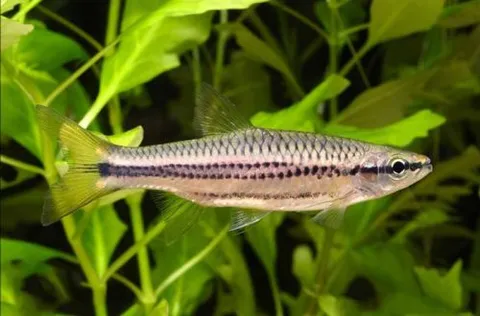
Rasbora cephalotaenia
Rasbora cephalotaenia, known in the aquarium hobby as the Two-striped Rasbora, is a member of the Cyprinidae family.
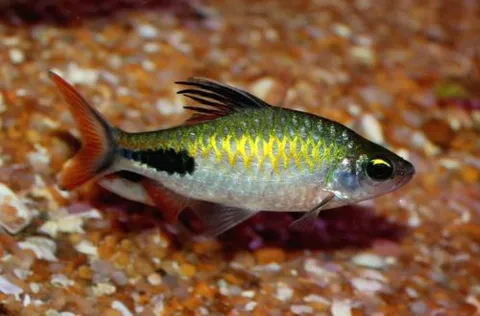
Dawkinsia rohani
The fish known as Rohan's Barb (Dawkinsia rohani by its scientific name) belongs to the family Cyprinidae. Its name is a tribute to two prominent biologist-ichthyologists, Richard Dawkins and Rohan Pethiyagoda. This…
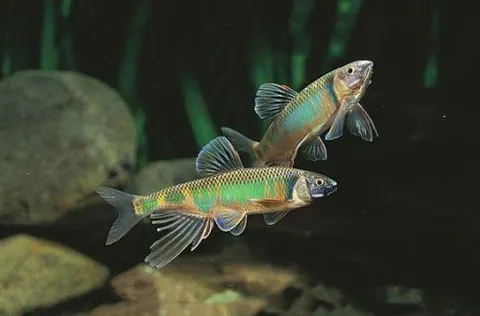
Zacco platypus
The scientific name Zacco platypus refers to the Common Zacco, a member of the family Cyprinidae, well-known as the carps. The habitat of this fish extends across East Asia, found in river systems from the northern…
Esomus thermoicos
Esomus, scientifically known as Esomus thermoicos, belongs to the extensive Carp family (Cyprinidae). It is sometimes called the Bearded Rasbora due to the presence of two long barbels. These fish have an elongated,…