Temperature22 – 25 °C
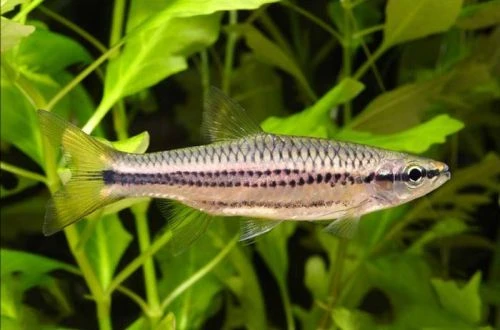
Rasbora cephalotaenia, known in the aquarium hobby as the Two-striped Rasbora, is a member of the Cyprinidae family.
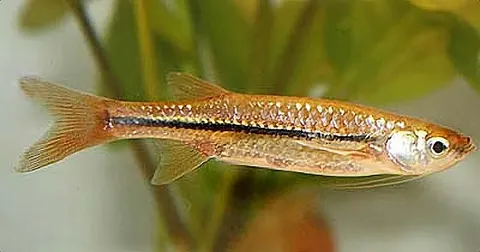
Adult Two-striped Rasboras reach approximately 13 cm in length. Their coloration varies from light gray to silvery. Two dotted lines, consisting of black specks, run along the body, giving this species its characteristic name – "Two-striped." The fins are transparent and short, and the tail appears quite large. Sexual dimorphism in these fish is weakly expressed: obvious external differences between males and females are absent.
This species originates from Southeast Asia, found in the southern regions of Thailand, Peninsular Malaysia, and the Greater Sunda Islands. Its natural habitat includes swampy parts of rivers and peat bogs. A typical biotope is characterized by dark, brownish water, rich in snags, fallen leaves, and various plant organic matter. The water in these areas has extremely low pH and dGH values.
Two-striped Rasboras exhibit schooling behavior, which is their natural characteristic. Therefore, for comfortable keeping, it is recommended to maintain a group of 8 to 10 individuals. These fish are peaceful in nature and get along well with similarly sized tankmates of a similar temperament – for example, with other Rasboras, Barbs, Danios, or some Loaches.
For a group of 8–10 Two-striped Rasboras, the aquarium should have a volume of at least 250 L. It is desirable to provide many shelters created by dense vegetation. The fish will feel most harmonious in an environment close to their natural conditions. For this, it is recommended to use a soft sandy substrate, several natural snags, and live aquatic plants. Lighting should be subdued. To give the water a characteristic brownish tint, special tannin concentrates can be used or pre-dried and soaked leaves of certain trees can be added to the bottom. An important condition for long-term keeping is maintaining a stable hydrochemical composition of the water and preventing excessive accumulation of organic waste. Regular aquarium maintenance includes weekly partial water changes and timely removal of uneaten food residues, excrement, and other contaminants.
Beginner aquarists find dry foods convenient, as there are usually no problems with their selection. Many manufacturers offer specialized products, enriched with all necessary vitamins and trace elements, specifically designed for Rasboras. Supplementing the diet with live foods will be very beneficial.
Spawning of the Two-striped Rasbora occurs according to a scenario typical for most cyprinids. Under suitable conditions, the fish lay their eggs among dense thickets of plants. They do not form a separate clutch; the eggs sink to the bottom or attach among leaves and root systems. The incubation period is 18 to 48 hours, its duration depending on water temperature. Hatched fry begin to swim freely within the next 1–2 days. Parental instincts are absent in these fish, so they may eat both their eggs and offspring. However, with numerous shelters, some of the fry can survive and reach adulthood. If the goal is to preserve all offspring, it is more rational to approach the breeding process more seriously, conducting spawning in a specially prepared separate aquarium.
Rasboras are susceptible to the same diseases as other aquarium inhabitants. As a rule, health problems arise from unsuitable keeping conditions, the presence of aggressive tankmates, or an unbalanced diet. External stress factors weaken immunity, making the fish more vulnerable to infections.
When purchasing, choose active individuals that show interest in their surroundings and conspecifics. It is important to carefully inspect the fish for signs of disease: fin damage, white spots on the body, ulcers, or an unnatural coating on the scales. Healthy fish should have clear eyes and tightly closed gill covers. Avoid purchasing individuals that stay near the water surface, breathe heavily, or exhibit sluggish behavior, lying on the bottom. Since the species is schooling, it is recommended to acquire a group of 8–10 individuals at once to minimize stress during adaptation to new conditions. Before purchasing, it is advisable to ask the seller what the fish were fed in the store to ensure a smooth transition to a familiar diet.
The essentials: size, tank volume, water parameters and care
An adult reaches 13 cm in length. Plan the tank around the maximum size: the fish quickly outgrows a cramped setup.
The recommended volume is 250 L. A smaller tank speeds up nitrate build-up and raises stress levels.
Temperature 22–25 °C, pH 5–7, hardness 1–12 dGH. Stability matters more than exact values: sudden swings are harder on the fish than a small deviation from the ideal.
Around 3 years when kept properly. Lifespan depends directly on tank volume, water quality and a varied diet.
Temperament: peaceful (regular). Keep this in mind when choosing tank mates.
Recommended setup: group (8–10 individuals). Ignoring this is a common cause of stress and disease.
Diet type: any (universal). Feed small portions that are finished within a couple of minutes — overfeeding does more harm than underfeeding.
The scientific name of the species is Rasbora cephalotaenia, family Cyprinids (Cyprinidae). It also appears in the literature as: Leuciscus cephalotaenia.
The water suits 197 of 208 plants in the catalogue — the easiest ones are shown first.
Afzelius's AnubiasAnacharisAnubiasBrazilian PennywortDwarf CloverDwarf CloverDwarf HygrophilaDwarf SagittariaDwarf ValGuppy GrassHornwortJava FernJava MossMoneywortMud SwordNarrow Leaf AnacharisNarrow-leaf CloverStringy MossSüsswassertangTaiwan MossTape GrassTemple PlantUssuri WatermilfoilWater Wisteria
Matched by family, categories and overlapping keeping conditions
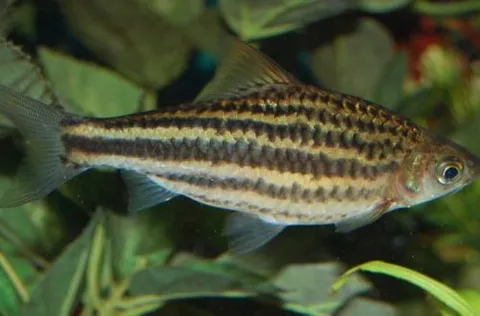
Desmopuntius johorensis
Desmopuntius johorensis, also known as the Five-banded Barb or Striped Barb, belongs to the Cyprinidae family. This fish is attractive due to its unique body pattern. Thanks to its unpretentiousness and peaceful nature,…
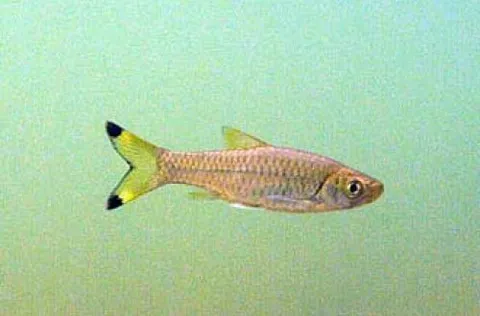
Rasbora rasbora
The Common Rasbora, known scientifically as Rasbora rasbora, belongs to the family Cyprinidae, or carps. As the name suggests, the coloration of this fish is quite modest when compared to its more brightly colored…
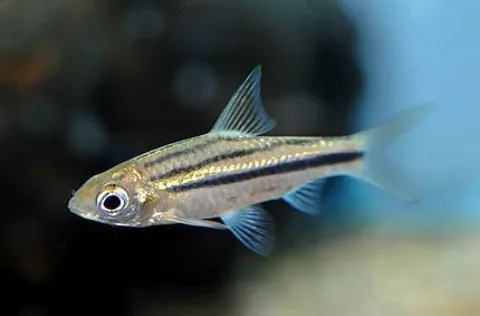
Striuntius lineatus
The Striped Barb, scientifically known as Striuntius lineatus, is a member of the Cyprinidae family. This active and friendly fish exhibits good compatibility with many common aquarium inhabitants. Possessing…
Esomus thermoicos
Esomus, scientifically known as Esomus thermoicos, belongs to the extensive Carp family (Cyprinidae). It is sometimes called the Bearded Rasbora due to the presence of two long barbels. These fish have an elongated,…