Temperature22 – 25 °C
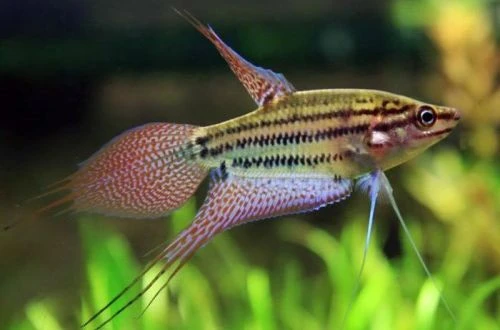
The Croaking Gourami, scientifically known as Trichopsis vittata, belongs to the family Osphronemidae. This fish is an excellent candidate for almost any general freshwater aquarium. It is unpretentious, can withstand various conditions, and is easy to keep. It also has a curious feature – it makes “croaking” sounds during the breeding season.
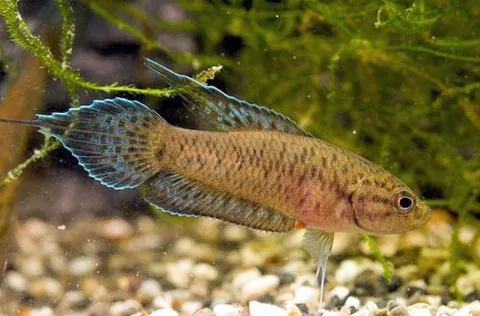
Adult Croaking Gourami reach a length of about 7 cm. Their coloration is mainly gray or slightly brownish, with rows of dark horizontal stripes. Males differ from females by having larger and brighter fins, which have a light purple hue with burgundy speckles.
This species is widespread throughout Southeast Asia, found in countries such as Vietnam, Laos, Cambodia, Thailand, Malaysia, and Indonesia. A wild population has also been introduced in Palm Beach County, Florida, USA. The fish inhabits swampy bodies of water with extensive vegetation, where conditions are sometimes quite extreme, such as stagnant water with very low dissolved oxygen content. It can often be found in areas used for agriculture, such as rice paddies.
This peaceful and gregarious species coexists perfectly with other fish of similar size and temperament. Given its unpretentiousness regarding water conditions, the range of possible tank mates becomes quite extensive.
For keeping one or a pair of fish, the optimal aquarium volume is from 50 liters. The setup should ideally include dense thickets of rooted plants and clusters of floating plants, as well as many shelters—these can be snags or various decorative elements (e.g., sunken ships or castles). Any substrate will do. The aquarium equipment settings should take into account the fish's need for low light levels and the absence of strong internal currents. It is mandatory to have a tightly fitting lid over the tank to create a warm and humid air layer above the water surface, which is vital for the normal breathing of labyrinth fish. The Croaking Gourami is undemanding regarding water chemistry and feels excellent within a wide range of pH and dGH values.
The fish are undemanding about their diet: in a home aquarium, their diet can be based on any high-quality dry food (in flakes or granules) from a reliable manufacturer.
If there are no other fish in the aquarium, spawning can occur directly in the main tank. Otherwise, a separate, smaller aquarium will be needed, where the adult fish will be moved during the breeding period. It has been noted that a gradual reduction of the water level to 10–15 cm and an increase in temperature to 24–25°C stimulate spawning. After some time, the females' bellies become noticeably rounded, and the males begin to build a bubble nest among floating plants. Then the courtship period begins. The male swims near the female, displaying his fanned fins and tail; sometimes his “croaking” sounds can be heard, which also serve to attract potential partners. The Gourami produces these sounds using special structures in its pectoral fins, similar to the behavior of the African veiled Synodontis catfish. This feature is reflected in the species' name — “croaking.” Spawning itself is accompanied by peculiar “embraces,” during which several eggs and a portion of sperm are released each time; the total clutch can reach 200 eggs. Soon after, the female leaves the nest and no longer shows interest in her offspring. The male, on the contrary, behaves quite differently: he stays near the nest, guarding it from other inhabitants. This behavior continues throughout the incubation period (from 24 to 48 hours) and for several more days until the fry begin to swim freely. After this, his care for the offspring ends.
Most diseases are caused by unsuitable keeping conditions and poor-quality food. Upon detecting the first signs of illness, it is necessary to immediately check the water parameters (such as pH and dGH) and ensure the absence of high concentrations of dangerous substances (ammonia, nitrites, nitrates, etc.). The parameters should be brought back to normal only after this before proceeding with treatment.
When purchasing, choose active individuals with clean fins and no visible body damage. Avoid fish with signs of fungal infections, which often occur after transportation stress, as well as individuals with sluggish behavior or sunken bellies. In the store, fish may appear timid, which is a normal reaction to a new environment.
The essentials: size, tank volume, water parameters and care
An adult reaches 7 cm in length. Plan the tank around the maximum size: the fish quickly outgrows a cramped setup.
The recommended volume is 50 L. A smaller tank speeds up nitrate build-up and raises stress levels.
Temperature 22–25 °C, pH 6–8, hardness 5–25 dGH. Stability matters more than exact values: sudden swings are harder on the fish than a small deviation from the ideal.
Around 4 years when kept properly. Lifespan depends directly on tank volume, water quality and a varied diet.
Temperament: peaceful (regular). Keep this in mind when choosing tank mates.
Recommended setup: mixed (solitary / pair / group). Ignoring this is a common cause of stress and disease.
Diet type: any (universal). Feed small portions that are finished within a couple of minutes — overfeeding does more harm than underfeeding.
The scientific name of the species is Trichopsis vittata, family Osphronemidae. It also appears in the literature as: Ctenops vittatus, Osphromenus vittatus, Trichopsis harrisi.
The water suits 196 of 208 plants in the catalogue — the easiest ones are shown first.
Afzelius's AnubiasAnacharisAnubiasBrazilian PennywortDwarf CloverDwarf CloverDwarf HygrophilaDwarf SagittariaDwarf ValGuppy GrassHornwortJava FernJava MossMoneywortMud SwordNarrow Leaf AnacharisNarrow-leaf CloverStringy MossSüsswassertangTaiwan MossTape GrassTemple PlantUssuri WatermilfoilWater Wisteria
Matched by family, categories and overlapping keeping conditions
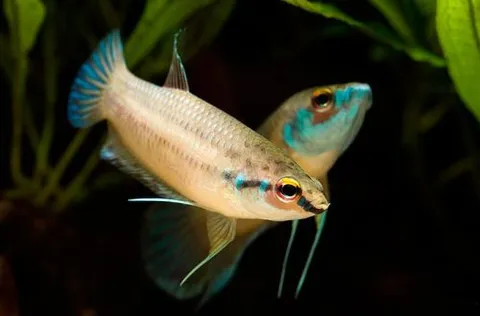
Betta kuehnei
The scientific name Betta kuehnei, or Kuehne's Betta, belongs to the family Osphronemidae. This fish was named in honor of collector Jens Kuehne, whose efforts brought it widespread recognition among aquarists. It is…
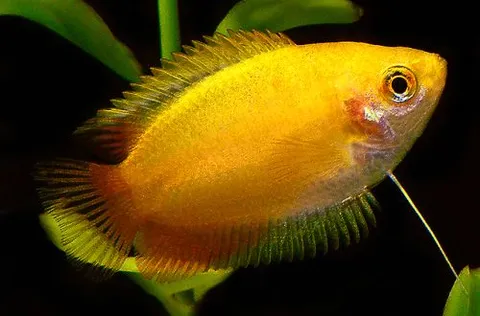
Trichogaster chuna
Trichogaster chuna, more commonly known as the Honey Gourami, is a member of the Osphronemidae family. This small, graceful fish is characterized by its soft coloration, ranging from silvery-gray to delicate yellow.…
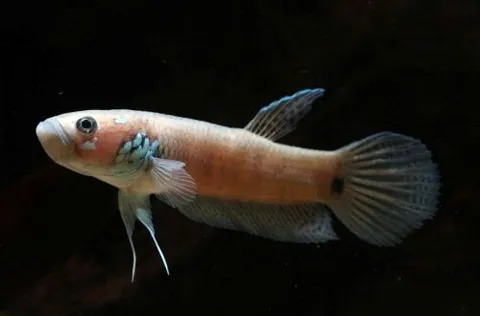
Betta ocellata
Betta ocellata, also known as the Ocellated Betta or Ocellata Betta, belongs to the family Osphronemidae. This fish has not gained widespread popularity among amateur aquarists because, despite its ease of keeping and…
Malpulutta kretseri
Malpulutta kretseri, also known as Kretser's Paradise Fish, bears the scientific name Malpulutta kretseri and belongs to the family Osphronemidae. It was named in honour of the Sri Lankan lawyer De Kretser, who…