Temperature24 – 28 °C
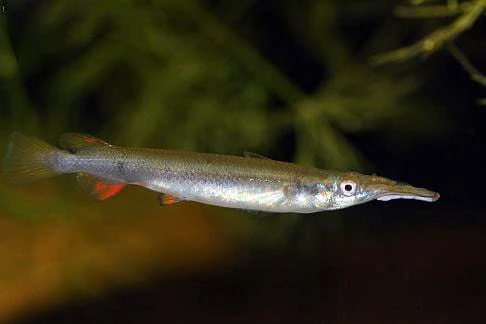
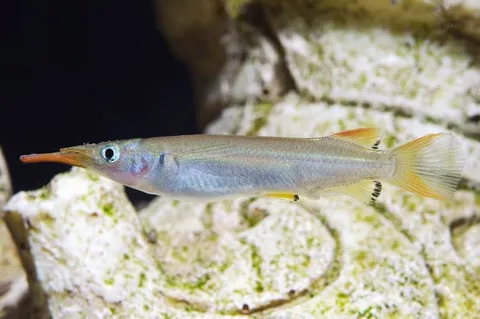
Dermogenys, or the Malayan Halfbeak, is scientifically known as Dermogenys pusilla and belongs to the family Zenarchopteridae. This is a distinctive fish with a remarkable appearance. Despite its lack of bright colors, it has captivated the interest of aquarists.
These fish are characterized by an elongated, streamlined body, with the dorsal and anal fins positioned far back, closer to the caudal fin. Their jaw has a unique beak-like structure: the upper part is shortened, and the lower part is greatly extended forward. This jaw structure is optimal for capturing food from the water surface. The fish's coloration is usually gray-brown, with the fins often having a reddish tint.
This species is widely distributed throughout Southeast Asia, found in the territories of modern-day Thailand, Sumatra, Java, Singapore, and Malaysia. Its natural habitat includes slow-moving waters such as river backwaters, swamps, and ponds rich in aquatic vegetation. It is also found in the brackish waters of coastal mangrove thickets.
Intraspecific competition is observed among males of this species. Therefore, keeping two or more males in a small aquarium is undesirable. These fish are peaceful towards other aquarium inhabitants. They get along well with most freshwater fish of similar or smaller size.
No specific conditions are required for keeping these fish. When setting up the aquarium, it is important to provide both open areas for free swimming and places for shelter. Ideal shelters are created by clusters of floating plants. However, complete overgrowth of the surface should be avoided to prevent hindering the fish's feeding. The decor of the middle and lower parts of the aquarium is not critical. Maintaining ecological balance is ensured by weekly renewal of 10–20% of the water with fresh water, combined with siphoning the substrate to remove organic waste (excrement, food remnants, and plant debris), as well as using an effective filtration system.
In their natural environment, fish feed on small insects, their larvae, and other invertebrates that they collect from the water surface. In a home aquarium, it is recommended to offer live or frozen foods such as flies, mosquito larvae, or bloodworms, as well as dry foods with a high protein content. It is important to remember that Dermogenys do not eat food from the bottom or from the water column, so foods should be floating.
Females of this species do not lay eggs; the development of fry occurs inside the fish's body, and they are born fully formed. This evolutionary feature serves as effective protection for future offspring. Breeding Dermogenys is quite simple and does not require special effort. Often, an aquarist learns about a successful spawning only after discovering fry swimming in the aquarium. Fry can be kept with their parents, but for their protection, reliable shelters must be provided, such as dense thickets of plants like Riccia. Young fish should be fed small fruit flies or specialized food.
Under favorable living conditions, cases of disease are infrequent. The risk of diseases increases in unkempt aquariums with poor water quality, insufficient or incorrect feeding, and contact with sick individuals.
When choosing a Dermogenys, it is important to carefully examine the fish's lower jaw: it should be straight, without bends, damage, or signs of injury, as any defects in the jaw apparatus are critical for the feeding of this species. A healthy specimen actively stays in the upper water layers, shows curiosity, and has no visible ulcers, spots, or scale damage. Avoid purchasing fish that appear emaciated, stay at the bottom, or show signs of timidity accompanied by sharp, chaotic movements, which may indicate stress or hidden diseases.
The essentials: size, tank volume, water parameters and care
An adult reaches 6–7 cm in length. Plan the tank around the maximum size: the fish quickly outgrows a cramped setup.
The recommended volume is 71 L. A smaller tank speeds up nitrate build-up and raises stress levels.
Temperature 24–28 °C, pH 7–8, hardness 10–20 dGH. Stability matters more than exact values: sudden swings are harder on the fish than a small deviation from the ideal.
Around 4 years when kept properly. Lifespan depends directly on tank volume, water quality and a varied diet.
Temperament: semi-peaceful (including aggression during spawning / intraspecific conflicts). Keep this in mind when choosing tank mates.
Recommended setup: small group (3–4 individuals). Ignoring this is a common cause of stress and disease.
Diet type: any (universal). Feed small portions that are finished within a couple of minutes — overfeeding does more harm than underfeeding.
The scientific name of the species is Dermogenys pusilla, family Halfbeaks (Zenarchopteridae).
The water suits 113 of 208 plants in the catalogue — the easiest ones are shown first.
African Onion PlantAfzelius's AnubiasAmazon FrogbitAmazon SwordAnacharisAnubiasArrowhead CryptDwarf CloverDwarf CloverDwarf HygrophilaDwarf SagittariaDwarf ValGuppy GrassHornwortJava MossMoneywortMud SwordNair's LagenandraNarrow Leaf AnacharisNarrow-leaf CloverStringy MossTaiwan MossTape GrassUssuri Watermilfoil
Matched by family, categories and overlapping keeping conditions
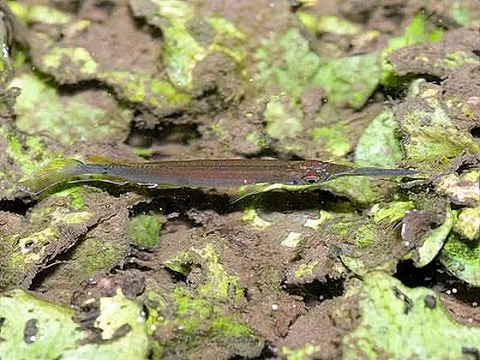
Hemirhamphodon pogonognathus
The Hemirhamphodon pogonognathus, known in the scientific world as Hemirhamphodon pogonognathus, is a representative of the family Zenarchopteridae (Halfbeaks). This fish, also called the Forest Halfbeak, attracts…
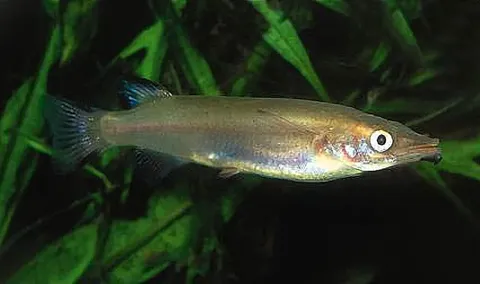
Nomorhamphus brembachi
Nomorhamphus brembachi, or Brembach's Halfbeak, belongs to the family Zenarchopteridae. This fish is not often found in hobbyists' aquariums, which is due to its modest coloration. Sometimes it appears for sale along…
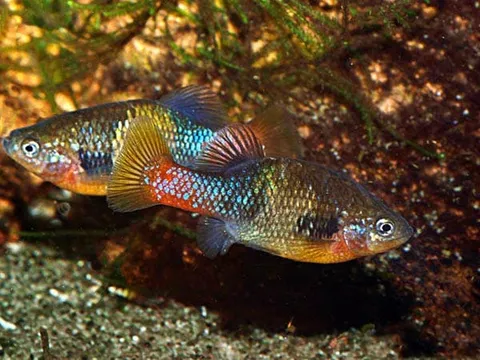
Xenotoca eiseni
Xenotoca eiseni, known as the Redtail or Orange Xenotoca, belongs to the family Goodeidae. This livebearing fish attracts attention with its bright colors and hardiness. It could be a wonderful addition to a freshwater…
Nomorhamphus ravnaki
Ravnaki's Halfbeak, scientifically known as Nomorhamphus ravnaki, belongs to the family Zenarchopteridae. This species is often compared to guppies, noted for its unpretentiousness and high endurance. It does not…