Temperature20 – 26 °C
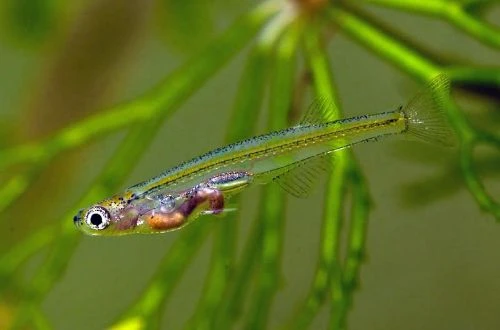
The Dracula Danio, or Danionella dracula according to scientific classification, belongs to the carp family (Cyprinidae). It's interesting to consider what might have led to such a formidable name for this miniature and seemingly harmless fish. The answer lies in the unique structure of the males' jaws. They possess tooth-like protrusions on both the upper and lower jaws. Among the lower rows of these "teeth," a pair of elongated "fangs" stands out, extending only 0.3 mm beyond the mouth, making them difficult to discern with the naked eye. It is precisely this unique jaw morphology, with these two fangs, that inspired biologists to name the species after the famous Count Dracula from Bram Stoker's novel. It's important to note that such "teeth" are characteristic only of males of this species and are not found in other members of the carp family.
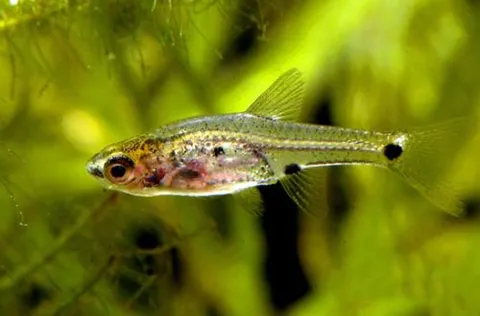
Adults reach a length of about 1.7 cm. Their translucent bodies allow observation of the spine and the arrangement of internal organs. During spawning, the large eggs are quite distinctly visible within the females' abdominal cavity.
The origin of this fish is linked to Southeast Asia, specifically the northern part of Myanmar (Burma). It is believed that this species is endemic to a limited range in the area of the Mohnyin River basin, which is a right tributary of the Chindwin River. Although precise details of its natural habitat are scarce, by analogy with other species inhabiting this region, it can be assumed that the Dracula Danio prefers small streams and rivers with slow currents, sheltered under the canopy of tropical forests.
These fish are distinguished by their peaceful and calm disposition. They prefer to live in shoals, which should consist of at least 200 individuals. Given their miniature size, the optimal option is to keep Dracula Danios in a species-only tank or with other similarly small fish species.
For keeping these fish, a minimum tank volume starts from 40 liters. In terms of aquarium decor, it is recommended to use an abundance of aquatic plants, including floating species, which should cover approximately half of the water surface. Any soft material will suffice as substrate; adding a few snags and large stones will also be appropriate. Lighting should be subdued. Dracula Danio is extremely sensitive to water movement; a strong current can easily carry away such small fish. If the number of aquarium inhabitants is small (e.g., about a dozen), a simple air-driven sponge filter will be quite sufficient as a filtering material. Such a filter provides gentle filtration and additionally saturates the water with oxygen, which is especially important in the presence of dense plant thickets. At night, when the light is off, the photosynthesis process in plants stops, and they begin to consume oxygen, which without aeration can lead to fish suffocation. An air-driven filter helps reduce the risk of such a situation. Aquarium maintenance boils down to standard procedures: weekly partial water changes, regular removal of organic waste (excrement, food remnants), prophylactic inspection of equipment, and maintaining stable pH and dGH levels.
Despite their tiny size, selecting suitable food for Dracula Danios is not particularly difficult; the main condition is that the particle size must be appropriate. These fish readily accept most common types of food: dry flakes, granules, as well as freeze-dried, live, and frozen varieties of daphnia and brine shrimp.
As of the publication of this material, there is no recorded information about successful breeding of Dracula Danios in artificial environments.
In a balanced aquarium ecosystem that meets the needs of this species, diseases are rare. Most often, ailments are provoked by deteriorating environmental conditions, contact with already sick fish, or mechanical damage. If the fish shows clear signs of illness, medicinal treatment should be applied.
When choosing Dracula Danios, it's important to consider their miniature size and delicate build. In the store, pay attention to the following criteria: — Fish activity: healthy individuals should swim in a school and show mobility, not hover motionless in a corner of the aquarium. — Absence of external damage: due to their transparent bodies, any spots, growths, or signs of emaciation are easily noticeable. — Keeping conditions: the fish should be in clean water with moderate current, as they are sensitive to water quality. Since this is a schooling species, it is recommended to purchase a group of 10–12 individuals to reduce stress during adaptation. Avoid buying fish if aggressive or significantly larger tankmates are present in the general aquarium, as they could injure or frighten this miniature species.
The essentials: size, tank volume, water parameters and care
An adult reaches 1.5–1.7 cm in length. Plan the tank around the maximum size: the fish quickly outgrows a cramped setup.
The recommended volume is 40 L. A smaller tank speeds up nitrate build-up and raises stress levels.
Temperature 20–26 °C, pH 6.5–7.5, hardness 2–5 dGH. Stability matters more than exact values: sudden swings are harder on the fish than a small deviation from the ideal.
Around 1 years when kept properly. Lifespan depends directly on tank volume, water quality and a varied diet.
Temperament: peaceful (regular). Keep this in mind when choosing tank mates.
Recommended setup: large group (10+ individuals). Ignoring this is a common cause of stress and disease.
Diet type: small / appropriate size / pieces. Feed small portions that are finished within a couple of minutes — overfeeding does more harm than underfeeding.
The scientific name of the species is Danionella dracula, family Cyprinids (Cyprinidae).
The water suits 196 of 208 plants in the catalogue — the easiest ones are shown first.
Afzelius's AnubiasAnacharisAnubiasBrazilian PennywortDwarf CloverDwarf CloverDwarf HygrophilaDwarf SagittariaDwarf ValGuppy GrassHornwortJava FernJava MossMoneywortMud SwordNair's LagenandraNarrow Leaf AnacharisNarrow-leaf CloverStringy MossSüsswassertangTaiwan MossTape GrassTemple PlantUssuri Watermilfoil
Matched by family, categories and overlapping keeping conditions
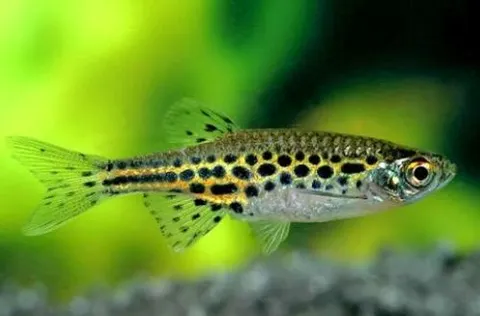
Danio tinwini
Danio tinwini, also known as the Gold-ring Danio or Burmese Spotted Danio, bears the scientific name Danio tinwini and belongs to the family Cyprinidae. It received one of its names in honor of U Tin Win, a prominent…
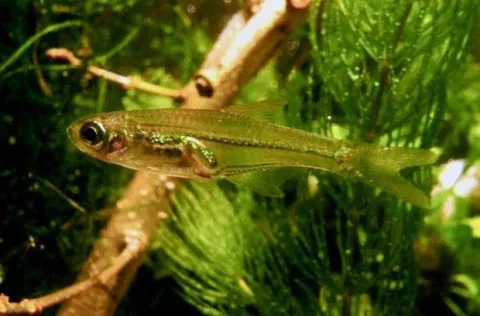
Microdevario gatesi
A member of the Cyprinidae family, Gates' Danio, scientifically named Microdevario gatesi, was named in honor of Gordon E. Gates, the person responsible for its discovery. Prior to 2009, this fish was traditionally…
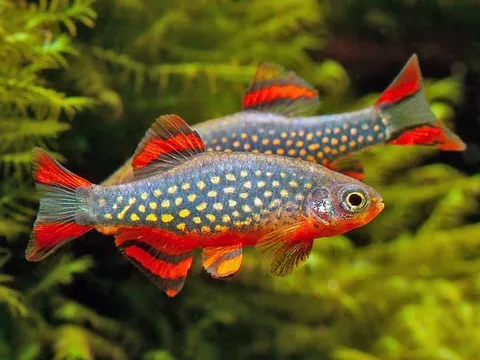
Danio margaritatus
The Celestial Pearl Danio, or Galaxy Rasbora (scientific name — Danio margaritatus), belongs to the family Cyprinidae. Sometimes, the Russian transliteration of the Latin name, Danio margaritatus, is used to refer to…
Boraras micros
Boraras micros, also known as the Dwarf Rasbora, belongs to the family Cyprinidae. Despite its rather modest coloration, which makes this species not the most sought-after among aquarists, these fish are quite capable…