Temperature20 – 27 °C
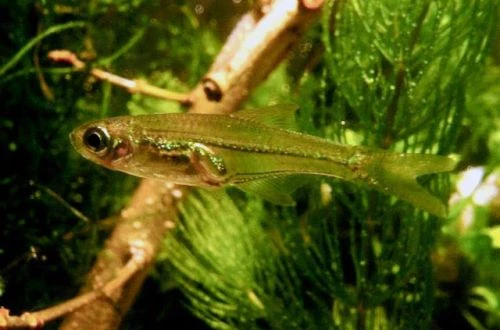
A member of the Cyprinidae family, Gates' Danio, scientifically named Microdevario gatesi, was named in honor of Gordon E. Gates, the person responsible for its discovery. Prior to 2009, this fish was traditionally classified as a Rasbora and was known as the Burmese Golden Rasbora; this name is sometimes still used today. It is well-suited for keeping and breeding, is easy to care for, and coexists wonderfully with other small species of aquarium fish.
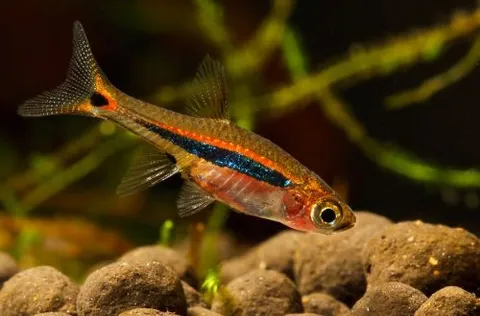
Adults grow to approximately 2 centimeters in length. The body of this fish is semi-transparent, allowing the silhouettes of its spine and internal organs to be clearly seen. Its coloration can vary from ash-gray to silvery, depending on how the light falls. Sexual dimorphism in the species is insignificant, making it quite difficult to distinguish males from females.
The natural habitat of this fish extends across Southeast Asia, in the southern part of Myanmar (Burma). It is likely endemic to the extensive Irrawaddy River delta, where it flows into the Andaman Sea. A characteristic feature of the Irrawaddy Delta is its flat landscape, with an elevation difference not exceeding 15 meters above sea level. This marshy lowland is dotted with numerous small channels, densely overgrown with aquatic vegetation. The water in these areas is often turbid due to the abundance of suspended silt and may have slight brackishness.
These fish are peaceful inhabitants, preferring to stay in schools of 8–10 individuals. They get along well with other freshwater species of similar size and temperament.
For keeping Gates' Danio, a relatively small aquarium, from 40 liters, but with abundant aquatic vegetation, will be suitable. The rest of the decor can be chosen at your discretion. Dimmed lighting is preferable. The presence of a large number of live plants requires an efficient aeration system. During the day, in the process of photosynthesis, plants produce oxygen and absorb carbon dioxide, but at night the situation changes: they begin to absorb oxygen, which can pose a threat of suffocation for fish. To avoid this, the aerator should be turned on at night. Aquarium maintenance includes standard procedures, the frequency and volume of which depend on the equipment and the number of inhabitants. The minimum required is a weekly partial water change with fresh water, removal of organic waste (such as uneaten food and excrement), and equipment maintenance.
In a home aquarium, these fish readily accept common foods: flakes and granules of appropriate size, as well as frozen or live daphnia, brine shrimp, and small pieces of bloodworms. It is recommended to supplement their diet with plant-based additives, such as spirulina flakes.
To date, there is no confirmed data on the successful breeding of Gates' Danio in artificial conditions. However, based on its kinship with Microdevario kubotai, a similar breeding mechanism can be assumed. Under favorable conditions in a home aquarium, spawning occurs regularly. The fish scatter their eggs among plants, showing no parental care. Approximately 72 hours later, fry emerge from the eggs left to themselves. After another 3–4 days, they begin to swim actively. It is important to note that the survival rate of the fry will be extremely low if they are not promptly transferred to a separate tank, as they may become prey for adult fish and face difficulties in finding adequate food.
In a balanced aquarium ecosystem, where all species-specific conditions are met, diseases rarely occur. Most often, diseases are provoked by deteriorating environmental parameters, contact with already sick fish, or physical injuries. If, despite all measures, the fish shows clear signs of illness, appropriate medicinal treatment will be required.
When choosing individuals, attention should be paid to their activity and the purity of their coloration. Healthy fish should swim in a school, show no signs of apathy or emaciation, and have no visible damage, sores, or white film on their scales. Avoid purchasing fish that stay at the water surface, breathe heavily, or have an unnaturally bloated abdomen, as this may indicate health problems or improper keeping conditions in the store. Since this species is schooling, it is recommended to acquire a group of 6–10 individuals at once to reduce stress during adaptation to a new aquarium.
The essentials: size, tank volume, water parameters and care
An adult reaches 2 cm in length. Plan the tank around the maximum size: the fish quickly outgrows a cramped setup.
The recommended volume is 40 L. A smaller tank speeds up nitrate build-up and raises stress levels.
Temperature 20–27 °C, pH 6–7.5, hardness 1–12 dGH. Stability matters more than exact values: sudden swings are harder on the fish than a small deviation from the ideal.
Around 3 years when kept properly. Lifespan depends directly on tank volume, water quality and a varied diet.
Temperament: peaceful (regular). Keep this in mind when choosing tank mates.
Recommended setup: group (8–10 individuals). Ignoring this is a common cause of stress and disease.
Diet type: small / appropriate size / pieces. Feed small portions that are finished within a couple of minutes — overfeeding does more harm than underfeeding.
The scientific name of the species is Microdevario gatesi, family Cyprinids (Cyprinidae). It also appears in the literature as: Microrasbora gatesi.
The water suits 197 of 208 plants in the catalogue — the easiest ones are shown first.
Afzelius's AnubiasAnacharisAnubiasBrazilian PennywortDwarf CloverDwarf CloverDwarf HygrophilaDwarf SagittariaDwarf ValGuppy GrassHornwortJava FernJava MossMoneywortMud SwordNair's LagenandraNarrow Leaf AnacharisNarrow-leaf CloverStringy MossSüsswassertangTaiwan MossTape GrassTemple PlantUssuri Watermilfoil
Matched by family, categories and overlapping keeping conditions
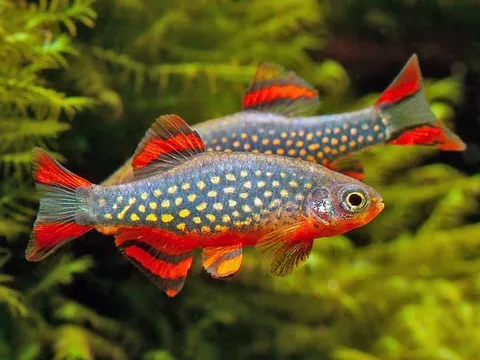
Danio margaritatus
The Celestial Pearl Danio, or Galaxy Rasbora (scientific name — Danio margaritatus), belongs to the family Cyprinidae. Sometimes, the Russian transliteration of the Latin name, Danio margaritatus, is used to refer to…
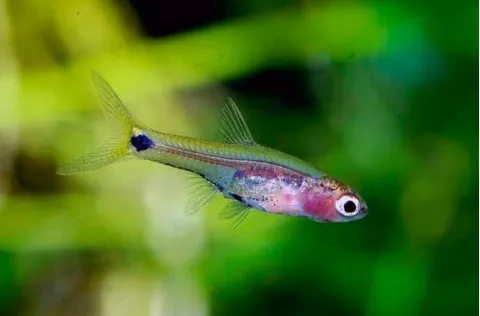
Barboides gracilis
A member of the Cyprinidae family, known as Barboides gracilis or the gracile barb, stands out for its modest size. Thanks to this quality, this fish is perfectly suited for keeping in nano-aquariums. With optimal…
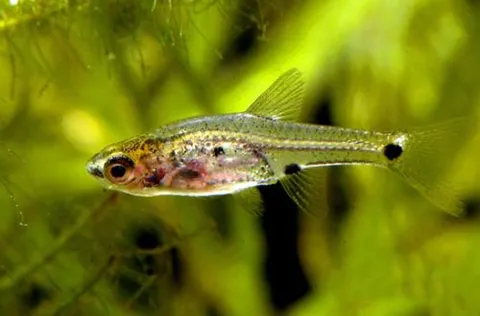
Boraras micros
Boraras micros, also known as the Dwarf Rasbora, belongs to the family Cyprinidae. Despite its rather modest coloration, which makes this species not the most sought-after among aquarists, these fish are quite capable…
Boraras urophthalmoides
Boraras urophthalmoides, known as the Firefly Rasbora, belongs to the family Cyprinidae. This fish is characterized by its miniature size, bright and vibrant coloration, and high activity. Its keeping and breeding do…