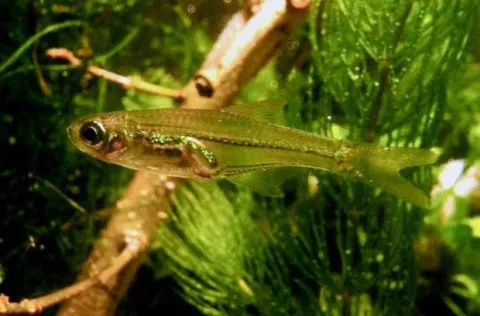
Gates' Danio
Microdevario gatesi
A member of the Cyprinidae family, Gates' Danio, scientifically named Microdevario gatesi, was named in honor of Gordon E. Gates, the person responsible for its discovery. Prior to 2009, this fish was traditionally…
Microdevario kubotai belongs to the family Cyprinidae. The species is named after the Thai biologist Katsuma Kubota. In the hobby it is also called the green neon rasbora or Kubota's rasbora. Despite these names, this fish belongs to the danio group. The classification was revised in 2009 following DNA studies. Microdevario kubotai is popular among aquarists and known for being undemanding, easy to keep and breed. It shows high compatibility with other species of similar size.
Adults reach about 2 cm in length. They are silvery with a noticeable greenish sheen. The fins are semi-transparent. Sexual dimorphism is weak; males and females have no obvious external differences.
The species is native to Southeast Asia, specifically the southern regions of Myanmar and Thailand. The largest populations live in the lower Salween River (also called Thanlwin) and in other large rivers such as the Ataran. In nature, these fish inhabit quiet sections of rivers and streams where the flow is moderate. Their habitat has clear water, sandy and gravelly substrates, fallen leaves, driftwood and dense vegetation along the banks.
These are peaceful, schooling fish that do well with non-aggressive species of comparable size. They prefer to school in groups of 8–10 or more. When choosing tank mates, avoid any large fish; even the most peaceful herbivores may accidentally swallow such a small fish.
A small school of 8–10 fish needs a tank of at least 54 litres. The setup should include dark substrate and various pieces of driftwood decorated with aquatic mosses and ferns. Plant densely along the sides, leaving the centre open for swimming. Stable water conditions with correct water chemistry are essential. The tank needs regular maintenance. Although the number of tasks may vary, weekly water changes of 30–50%, removal of organic waste (uneaten food and droppings), and monitoring of Water pH and Water dH are mandatory. An efficient filtration system is also important.
These fish readily accept most popular aquarium foods of appropriate size. A daily diet can consist of dry flakes or pellets, supplemented with live or frozen brine shrimp, daphnia, or finely chopped bloodworm.
Breeding in aquariums is straightforward. During spawning, the fish scatter many eggs among plants. Incubation takes about 72 hours; fry become free-swimming 3–4 days later. The parents do not guard the eggs or fry and may eat them. In a single tank with adults, very few fry will survive. To preserve the fry, use a separate tank for the eggs immediately after spawning to keep them safe. Not all eggs will be fertilized, but with many eggs laid, several dozen fry are likely. They are tiny and need microscopic food. For the first week, use infusoria or specialist liquid or powdered fry food if possible. As the fry grow, offer larger foods such as brine shrimp nauplii or finely crushed flakes and pellets. The fry tank needs a simple airlift filter and a heater; separate lighting is not necessary. Usually no decoration is used to make maintenance easier.
In a well-balanced tank that meets this species' needs, disease is rare. Illness is usually triggered by poor conditions, contact with sick fish, or injury. If a fish shows signs of disease, medication is needed.
When choosing Microdevario kubotai, watch for an active school: healthy fish should be mobile and constantly moving through the water. Avoid specimens showing signs of emaciation, sunken bellies, or damaged scales. Check the fins for clarity — they should be free of film, white spots and signs of rot, indicating good health. Since this is a schooling species, buy at least 8–10 fish at once; in isolation or in too small a group they become stressed, shy and pale. Ask in the shop when the batch arrived: recently imported fish are often weakened and need careful acclimatization to new water conditions.
There are no pair reviews for this species yet — check tankmates in the matcher.
All tankmatesThe water suits 197 of 208 plants in the catalogue — the easiest ones are shown first.
Afzelius's AnubiasAnacharisAnubiasBrazilian PennywortDwarf CloverDwarf CloverDwarf HygrophilaDwarf SagittariaDwarf ValGuppy GrassHornwortJava FernJava MossMoneywortMud SwordNair's LagenandraNarrow Leaf AnacharisNarrow-leaf CloverStringy MossSüsswassertangTaiwan MossTape GrassTemple PlantUssuri Watermilfoil
Matching water does not mean the plant will stay intact.
The essentials: size, tank volume, water parameters and care
An adult reaches 2 cm in length. Plan the tank around the maximum size: the fish quickly outgrows a cramped setup.
The recommended volume is 54 L. A smaller tank speeds up nitrate build-up and raises stress levels.
Temperature 20–27 °C, pH 6–7.5, hardness 1–10 dGH. Stability matters more than exact values: sudden swings are harder on the fish than a small deviation from the ideal.
Around 3 years when kept properly. Lifespan depends directly on tank volume, water quality and a varied diet.
Temperament: peaceful (regular). Keep this in mind when choosing tank mates.
Recommended setup: group (8–10 individuals). Ignoring this is a common cause of stress and disease.
Diet type: small / appropriate size / pieces. Feed small portions that are finished within a couple of minutes — overfeeding does more harm than underfeeding.
The scientific name of the species is Microdevario kubotai, family Cyprinids (Cyprinidae). It also appears in the literature as: Microrasbora kubotai.
Matched by family, categories and overlapping keeping conditions
Microdevario gatesi
A member of the Cyprinidae family, Gates' Danio, scientifically named Microdevario gatesi, was named in honor of Gordon E. Gates, the person responsible for its discovery. Prior to 2009, this fish was traditionally…
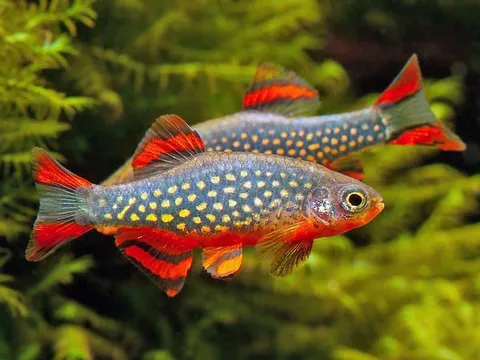
Danio margaritatus
The Celestial Pearl Danio, or Galaxy Rasbora (scientific name — Danio margaritatus), belongs to the family Cyprinidae. Sometimes, the Russian transliteration of the Latin name, Danio margaritatus, is used to refer to…
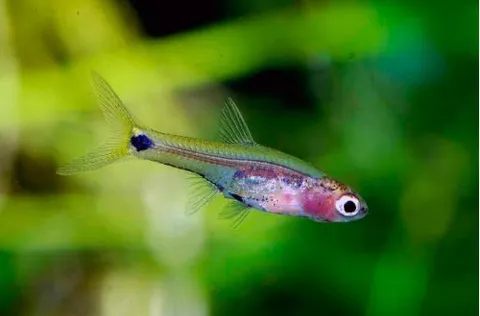
Barboides gracilis
A member of the Cyprinidae family, known as Barboides gracilis or the gracile barb, stands out for its modest size. Thanks to this quality, this fish is perfectly suited for keeping in nano-aquariums. With optimal…
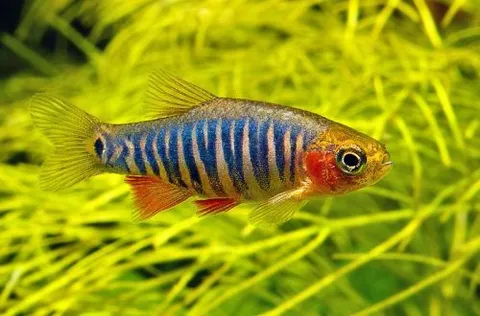
Danio erythromicron
The Emerald Danio, known to the scientific community as Danio erythromicron, belongs to the family Cyprinidae. Previously, it was mistakenly called the Emerald Microrasbora or Microrasbora erythromicron. However,…