Temperature21 – 26 °C
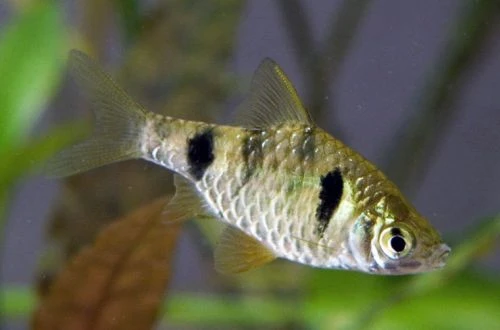
The Phutunio Barb, also known as the Dwarf Barb (scientific name Pethia phutunio), belongs to the carp family (Cyprinidae). This miniature fish is easy to keep and breed, making it an excellent choice for beginner aquarists. It also coexists successfully with other species of similar size.
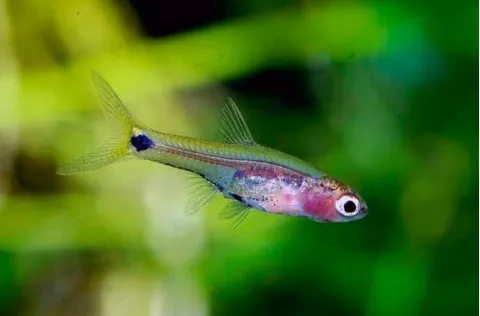
Adults grow to a length of only 3 cm. Their coloration has a silvery hue with a noticeable yellow tint on the back. Two black dashes run along the body, alternately located near the head and tail. Males and females are practically indistinguishable from each other, as sexual dimorphism is extremely weak.
The natural habitat of this fish covers the eastern regions of India and Bangladesh, where it is found in the lower reaches of the Ganges and Brahmaputra rivers. Here it can be found in extensive swampy areas abundant with aquatic vegetation. In such bodies of water as swamps, backwaters, and lakes, the current is usually weak, and the bottom is covered with silt, mud, and fallen trees and branches.
This is a peaceful schooling fish, but due to the modest size of the Dwarf Barb, the choice of tank mates should be approached very carefully. Large and especially aggressive species are categorically excluded. It is recommended to keep these fish in groups of 8–10 individuals.
For a small group of these fish, an aquarium of 50 liters or more will be optimal. Although the decor can be arbitrary, the fish looks especially harmonious in an environment imitating its natural biotope — with dark, soft substrate and an abundance of aquatic plants, including floating ones. Lighting should be subdued. To give the water a characteristic brown tint and create a more natural atmosphere, you can add dried leaves, which will slowly decompose. Standard care includes weekly partial water changes, regular cleaning of organic waste, equipment checks, and monitoring of water parameters such as pH, dGH, and oxidizability. Since the fish do not tolerate strong currents well, when choosing a filter, it is worth opting for models that do not create excessive water movement.
This species is omnivorous and in a home aquarium readily accepts most common foods of appropriate size. To maintain a complete diet, it is recommended to offer live or frozen foods, such as bloodworms or brine shrimp, at least once a week.
Breeding these barbs has much in common with other species. During the spawning period, the female evenly distributes eggs throughout the water column, after which the male fertilizes them. Once on the bottom, the eggs are left without parental care. Fry hatch in approximately 2 days, and after another 3–4 days, they are already freely moving in the water. This species completely lacks parental instincts, which means that adults will not miss the opportunity to feast on their own offspring. For this reason, it is highly unlikely that fry will survive in a community tank. To preserve the offspring, it is recommended to carefully transfer both the eggs and newly hatched fry to a separate container, ensuring water parameters identical to the main aquarium. For such an improvised breeding tank, it will be sufficient to install a simple air-driven sponge filter and a heater. Special lighting is not necessary. In the first days, feeding should consist of the smallest foods, such as infusoria; as they grow, the diet can be diversified with brine shrimp nauplii or special powdered foods developed for aquarium fish fry.
In a balanced aquarium ecosystem, closely matching the requirements of this species, diseases are extremely rare. Illnesses often arise due to deteriorating habitat quality, contact with already sick fish, or physical injuries.
When choosing dwarf barbs, attention should be paid to the overall activity of the school in the aquarium: healthy fish are constantly in motion, demonstrate natural schooling behavior, and show interest in food. Avoid individuals with signs of emaciation, scale damage, film, or an unnaturally bloated abdomen. Since the species tends to be timid, the fish may appear pale in the store, but their coloration should quickly recover in calm conditions. It is recommended to purchase a group of 8–10 individuals to reduce stress during transport and adaptation.
The essentials: size, tank volume, water parameters and care
An adult reaches 2.5–3 cm in length. Plan the tank around the maximum size: the fish quickly outgrows a cramped setup.
The recommended volume is 50 L. A smaller tank speeds up nitrate build-up and raises stress levels.
Temperature 21–26 °C, pH 6–7, hardness 3–12 dGH. Stability matters more than exact values: sudden swings are harder on the fish than a small deviation from the ideal.
Around 4 years when kept properly. Lifespan depends directly on tank volume, water quality and a varied diet.
Temperament: peaceful (regular). Keep this in mind when choosing tank mates.
Recommended setup: group (8–10 individuals). Ignoring this is a common cause of stress and disease.
Diet type: small / appropriate size / pieces. Feed small portions that are finished within a couple of minutes — overfeeding does more harm than underfeeding.
The scientific name of the species is Pethia phutunio, family Cyprinids (Cyprinidae). It also appears in the literature as: Barbus phutunio, Cyprinus phutunio, Puntius phutunio.
The water suits 197 of 208 plants in the catalogue — the easiest ones are shown first.
Afzelius's AnubiasAnacharisAnubiasBrazilian PennywortDwarf CloverDwarf CloverDwarf HygrophilaDwarf SagittariaDwarf ValGuppy GrassHornwortJava FernJava MossMoneywortMud SwordNair's LagenandraNarrow Leaf AnacharisNarrow-leaf CloverStringy MossSüsswassertangTaiwan MossTape GrassTemple PlantUssuri Watermilfoil
Matched by family, categories and overlapping keeping conditions
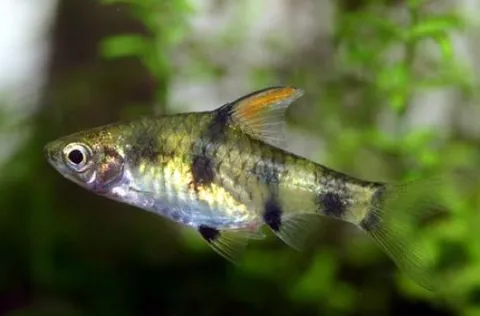
Pethia canius
Pethia canius, scientifically known as Pethia canius, belongs to the family Cyprinidae. The genus name Pethia is the Sinhalese collective name for small cyprinids, while the specific name “canius” appears to follow a…
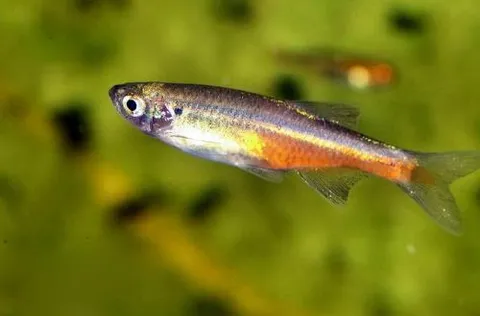
Devario sondhii
The fish, known scientifically as Devario sondhii, belongs to the Cyprinidae family and is commonly called Devario sondhii. These aquarium inhabitants became available to hobbyists in the early 2000s. Initially, there…
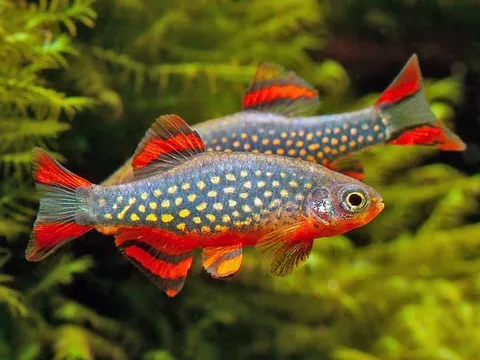
Danio margaritatus
The Celestial Pearl Danio, or Galaxy Rasbora (scientific name — Danio margaritatus), belongs to the family Cyprinidae. Sometimes, the Russian transliteration of the Latin name, Danio margaritatus, is used to refer to…
Barboides gracilis
A member of the Cyprinidae family, known as Barboides gracilis or the gracile barb, stands out for its modest size. Thanks to this quality, this fish is perfectly suited for keeping in nano-aquariums. With optimal…