Temperature18 – 24 °C
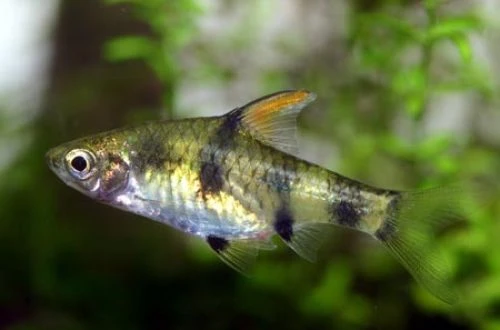
Pethia canius, scientifically known as Pethia canius, belongs to the family Cyprinidae. The genus name Pethia is the Sinhalese collective name for small cyprinids, while the specific name “canius” appears to follow a local vernacular name for the fish. This species was officially recognized as distinct only in 2013; prior to that, it was considered a variety of the Sunset Barb. The fish is easy to keep and breed, and it is highly compatible with other peaceful species of similar size, making it suitable even for beginner aquarists.
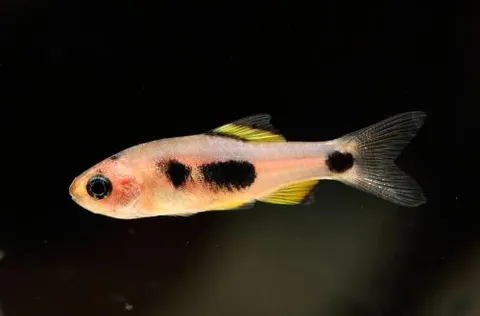
Adults of this species reach approximately 3 cm in length. Their bodies are golden with a silvery belly, adorned with large black dashes across the entire surface. Pethia canius closely resembles its close relative, the Sunset Barb; their main difference lies in the dorsal fin – in Pethia canius, the first rays of this part of the body have a reddish tint, and the fin itself is yellow. Sexual dimorphism is insignificant, making it difficult to determine the sex of individual fish in a school.
The natural habitat of this species extends across the Indian subcontinent, covering territories of historical Bengal, now divided between India and Bangladesh, as well as upstream of the Ganges River. It prefers shallow bodies of water with slow currents, backwaters, and tributaries where aquatic vegetation grows abundantly.
As a peaceful schooling fish, Pethia canius thrives best in groups of 10 or more individuals. This species is well-suited for cohabitation with other miniature aquarium inhabitants. However, cohabitation with larger fish, especially catfish, should be avoided, as they might accidentally mistake Pethia canius for prey.
For the comfortable existence of a small group of these fish, an aquarium of at least 60 liters is recommended. The aquarium setup should include abundant aquatic vegetation, including floating plants, as well as various snags and decorative elements that create hiding spots. Lighting should be subdued. Successful keeping of Pethia canius is possible with stable water parameters, appropriate hydrochemical values (pH and dGH), and regular removal of organic waste. An effective filtration system plays an important role, especially in densely populated aquariums. When choosing a filter, it is advisable to opt for models that do not create excessive current, as these fish are not well-adapted to strong water flows.
In their natural habitat, the diet of Pethia canius consists of small zooplankton. Therefore, in a home aquarium, it is highly desirable to include live or frozen daphnia, brine shrimp, and bloodworms in their diet. Nevertheless, common dry foods such as flakes or granules can also form the basis of the Pethia canius diet.
The breeding process for these fish is similar to that of other barb species. During spawning, females scatter eggs throughout the water column, and males fertilize them simultaneously. These fish lack parental instincts; moreover, adult fish will readily consume their own eggs if given the opportunity. The incubation period lasts from 24 to 36 hours, after which fry begin to swim freely within another 3–4 days. It should be noted that the survival rate of fry in a community tank will be extremely low. Those fry that manage to avoid being eaten will face difficulties in finding suitable food. If the goal is to save the entire brood, either the eggs or the hatched fry must be moved to a separate tank with identical water conditions. This breeding tank can be equipped with a simple sponge filter (airlift filter) and a heater. A separate constant light source is not required. Fry should be fed specialized micro-foods, such as Artemia nauplii, and similar options.
In a balanced aquarium ecosystem, closely matching the requirements of this species, diseases are extremely rare. Illnesses often arise due to deteriorating habitat quality, contact with already sick fish, or physical injuries.
When selecting individuals, attention should be paid to the overall activity of the school: healthy fish should be active, show curiosity, and not constantly hide in the corners of the aquarium. Avoid specimens with visible fin damage, film on scales, abnormally bloated or, conversely, sunken bellies, as these may indicate infections or parasites. Given the shy nature of the species, it is important to assess the conditions in the store: in overcrowded or poorly maintained aquariums, fish often experience stress, which negatively affects their immunity. Refuse to buy if individuals with signs of disease are present in the same tank as the barbs, or if high mortality is observed in the aquarium. When purchasing these fish, prefer a group of 8–10 individuals to ensure comfortable social adaptation in their new aquarium.
The essentials: size, tank volume, water parameters and care
An adult reaches 2.5–3 cm in length. Plan the tank around the maximum size: the fish quickly outgrows a cramped setup.
The recommended volume is 60 L. A smaller tank speeds up nitrate build-up and raises stress levels.
Temperature 18–24 °C, pH 6–7, hardness 1–10 dGH. Stability matters more than exact values: sudden swings are harder on the fish than a small deviation from the ideal.
Around 2 years when kept properly. Lifespan depends directly on tank volume, water quality and a varied diet.
Temperament: peaceful (regular). Keep this in mind when choosing tank mates.
Recommended setup: large group (10+ individuals). Ignoring this is a common cause of stress and disease.
Diet type: small / appropriate size / pieces. Feed small portions that are finished within a couple of minutes — overfeeding does more harm than underfeeding.
The scientific name of the species is Pethia canius, family Cyprinids (Cyprinidae). It also appears in the literature as: Cyprinus canius, Systomus canius.
The water suits 196 of 208 plants in the catalogue — the easiest ones are shown first.
Afzelius's AnubiasAnacharisAnubiasBrazilian PennywortDwarf CloverDwarf CloverDwarf HygrophilaDwarf SagittariaDwarf ValGuppy GrassHornwortJava FernJava MossMoneywortMud SwordNarrow Leaf AnacharisNarrow-leaf CloverStringy MossSüsswassertangTaiwan MossTape GrassTemple PlantUssuri WatermilfoilWater Wisteria
Matched by family, categories and overlapping keeping conditions
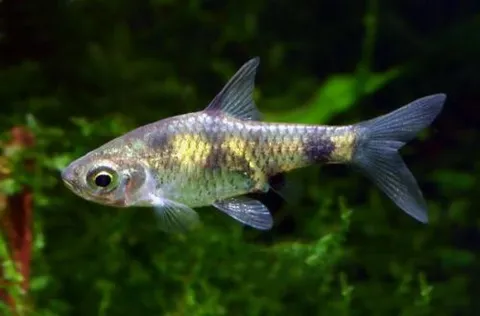
Pethia aurea
The small Golden Barb, scientifically known as Pethia aurea, belongs to the family Cyprinidae. This peaceful, undemanding, small-sized fish can be a wonderful addition to any small aquarium. Its care and breeding do not…
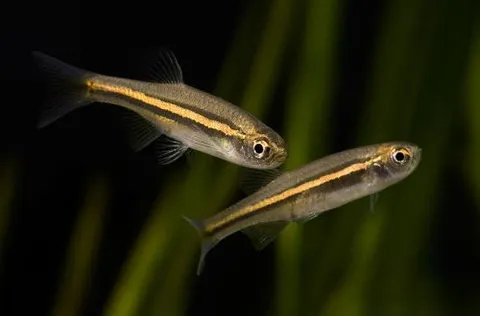
Danio jaintianensis
The Jaintia Danio, scientifically known as Danio jaintianensis, belongs to the family Cyprinidae. The fish is named after the Jaintia Hills, where it was first discovered. Although this species is not frequently…
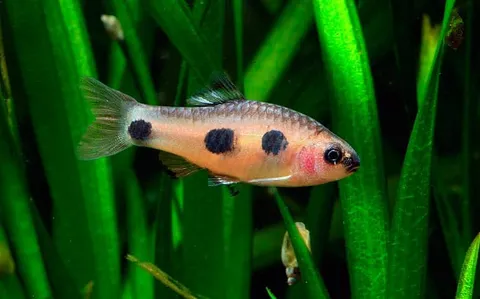
Enteromius candens
The Rosy Barb, also known by its scientific name Enteromius candens, belongs to the family Cyprinidae. These fish are deservedly valued for their peaceful nature and distinctive body pattern, as well as for their ease…
Enteromius hulstaerti
Enteromius hulstaerti, known as the Butterfly Barb or Moth Barb, belongs to the family Cyprinidae. This fish attracts attention with its beauty and does not cause much trouble in maintenance, but it is not often found…