Temperature18 – 24 °C
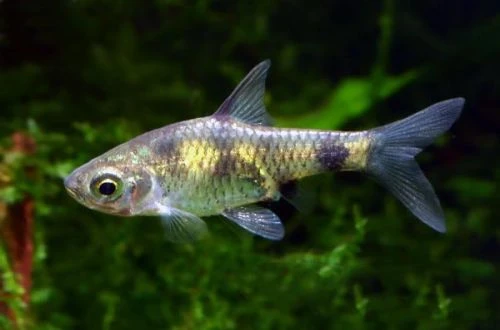
The small Golden Barb, scientifically known as Pethia aurea, belongs to the family Cyprinidae. This peaceful, undemanding, small-sized fish can be a wonderful addition to any small aquarium. Its care and breeding do not require special effort, making it a suitable choice for beginner aquarists.
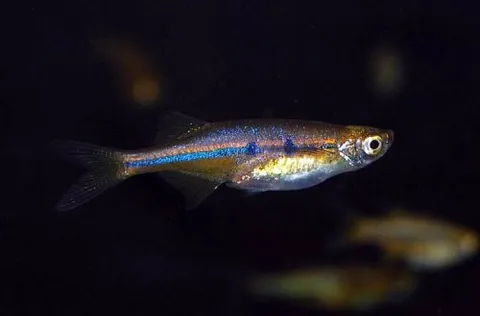
This is a miniature, even tiny fish, barely reaching 2.5 cm in length. Its appearance resembles the Sunset Barb, but Pethia aurea is significantly smaller. Its coloration consists of yellow-grey tones with large dark spots evenly distributed over the entire body. The fins remain translucent. Differences between sexes are weakly expressed; although females may have a slightly larger abdomen, this trait is not always obvious due to the small size of adult specimens.
The species is so far known only from a series of ponds in South 24 Parganas District, West Bengal state, northern India, in the Ganges delta region. Its natural habitat is predominantly the Ganges River delta, where it prefers to stay in areas with abundant aquatic vegetation, avoiding open water spaces.
Being a peaceful schooling fish, this barb feels best in a group consisting of at least 10 individuals. Due to its modest size, it is not recommended to keep it with large fish. Even herbivorous species can accidentally pose a danger by consuming this small barb. This is especially true for catfish, which tend to eat anything that fits into their mouths.
The optimal aquarium volume starts from 40 liters, although experienced aquarists can successfully keep Golden Barbs in smaller tanks. For decoration, it is recommended to use an abundance of aquatic vegetation, including floating species, as well as various shelters such as driftwood or decorative elements. Water conditions should be maintained at a slightly acidic pH and low hardness. A regular filtration system and weekly partial water changes with fresh water will help prevent the accumulation of organic waste. When choosing a filter, preference should be given to models that do not create excessive current, as these fish do not tolerate strong water movement well.
This species is omnivorous and does not show particular preferences in feeding. It readily accepts most common foods of appropriate size. The fish can adapt even to exclusively dry products, such as flakes or granules. However, if given the opportunity, they will not refuse live or frozen brine shrimp, daphnia, or bloodworms.
The appearance of fry in a community tank is possible, but their survival rate will be extremely low. Fry often become prey for adult fish and suffer from a lack of food. During spawning, the fish scatter their eggs in the water column, after which they are left without parental care. Since barbs do not have developed parental instincts, they can readily feast on their own offspring. To increase the chances of survival, eggs or newly hatched fry can be timely moved to a separate tank with similar water conditions. This breeding tank should be equipped with a simple air-driven sponge filter and a heater. An additional light source is not required. For decoration, shade-loving mosses and ferns or artificial plants can be used. The incubation period lasts from 24 to 36 hours, depending on the water temperature. After another 3–4 days, the fry begin to swim freely in search of food. They should be fed specialized micro-foods or paramecium. As they grow, brine shrimp nauplii can be introduced into their diet. Choosing the right food is perhaps one of the most challenging aspects of breeding Golden Barbs.
In a balanced aquarium ecosystem, closely matching the requirements of this species, diseases are extremely rare. Illnesses often arise due to deteriorating habitat quality, contact with already sick fish, or physical injuries.
When choosing a Golden Barb, attention should be paid to the fish's activity: healthy individuals should be active and stay in a school. Avoid purchasing fish with signs of emaciation, fin damage, white spots or film on the body, as well as individuals that appear sluggish or stay isolated from the group. Given the miniature size of the species, it is important to ensure that the fish in the store are kept in appropriate conditions, as they are sensitive to water quality and stress during transportation.
The essentials: size, tank volume, water parameters and care
An adult reaches 2.5 cm in length. Plan the tank around the maximum size: the fish quickly outgrows a cramped setup.
The recommended volume is 40 L. A smaller tank speeds up nitrate build-up and raises stress levels.
Temperature 18–24 °C, pH 6–7, hardness 1–10 dGH. Stability matters more than exact values: sudden swings are harder on the fish than a small deviation from the ideal.
Around 3 years when kept properly. Lifespan depends directly on tank volume, water quality and a varied diet.
Temperament: peaceful (regular). Keep this in mind when choosing tank mates.
Recommended setup: large group (10+ individuals). Ignoring this is a common cause of stress and disease.
Diet type: small / appropriate size / pieces. Feed small portions that are finished within a couple of minutes — overfeeding does more harm than underfeeding.
The scientific name of the species is Pethia aurea, family Cyprinids (Cyprinidae).
The water suits 196 of 208 plants in the catalogue — the easiest ones are shown first.
Afzelius's AnubiasAnacharisAnubiasBrazilian PennywortDwarf CloverDwarf CloverDwarf HygrophilaDwarf SagittariaDwarf ValGuppy GrassHornwortJava FernJava MossMoneywortMud SwordNarrow Leaf AnacharisNarrow-leaf CloverStringy MossSüsswassertangTaiwan MossTape GrassTemple PlantUssuri WatermilfoilWater Wisteria
Matched by family, categories and overlapping keeping conditions
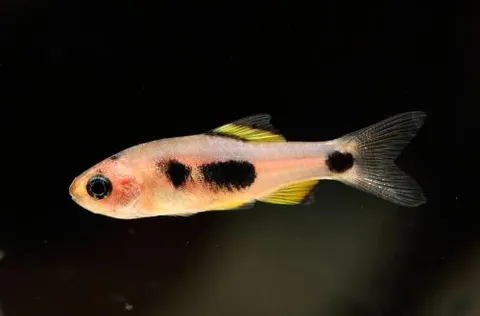
Enteromius hulstaerti
Enteromius hulstaerti, known as the Butterfly Barb or Moth Barb, belongs to the family Cyprinidae. This fish attracts attention with its beauty and does not cause much trouble in maintenance, but it is not often found…
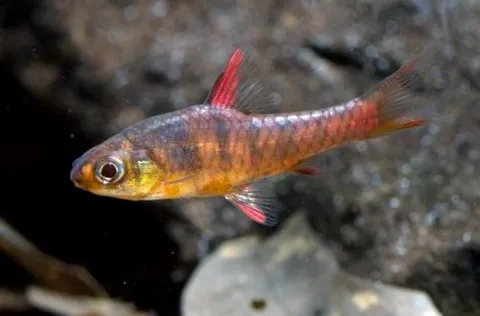
Enteromius jae
The Jae Barb, also known by its scientific name Enteromius jae, belongs to the family Cyprinidae. This miniature and picturesque fish can become a true gem in a nano aquarium. Its care and breeding are straightforward,…
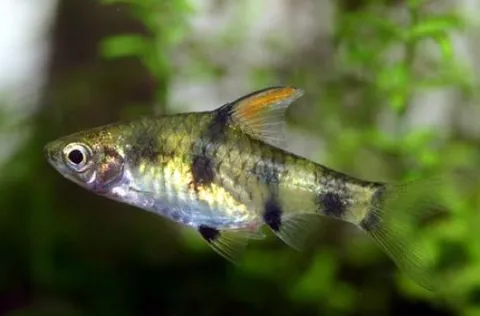
Pethia canius
Pethia canius, scientifically known as Pethia canius, belongs to the family Cyprinidae. The genus name Pethia is the Sinhalese collective name for small cyprinids, while the specific name “canius” appears to follow a…
Neochela dadiburjori
The Dadiburjor's Danio, scientifically known as Neochela dadiburjori, belongs to the family Cyprinidae. It was named in honor of Sam Dadiburjor, a Mumbai aquarist whose efforts helped reveal this species to science.