Temperature20 – 24 °C
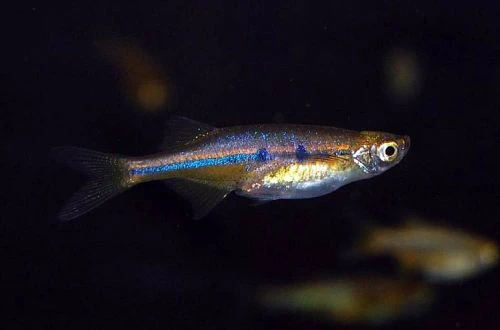
The Dadiburjor's Danio, scientifically known as Neochela dadiburjori, belongs to the family Cyprinidae. It was named in honor of Sam Dadiburjor, a Mumbai aquarist whose efforts helped reveal this species to science.
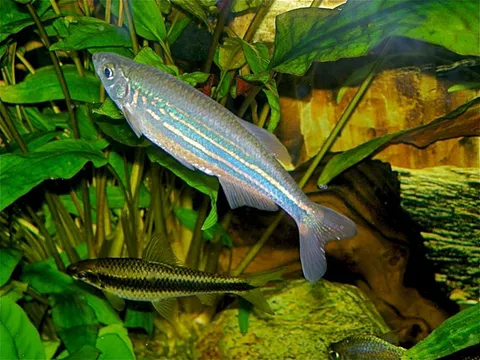
Adults of this fish typically reach a length of 2 to 3 cm. Their body is adorned with a dark blue dotted line that runs horizontally from head to tail against a background varying from golden to orange. The belly has a silvery hue. The fins are colorless and translucent. Sexual dimorphism in Dadiburjor's Danio is weakly expressed, and males are practically indistinguishable from females based on external characteristics.
This species inhabits waters of South Asia, particularly in western India — in the states of Goa, Karnataka, Kerala, and Tamil Nadu. Preferred habitats are numerous river systems that originate in the Western Ghats mountains and flow into the Arabian Sea. They are characterized by shallow streams with abundant riparian and submerged aquatic vegetation.
These are peaceful and active fish. It is advisable to keep them in a school (at least 8–10 individuals) with similarly sized miniature cyprinid species, such as other danios or rasboras.
For a group of 8–10 individuals, an aquarium of at least 40 liters is recommended. The setup should ideally recreate a dimly lit space, abundant with aquatic vegetation and driftwood that can serve as shelters. The use of floating plants will help create additional shade. It is important to provide gentle filtration, avoiding strong water movement, as these small fish do not tolerate powerful currents well. A simple air-driven sponge filter can be an excellent solution. Keeping Dadiburjor's Danio is not particularly difficult; key aspects include quality feeding, maintaining stable water parameters (temperature, pH, and dGH), and regular aquarium maintenance procedures, including waste removal and partial water changes.
These fish do not have specific dietary requirements. A typical daily diet can consist of various dry foods, such as flakes, granules, or tablets. To enrich their diet, it is very beneficial to add live or frozen foods, for example, Artemia, small bloodworms, or Daphnia.
Under favorable conditions and a protein-enriched diet, spawning occurs regularly in these fish. The entire group spawns simultaneously, attaching eggs to leaves closer to the water surface. Since they lack parental instincts, the eggs can be quickly eaten by adult fish. To increase the chances of offspring survival, it is important to timely transfer the leaf with eggs to a separate tank. The incubation period lasts 2–3 days. After hatching, the fry remain attached for 4–5 days, feeding on the yolk sac reserves, and only then begin to swim freely. From this point, they should be fed microscopic foods, such as infusoria, and as they grow, Artemia nauplii and similar products can be included in their diet.
Most health problems in fish arise from unsuitable keeping conditions. If the fish has not been subjected to aggression from conspecifics and has not sustained physical injuries, then the cause is most likely poor water quality or food. Often, after eliminating these factors, the fish's body can cope with the ailment on its own. However, in the case of prolonged negative exposure, medication may be required.
When selecting individuals, attention should be paid to their activity and the integrity of their skin. Healthy fish should be active, without visible damage, spots, or signs of emaciation. Avoid purchasing fish that isolate themselves, appear sluggish, or have clamped fins. Since the species is sensitive to water quality, it is recommended to assess the condition of the aquarium in the store: there should be no dead individuals, and the water should be clear and without a strong odor. It is best to purchase a group of 8–10 individuals at once, as fish experience severe stress when kept alone.
The essentials: size, tank volume, water parameters and care
An adult reaches 2–3 cm in length. Plan the tank around the maximum size: the fish quickly outgrows a cramped setup.
The recommended volume is 40 L. A smaller tank speeds up nitrate build-up and raises stress levels.
Temperature 20–24 °C, pH 6–7, hardness 1–9 dGH. Stability matters more than exact values: sudden swings are harder on the fish than a small deviation from the ideal.
Around 4 years when kept properly. Lifespan depends directly on tank volume, water quality and a varied diet.
Temperament: peaceful, active/mobile. Keep this in mind when choosing tank mates.
Recommended setup: group (8–10 individuals). Ignoring this is a common cause of stress and disease.
Diet type: small / appropriate size / pieces. Feed small portions that are finished within a couple of minutes — overfeeding does more harm than underfeeding.
The scientific name of the species is Neochela dadiburjori, family Cyprinids (Cyprinidae). It also appears in the literature as: Chela dadyburjori, Chela dadydurjori, Laubuca dadidurjori.
The water suits 195 of 208 plants in the catalogue — the easiest ones are shown first.
Afzelius's AnubiasAnacharisAnubiasBrazilian PennywortDwarf CloverDwarf CloverDwarf HygrophilaDwarf SagittariaDwarf ValGuppy GrassHornwortJava FernJava MossMoneywortMud SwordNarrow Leaf AnacharisNarrow-leaf CloverStringy MossSüsswassertangTaiwan MossTape GrassTemple PlantUssuri WatermilfoilWater Wisteria
Matched by family, categories and overlapping keeping conditions
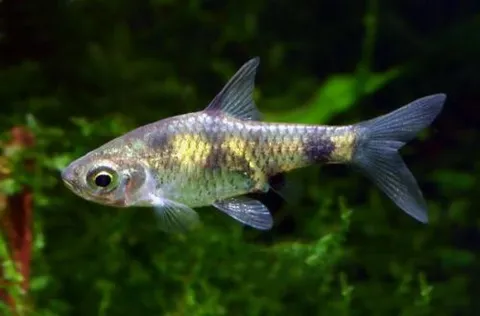
Pethia aurea
The small Golden Barb, scientifically known as Pethia aurea, belongs to the family Cyprinidae. This peaceful, undemanding, small-sized fish can be a wonderful addition to any small aquarium. Its care and breeding do not…
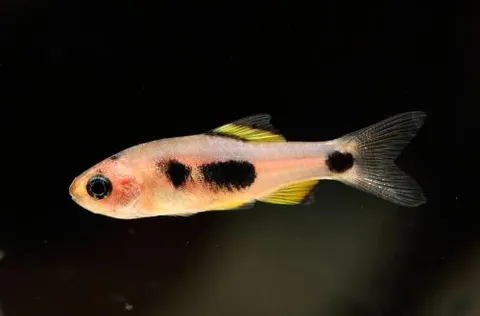
Enteromius hulstaerti
Enteromius hulstaerti, known as the Butterfly Barb or Moth Barb, belongs to the family Cyprinidae. This fish attracts attention with its beauty and does not cause much trouble in maintenance, but it is not often found…
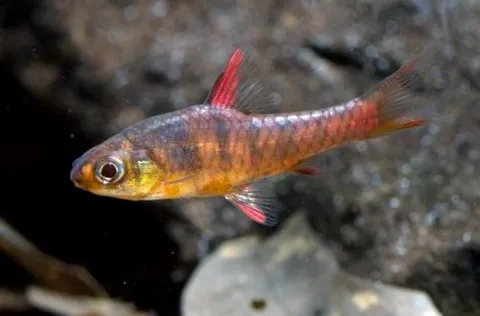
Enteromius jae
The Jae Barb, also known by its scientific name Enteromius jae, belongs to the family Cyprinidae. This miniature and picturesque fish can become a true gem in a nano aquarium. Its care and breeding are straightforward,…
Devario aequipinnatus
Devario aequipinnatus, known as the Giant Danio, is a member of the Cyprinidae family. This name accurately reflects its characteristic: this species is indeed larger than its other relatives. Thanks to its exceptional…