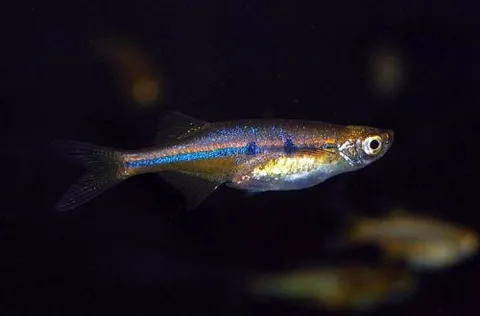
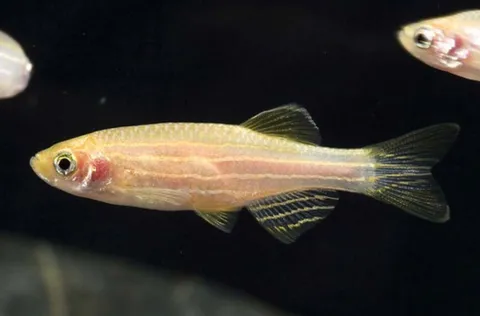
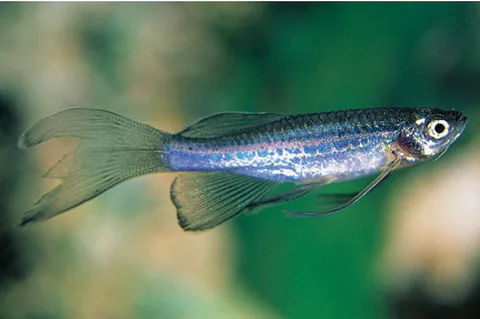
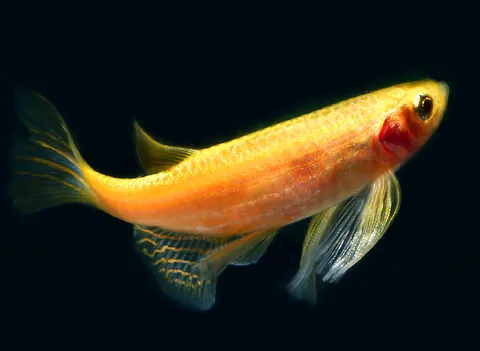
The first description of the Giant Danio was made by researcher John McClelland in 1839 during his study of Indian fauna. This species is widespread in the northern regions of India, and also found in Nepal, Bangladesh, Sri Lanka, Myanmar, and northern Thailand. In their natural habitat, these fish inhabit mid-mountain rivers at altitudes up to 300 meters above sea level. River conditions in these areas are diverse, but shaded areas often prevail, sometimes with trees whose branches hang down to the water. Danios prefer to stay in the upper layers of the water, where they actively feed on insects and their larvae. The following conditions are important for keeping these fish: Aquarium volume — from 100 L Temperature — 21–24 °C pH value — 6.0–8.0 Water hardness — 5 to 19 GH (soft to medium hard) Substrate type — dark gravel or sand Lighting — subdued Brackish water — absent Water movement — strong or moderate Size — up to 10 cm Diet — any appropriately sized foods Lifespan — 5–7 years Description The Giant Danio is characterized by a large, elongated body. Small barbels are visible at the mouth, at the tip of each lip. Among related species, it stands out for its size: in the wild, individual specimens can reach 15 cm in length, although in aquarium conditions they rarely grow larger than 10 cm. The coloration of these fish can vary significantly depending on the region of origin and environmental conditions, but a grayish hue most often prevails. Along the sides of their body, there is an ornament of irregularly shaped stripes and spots with yellow or greenish pigment. Albino forms of this species also exist, which are usually the result of a random mutation and are rarely fixed in subsequent generations. Outwardly, the Giant Danio resembles the Malabar and Royal Danios, which often leads to their confusion. Feeding This species is omnivorous and readily consumes both dry and live or frozen foods. It is important that the food floats on the surface of the water. Unlike many other omnivorous species, the Giant Danio does not require a varied diet; it can be fed with a single type of food. Care and Maintenance For successful keeping of the Giant Danio, several conditions are crucial: clean water with regular weekly changes of at least 25% of the total volume, and sufficient space for free swimming. Since the fish is sensitive to oxygen content in the water, aeration with compressors or universal filters is recommended, which, among other things, will help create the desired gentle current. Lighting should be moderate. If the room temperature is sufficient, a heater may not be needed, as the fish does not require high water temperatures. The aquarium should have dense plant thickets in one of the corners or along a side wall, thus creating hiding places for the fish. Floating plants will provide additional shading. Dark fractions of smooth fine gravel or coarse sand are preferred as substrate. Behavior and Compatibility This is an active and peaceful schooling species that requires a community of at least 8 individuals. With fewer numbers, the fish may become restless, attack conspecifics, and chase smaller neighbors. However, such behavior is not aggression, but rather a search for playmates. Coexistence is possible with fish of similar size and temperament. Breeding / Reproduction Males differ from females by a more slender body shape and more intense coloration. Breeding Giant Danios in a home aquarium is not difficult. Sexual maturity is reached at a body length of 7 cm. Although two Danios can maintain a pair throughout their lives, this does not affect their parental instincts: after spawning, the future offspring are left unattended. It is recommended to breed these fish in a separate tank, the bottom of which is densely planted with small plants. A gravel substrate with particles about 1 cm in diameter will help protect the eggs from being eaten. The female should be placed in the aquarium a day before the male. When the pair forms, the temperature should be gradually raised to 27–28 °C, which will initiate the courtship process. Under favorable conditions, the female lays 5–20 eggs directly into the water after each mating, and the male fertilizes them; the total number of eggs laid can reach about 300. After spawning is complete, the parents should be moved back to the main aquarium. More about Danio reproduction. Diseases Under conditions favorable for their existence, these fish are rarely susceptible to diseases. However, sharp changes in the habitat can provoke disease outbreaks, among which ichthyophthiriosis is one of the most common. Detailed information on symptoms and treatment methods can be found in the "Fish Diseases" section.