Temperature26 – 28 °C
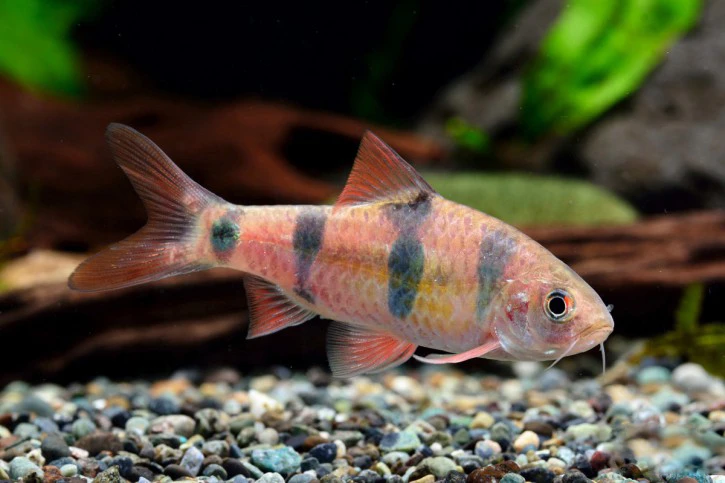
Everett's Barb, scientifically known as Barbodes everetti (formerly Puntius everetti), is a member of the Cyprinidae family. This tropical fish is characterized by its active behavior and striking coloration, reminiscent of a clown's attire, which earned it another name — the "Clown Barb." Certain aspects of its care make this species unsuitable for beginner aquarists. Therefore, before deciding to keep this barb, it is important to thoroughly study the species description and its requirements.
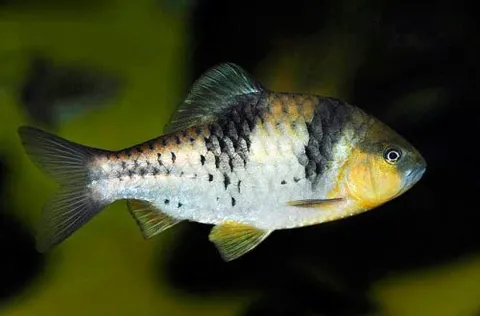
This fish has a streamlined, torpedo-shaped body and a forked caudal fin. In aquarium conditions, its size usually does not exceed 10 cm. The body coloration can be described as reddish-golden, transitioning from darker shades on the back to lighter ones on the belly. Red pigments are sometimes visible on the iris of the eyes. Dark, elongated spots are located on the sides, typically numbering around four. Under favorable conditions, the lifespan of this species can reach up to 8 years.
The first detailed description of Everett's Barb dates back to 1894. Its habitat is Southeast Asia and adjacent islands, where it prefers shallow, well-heated bodies of water, as well as quiet forest streams and tributaries with moderate currents. In its natural environment, the fish's diet includes worms, insects, crustaceans, as well as plant matter and organic detritus such as fallen leaves and fruits.
Everett's Barb is a schooling species, so it should be kept in groups of at least 5–6 individuals. Its activity sometimes borders on aggressiveness, which can harm or even lead to the death of slow-moving or smaller tank mates. For this reason, it is preferable to choose large and active fish for cohabitation. Solitary keeping significantly increases aggression, which is mitigated in a group, and the barb may start attacking fish even of its own size, pursuing them.
One of the most important conditions for successful keeping is maintaining water purity and regularly refreshing its volume. It is advisable to replace 30–50% of the water volume weekly, as the Clown Barb is sensitive to the accumulation of organic waste products, such as uneaten food remnants, plant fragments, and excrement. For a group of adult individuals, a significant-sized aquarium, with a volume of 200 liters or more, will be needed. In terms of decor, it is preferable to strive to recreate its natural habitat, which will help the fish stay in good condition and minimize stressful situations. Coarse sand, supplemented with smooth stones, is ideal as a bottom substrate. When choosing plants, opt for species with strong stems and tough leaves that can withstand the activity of these fish. Vegetation is recommended to be placed around the perimeter, leaving the central part of the aquarium free for swimming. Natural elements such as tree roots, branches, and various snags are excellent for creating shelters.
Everett's Barb is omnivorous and readily consumes various types of dry commercial foods, as well as live and frozen products such as bloodworms, Artemia, and tubifex worms, in addition to plant-based food. It is important to avoid feeding the fish exclusively one type of food. It is recommended to combine different types, for example, offering dry food in combination with live food. The use of specialized food that already contains all the necessary nutrients for this species is an exception to this rule.
Sexual dimorphism in this species is weakly expressed. Breeding the Clown Barb presents certain difficulties, requiring careful pair selection and a separate spawning tank with specific conditions. Males reach sexual maturity by one and a half years, females by one year. However, if the age difference between partners exceeds 2 years, breeding does not occur. The spawning tank should be filled with water to a depth of 15–20 cm, and the bottom should be covered with a fine mesh and Java moss, where the eggs will fall to protect them from being eaten by the parents. Lighting should be subdued. Water parameters: soft and slightly acidic. After spawning, the parents should be transferred back to the main aquarium. Fry appear after 20–30 days; the duration of this period depends on the water temperature.
Keeping fish in favorable conditions helps prevent health problems. Currently, no specific diseases characteristic of this species have been observed. More detailed information on diseases and their symptoms can be found in the "Fish Diseases" section.
When purchasing, it should be noted that another species, Barbodes dunckeri, is often sold under the name Everett's Barb in pet stores. True Barbodes everetti is extremely rare in retail. When selecting individuals, pay attention to the following signs: activity and absence of external damage, such as ulcers, film, or fin rot. A healthy fish should show curiosity, have clear eyes, and scales tightly pressed to the body. — Avoid purchasing fish that stay separate from the school, appear emaciated, or have an unnaturally bloated belly. — Check for any signs of stress or lethargy, as barbs are dynamic and active fish. — Ensure that there are no signs of infectious diseases in other inhabitants of the aquarium with the fish, as barbs are sensitive to water quality and environmental cleanliness.
The essentials: size, tank volume, water parameters and care
An adult reaches 10 cm in length. Plan the tank around the maximum size: the fish quickly outgrows a cramped setup.
The recommended volume is 200 L. A smaller tank speeds up nitrate build-up and raises stress levels.
Temperature 26–28 °C, pH 6–6.5, hardness 8–10 dGH. Stability matters more than exact values: sudden swings are harder on the fish than a small deviation from the ideal.
Around 8 years when kept properly. Lifespan depends directly on tank volume, water quality and a varied diet.
Temperament: peaceful, active/mobile. Keep this in mind when choosing tank mates.
Recommended setup: schooling (usually from 5–6 individuals and more). Ignoring this is a common cause of stress and disease.
Diet type: high protein (predominantly meat). Feed small portions that are finished within a couple of minutes — overfeeding does more harm than underfeeding.
The scientific name of the species is Barbodes everetti, family Cyprinids (Cyprinidae). It also appears in the literature as: Barbus everetti, Puntius everetti.
The water suits 174 of 208 plants in the catalogue — the easiest ones are shown first.
Afzelius's AnubiasAnacharisAnubiasBrazilian PennywortDwarf CloverDwarf CloverDwarf HygrophilaDwarf SagittariaDwarf ValGuppy GrassHornwortJava FernJava MossMoneywortMud SwordNair's LagenandraNarrow Leaf AnacharisNarrow-leaf CloverSüsswassertangTaiwan MossTape GrassTemple PlantUssuri WatermilfoilWater Wisteria
Matched by family, categories and overlapping keeping conditions
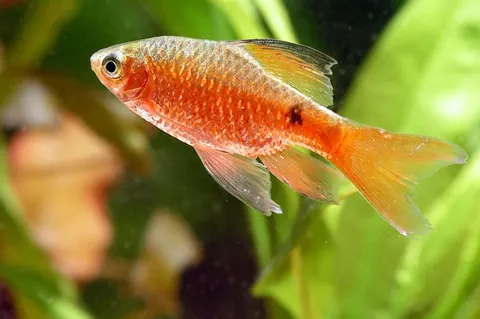
Pethia conchonius
The Rosy Barb, scientifically known as Pethia conchonius, is a member of the Cyprinidae family. Its vibrant appearance is sure to catch the eye, and its high activity makes observing these fish a captivating experience,…
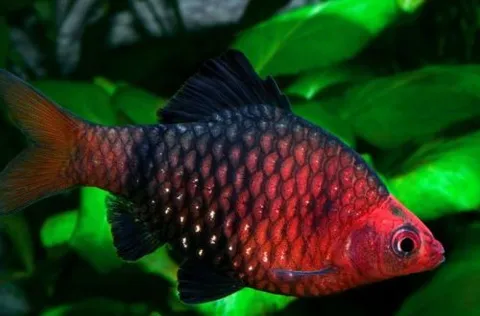
Pethia nigrofasciata
Pethia nigrofasciata, also known as the Black Ruby Barb or Purplehead Barb, belongs to the family Cyprinidae. This fish is distinguished by its beauty and high level of activity. It is perfectly adapted to life in a…
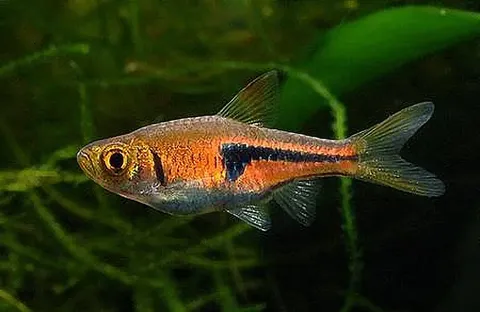
Trigonostigma espei
Trigonostigma espei, known as the Espei rasbora or false harlequin rasbora, belongs to the family Cyprinidae. This attractive, miniature schooling fish inhabits overgrown streams in tropical rainforests. It was only in…
Barbodes kuchingensis
The Deceptive Barb, also known as the False Cross Barb (scientific name Barbodes kuchingensis), belongs to the family Cyprinidae. This fish is a typical representative of the Barb genus, distinguished by its…