Temperature20 – 28 °C
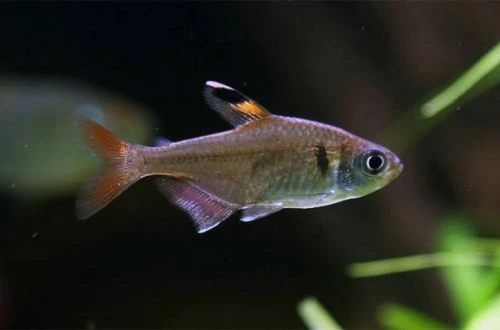
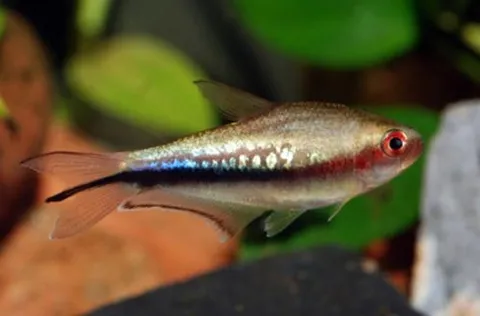
Hyphessobrycon simulatus, or the False Pristella Tetra (also known as the False Transparent Tetra), belongs to the Acestrorhamphidae family. As its name suggests, this fish bears a resemblance to the Pristella Tetra, another characin, although it is not as popular among aquarists. It is easy to keep and breed, and also coexists well with many other freshwater species. These qualities make it an excellent choice for a home aquarium.
Adults of this fish species reach a length of about 3 centimeters. Sexual dimorphism is weakly expressed, and sex determination is difficult; females may appear slightly larger, especially during the pre-spawning period. Outwardly, these fish resemble the Pristella Tetra, but differ from it in their darker, gray coloration.
Its habitat is in South America; it is presumed to be endemic to French Guiana. There, it inhabits the basins of small rivers, extending from the Maroni in the west to the Oyapock in the east. These fish prefer streams, small rivers, and floodplain lakes located in dense, humid tropical forests. They are found in areas with slow currents, where riverbeds are covered with fallen leaves and tree branches, and dense vegetation overhangs the water.
This is a peaceful schooling fish, perfectly compatible with other freshwater species of similar size. It should not be kept with aggressive or territorial tankmates. It is recommended to maintain a group of at least 8–10 individuals, as with fewer numbers, the fish may become overly timid.
For comfortable keeping of a school of 8–10 fish, an aquarium of 70–80 liters is required. The decor can be anything, as the False Pristella Tetra can adapt to various conditions, including even relatively empty tanks in which fish are usually kept for sale. Often, leaves from certain trees are used for decoration, laid on the bottom. This allows for the recreation of natural habitat conditions. During decomposition, the leaves release tannins, which have antibacterial and antifungal properties, and also stain the water a brownish hue. Additionally, leaves serve as a substrate for the development of colonies of beneficial microorganisms, such as paramecia, which are a valuable food source for fry. Successful long-term keeping of this species depends on several key factors: quality nutrition, compatible tankmates, and water parameters and quality. The latter implies maintaining stable water conditions within an acceptable range of temperatures and hydrochemical parameters. For this, the aquarium is equipped with the necessary equipment and regular maintenance procedures are carried out (weekly partial water changes, removal of organic waste, etc.).
This species is undemanding regarding its diet. The fish readily accept a variety of appropriately sized foods, including dry flakes and granules. Their diet can be supplemented with live or frozen daphnia, artemia, and small bloodworms.
The False Pristella Tetra exhibits a breeding strategy typical of many characins. The fish scatter their eggs haphazardly across the bottom, without forming nests. Parental instincts are not developed, so the fry will be quickly eaten if not promptly transferred to a separate tank. Note that in home aquariums, the breeding season for these fish is not pronounced. In a large school, spawning can occur throughout the year.
Specific diseases that affect only this particular fish species have not been identified. When kept in suitable conditions, including high water quality, a balanced diet, and peaceful tank mates, health issues usually do not arise. The most common cause of illness is a deterioration of living conditions, which weakens the immune system and makes the fish susceptible to infections that are always present in their environment. Upon noticing initial signs of sickness (such as lethargy, emaciation, refusal to eat, or clamped fins), it is crucial to immediately check the basic water parameters. Often, restoring acceptable living conditions will lead to self-recovery, but if the fish is too weak or has suffered visible damage, medicinal treatment may be required.
When selecting individuals, attention should be paid to their activity and fin integrity. Healthy fish should exhibit schooling behavior, actively move around the aquarium, and show no signs of apathy or emaciation. Avoid specimens with damaged scales, whitish coatings, or an unnaturally swollen abdomen, as these may indicate the presence of diseases. Since the species is rarely available for sale and is often confused with other characins, it is recommended to purchase a group of 8–10 individuals to ensure their comfortable conditions and observe natural behavior.
The essentials: size, tank volume, water parameters and care
An adult reaches 3–3.5 cm in length. Plan the tank around the maximum size: the fish quickly outgrows a cramped setup.
The recommended volume is 70 L. A smaller tank speeds up nitrate build-up and raises stress levels.
Temperature 20–28 °C, pH 5–7, hardness 1–10 dGH. Stability matters more than exact values: sudden swings are harder on the fish than a small deviation from the ideal.
Around 4 years when kept properly. Lifespan depends directly on tank volume, water quality and a varied diet.
Temperament: peaceful (regular). Keep this in mind when choosing tank mates.
Recommended setup: group (8–10 individuals). Ignoring this is a common cause of stress and disease.
Diet type: small / appropriate size / pieces. Feed small portions that are finished within a couple of minutes — overfeeding does more harm than underfeeding.
The scientific name of the species is Hyphessobrycon simulatus, family Acestrorhamphidae. It also appears in the literature as: Pseudopristella simulata.
The water suits 198 of 208 plants in the catalogue — the easiest ones are shown first.
Afzelius's AnubiasAnacharisAnubiasBrazilian PennywortDwarf CloverDwarf CloverDwarf HygrophilaDwarf SagittariaDwarf ValGuppy GrassHornwortJava FernJava MossMoneywortMud SwordNair's LagenandraNarrow Leaf AnacharisNarrow-leaf CloverStringy MossSüsswassertangTaiwan MossTape GrassTemple PlantUssuri Watermilfoil
Matched by family, categories and overlapping keeping conditions
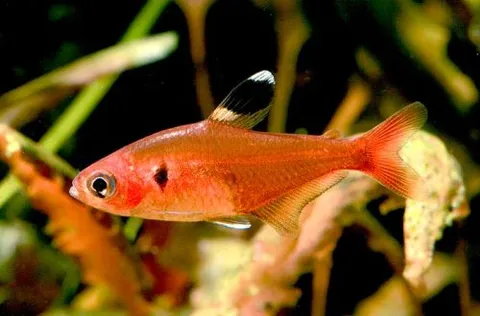
Megalamphodus haraldschultzi
Timari Tetra, or Schultz's Tetra (Megalamphodus haraldschultzi), is a member of the Characin family. It is often called the Red Dwarf Tetra due to its striking coloration. This picturesque miniature fish is ideal for…
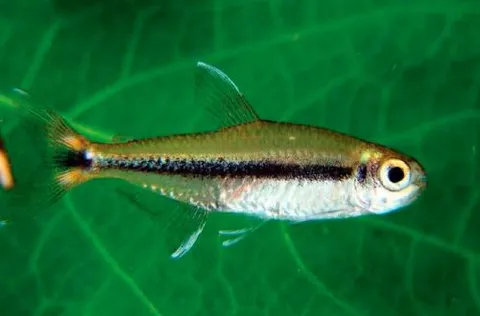
Hyphessobrycon stegemanni
The Savannah Tetra, scientifically known as Hyphessobrycon stegemanni, belongs to the Acestrorhamphidae family. Its care is straightforward, making it an excellent choice for most freshwater aquariums, as it coexists…
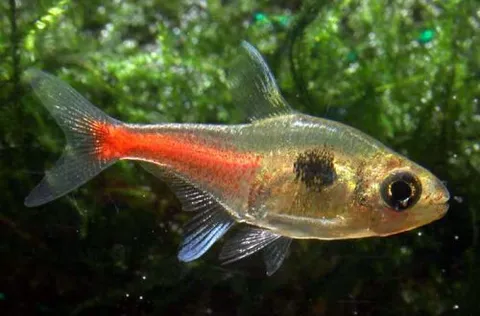
Hyphessobrycon roseus
The Yellow Phantom Tetra, scientifically known as Hyphessobrycon roseus, belongs to the Acestrorhamphidae family. This freshwater fish is notably popular among aquarists due to its ease of care and breeding. It also…
Nematobrycon lacortei
The Rainbow Tetra, also known as the Rainbowfish Tetra, bears the scientific name Nematobrycon lacortei and belongs to the family Acestrorhamphidae. Its name reflects its characteristic iridescent coloration, although…