Temperature22 – 28 °C
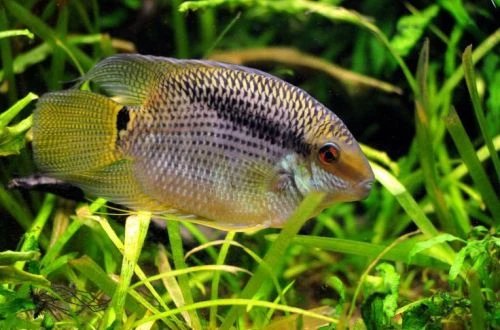
The Festivum cichlid, or Mesonauta festivus, belongs to the Cichlidae family. These fish are an excellent choice for beginner aquarists, as they are hardy and undemanding. They are easy to keep and breed, and can coexist peacefully with other fish species.
In the wild the species reaches 20 cm, while in the aquarium adults usually stay within 12–15 cm. This species exhibits weak sexual dimorphism, making sex determination difficult. This species is a close relative of Angelfish, which is evident in their appearance. The fish has an angular body shape, significantly compressed laterally. Its anal and dorsal fins are pointed. A distinctive feature of the species is a black stripe running diagonally from the eyes to the very rear of the dorsal fin. Body coloration varies from silvery to yellowish-brown, with the color depending on the region of origin of the specific subspecies. It is important to note that hybrid individuals are more commonly found in aquariums.
This species is widely distributed across a significant territory of South America. These fish are found in river systems and bodies of water in Brazil, Paraguay, Peru, and Bolivia. Festivums prefer areas with clean water, slow currents, and abundant aquatic vegetation.
The Festivum cichlid is characterized by peaceful behavior and is well compatible with many other non-aggressive species of comparable size. However, it can pose a threat to very small fish, such as neon tetras, which may accidentally become their prey. Good tank mates include other large South American cichlids, such as Angelfish, Acaras, Brazilian Geophagus, Severums, as well as some species of Gouramis and catfish.
For a pair of these fish, an aquarium with a volume of 120 to 150 liters will be optimal. The decor usually includes a substrate of fine gravel mixed with stones, several snags, and floating or rooted plants. The latter are recommended to be planted in groups to leave enough free swimming space. Festivums prefer weak to moderate water flow and medium light levels. It is extremely important to ensure good aeration and water filtration, as these fish are sensitive to the accumulation of organic waste and nitrogen compounds formed during the nitrogen cycle. Therefore, it is necessary to constantly monitor water quality. Essential maintenance procedures include: weekly replacement of 15–25% of the water volume with fresh water and regular substrate cleaning.
In a home aquarium, these fish readily accept all types of dry, frozen, and live foods. It is recommended to combine different types of products; for example, flakes or granules can be combined with bloodworms and Artemia. Furthermore, the use of plant-based supplements is an important condition. These can be part of dry food or added separately, such as spirulina or nori.
As they mature, the fish form a permanent monogamous pair that lasts throughout their lives. The mechanism of partner selection in these fish is not yet fully understood. However, it is known that adult individuals raised in different aquariums rarely produce offspring. Thus, successful breeding will require either finding an already established pair or creating conditions for its formation. This may mean acquiring a dozen young fish from different broods and waiting for the male and female to find each other. Under favorable conditions, with the onset of the breeding season, the female lays about 100 eggs, attaching them to the surface of a leaf or a flat stone. The male then releases a cloud of milt, and fertilization occurs. In their natural habitat, the fish prefer to lay eggs on the stem of sugarcane submerged in water. Cichlasoma seeks a surface with a similar texture and in some cases even refuses to spawn if it cannot find a suitable place. The parents carefully protect the eggs and hatched fry until they reach a sufficient size. To ensure the safety of the offspring, spawning should preferably take place in a separate tank with water conditions identical to those of the main aquarium.
Most fish diseases arise from unsuitable keeping conditions, which weaken their immune system and make them vulnerable. At the first signs of illness or unusual behavior in fish, all basic water parameters and the concentration of nitrogen compounds (products of the nitrogen cycle) should be checked first. As a rule, improving keeping conditions positively affects the well-being of the fish, and their bodies are able to cope with the illness on their own. However, in advanced cases, medication may be required.
When choosing a Mesonauta, preference should be given to active individuals with clean fins and no visible damage to the body. A healthy fish should have clear coloration, show no signs of apathy or constant stress, and exhibit interest in the food offered at the store. — Avoid specimens with sunken bellies, which may indicate emaciation or internal parasites. — Carefully inspect the gills and eyes: they should be clean, without plaque, spots, or cloudiness. — Make sure the fish does not constantly stay at the water surface or in a corner of the aquarium, as this is often a sign of unsatisfactory water quality or illness.
The essentials: size, tank volume, water parameters and care
An adult reaches 12–15 cm in length. Plan the tank around the maximum size: the fish quickly outgrows a cramped setup.
The recommended volume is 150 L. A smaller tank speeds up nitrate build-up and raises stress levels.
Temperature 22–28 °C, pH 5.5–7.2, hardness 5–12 dGH. Stability matters more than exact values: sudden swings are harder on the fish than a small deviation from the ideal.
Around 10 years when kept properly. Lifespan depends directly on tank volume, water quality and a varied diet.
Temperament: semi-peaceful (dangerous to smaller ones). Not a predatory species, but small fish that fit in its mouth will eventually be eaten.
Recommended setup: mixed (solitary / pair / group). Ignoring this is a common cause of stress and disease.
Diet type: any (universal). Feed small portions that are finished within a couple of minutes — overfeeding does more harm than underfeeding.
The scientific name of the species is Mesonauta festivus, family Cichlids (Cichlidae). It also appears in the literature as: Cichlasoma festivum, Heros festivus.
The water suits 198 of 208 plants in the catalogue — the easiest ones are shown first.
Afzelius's AnubiasAnacharisAnubiasBrazilian PennywortDwarf CloverDwarf CloverDwarf HygrophilaDwarf SagittariaDwarf ValGuppy GrassHornwortJava FernJava MossMoneywortMud SwordNair's LagenandraNarrow Leaf AnacharisNarrow-leaf CloverStringy MossSüsswassertangTaiwan MossTape GrassTemple PlantUssuri Watermilfoil
Matched by family, categories and overlapping keeping conditions
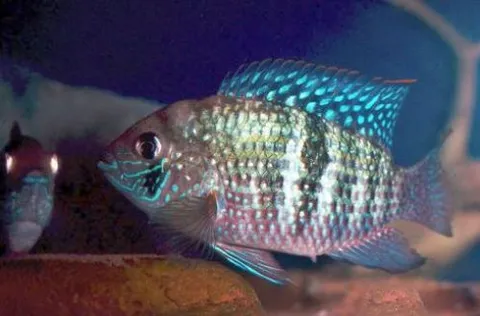
Andinoacara pulcher
The Blue Acara, also known as the Electric Blue Acara, or by its scientific name Andinoacara pulcher, belongs to the Cichlidae family. Maintaining its popularity among aquarists for many years, this species attracts…
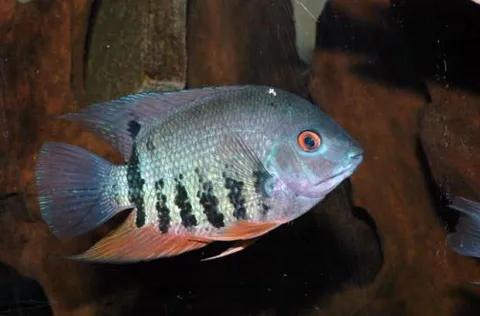
Heros efasciatus
Cichlidae is the family to which the Severum Efasciatus cichlid belongs, known by its scientific name Heros efasciatus. This cichlid, native to South America, is one of the most popular, alongside Discus. It attracts…
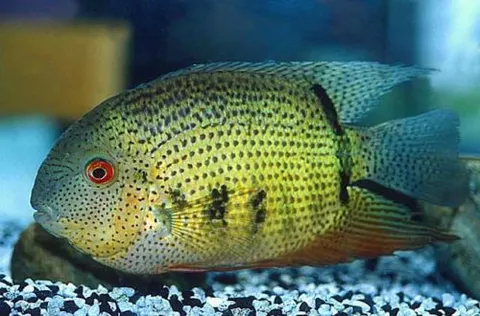
Heros notatus
The Cichlasoma Severum Notatus, scientifically known as Heros notatus, is a member of the Cichlidae family. This large and beautiful fish possesses a range of qualities highly valued by hobbyists: it is hardy, easy to…
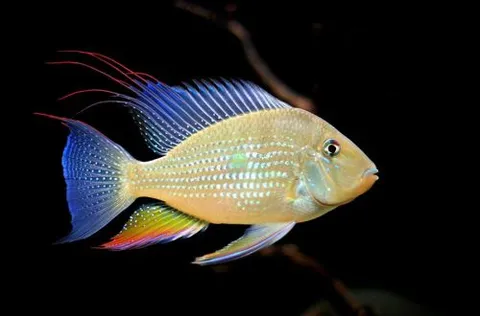
Acarichthys heckelii
Acarichthys heckelii, known as Heckel's Acara or Threadfin Acara, belongs to the Cichlidae family. This vibrant and attractive fish is relatively easy to keep, standing out with its unusual behavior during the breeding…