Temperature19 – 27 °C
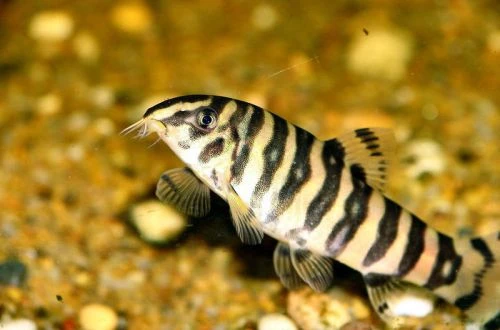
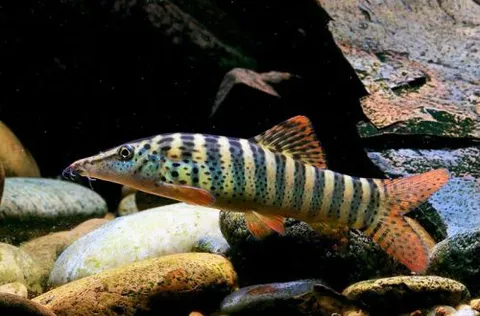
Botia rostrata, also known as the Gangetic Loach, belongs to the family Botiidae (Loaches) and bears the scientific name Gangetic loach. When young, the fish is distinguished by its bright coloration, which becomes more subdued with age. Despite being a rather hardy and undemanding species that requires certain conditions to be maintained, its keeping does not present particular difficulties. Nevertheless, certain behavioral characteristics can complicate the selection of suitable tank mates.
Adults grow to approximately 11–12 cm in length. Sexual dimorphism in these fish is subtly expressed. Males are generally smaller than females and have a more elongated mouth. Coloration changes with age: young fish are adorned with alternating yellow and black stripes. As they mature, the body pattern transforms into brownish hues with white speckles, and the stripes gradually lose their distinctness.
The natural habitat of this species extends across India and Bangladesh, covering the basins of the Ganges and the Brahmaputra — two rivers that meet only in their shared delta. The fish prefer relatively small tributaries with slow currents, where the bottom is strewn with stones and pebbles.
Keeping Gangetic Loaches in a group of 5–6 individuals is considered desirable, as with fewer numbers, they may exhibit aggressive behavior towards other aquarium inhabitants. Furthermore, in small aquariums, it is advisable to avoid cohabitation with small catfish and species with long, flowing fins, as they may also suffer. The most harmonious community with the Gangetic Loach is formed with fish that inhabit the water column or near its surface.
For a group consisting of 4–5 individuals, the aquarium should have a volume of at least 200 liters. An optimal setup is considered to be a rocky or sandy substrate, supplemented with several snags. Live plants are not an essential element; they can be replaced with artificial ones or by using undemanding species of mosses and ferns that easily attach to the surface of snags. In general, the aquarium design plays a secondary role; the main thing is to provide the fish with a sufficient number of shelters. Creating suitable conditions involves moderate current and maintaining high water quality. A high-performance filtration system combined with regular weekly changes of 30–50% of the water volume is mandatory.
This species is omnivorous and, unlike many of its relatives, is active not only at the bottom but also rises to the water surface for feeding. Both dry and frozen, as well as live foods, are suitable for their diet. It is important to include plant-based supplements in the menu to prevent possible damage to ornamental aquarium plants.
To date, no successful cases of breeding Botia rostrata in home aquariums have been recorded. Large-scale breeding of this species is carried out on specialized fish farms, where hormonal stimulation methods are used.
Non-ornamental fish species that have retained a close resemblance to their wild relatives usually exhibit high endurance, strong immunity, and resistance to various diseases. The occurrence of health problems most often indicates unsuitable keeping conditions. Therefore, before proceeding with treatment, it is strongly recommended to check the water quality and parameters. Only after all indicators have been brought back to normal should treatment begin, if it is still necessary.
When choosing a Gangetic loach, attention should be paid to the condition of the skin and the activity of the fish. Healthy individuals should be mobile, without visible damage, ulcers, plaque, or signs of emaciation where the skull bones are noticeably protruding. Avoid purchasing fish that appear sluggish, constantly lie on their side, or have an unnaturally bloated abdomen. — Check for the absence of external parasites and the integrity of the fins. — Ensure that the fish exhibits exploratory behavior and actively moves along the bottom. — Refuse to purchase if dead fish or signs of mass disease are observed in the aquarium with the fish for sale.
The essentials: size, tank volume, water parameters and care
An adult reaches 11–12 cm in length. Plan the tank around the maximum size: the fish quickly outgrows a cramped setup.
The recommended volume is 200 L. A smaller tank speeds up nitrate build-up and raises stress levels.
Temperature 19–27 °C, pH 6–7.5, hardness 2–12 dGH. Stability matters more than exact values: sudden swings are harder on the fish than a small deviation from the ideal.
Around 8 years when kept properly. Lifespan depends directly on tank volume, water quality and a varied diet.
Temperament: aggressive / incompatible / unfriendly. Keep this in mind when choosing tank mates.
Recommended setup: small group (5–6 individuals). Ignoring this is a common cause of stress and disease.
Diet type: any (universal). Feed small portions that are finished within a couple of minutes — overfeeding does more harm than underfeeding.
The scientific name of the species is Botia rostrata, family Botiidae.
The water suits 197 of 208 plants in the catalogue — the easiest ones are shown first.
Afzelius's AnubiasAnacharisAnubiasBrazilian PennywortDwarf CloverDwarf CloverDwarf HygrophilaDwarf SagittariaDwarf ValGuppy GrassHornwortJava FernJava MossMoneywortMud SwordNair's LagenandraNarrow Leaf AnacharisNarrow-leaf CloverStringy MossSüsswassertangTaiwan MossTape GrassTemple PlantUssuri Watermilfoil
Matched by family, categories and overlapping keeping conditions
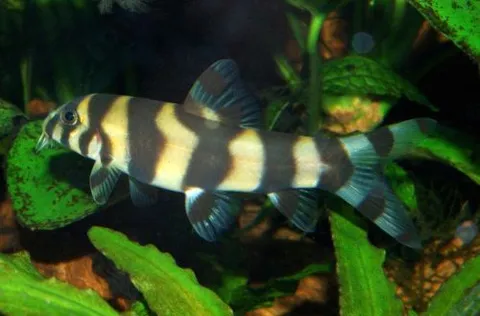
Botia histrionica
The Burmese Border Loach, also known as Botia histrionica (scientific name Botia histrionica), belongs to the family Botiidae, or True Loaches. It is a peaceful and friendly fish with a unique body pattern. It coexists…
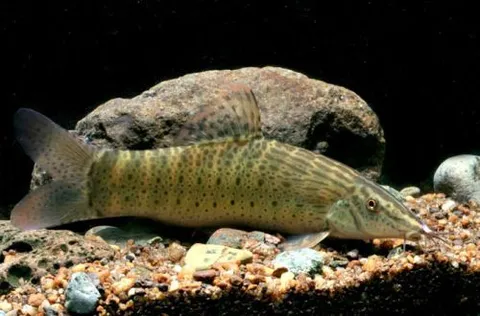
Syncrossus beauforti
The Chameleon Loach, officially known by its scientific name Syncrossus beauforti, belongs to the family Botiidae. This species can be unfriendly towards other aquarium inhabitants, which sometimes complicates the…
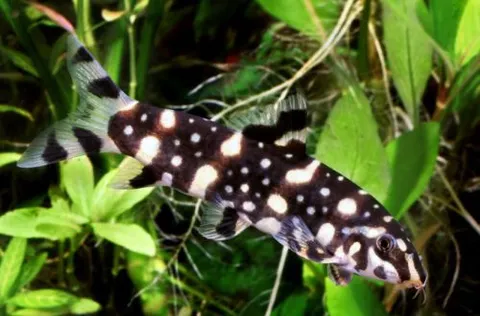
Botia kubotai
Kubotai Loach, also known as the Chessboard Botia (scientific name Botia kubotai), belongs to the family Botiidae, or true loaches. Before the species received a formal scientific description, it was already actively…
Syncrossus berdmorei
Berdmore's Loach, also known as the Red-tailed Tiger Botia or Blyth's Loach (Syncrossus berdmorei, family Botiidae), is a striking fish that can truly adorn a freshwater aquarium with its original pattern. However, its…