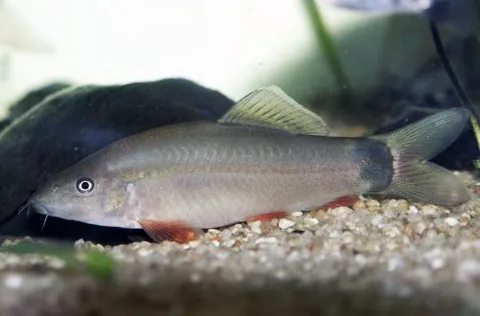
Temperature21 – 26 °C
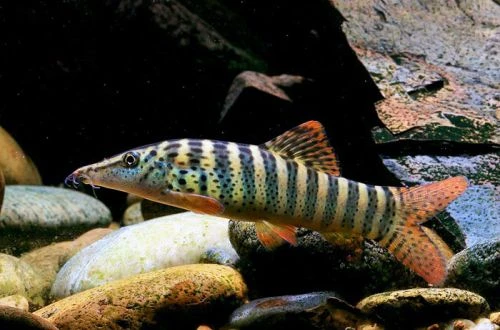
Berdmore's Loach, also known as the Red-tailed Tiger Botia or Blyth's Loach (Syncrossus berdmorei, family Botiidae), is a striking fish that can truly adorn a freshwater aquarium with its original pattern. However, its temperament places certain restrictions on the choice of tank mates. Despite this, it is otherwise relatively undemanding and will not cause much trouble in care.
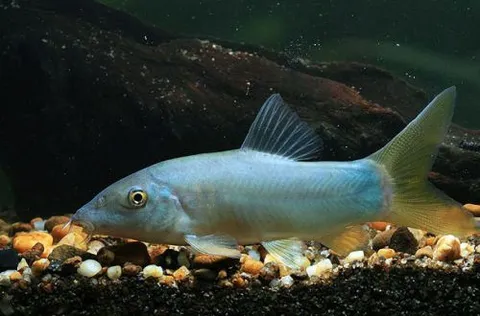
Adults reach a length of 20–25 cm. Sexual dimorphism is weakly expressed; males are typically slightly smaller than females. The body is adorned with a striped pattern: dark stripes are evenly distributed on a yellow background. Young fish also have black speckles that disappear as they mature. The fins and tail may have a reddish tint. This pattern and coloration are the reason for one of the fish's names — the “Tiger Botia.”
This species originates from Southeast Asia, where it inhabits Myanmar (formerly Burma) and the bordering Indian state of Manipur. Berdmore's Loach can be found in various river systems, including the Irrawaddy, Sittaung, and Ataran. It prefers areas with slow currents, shaded by tropical forest. Its natural habitat is characterized by very clean water, sandy-stony bottoms, and an abundance of snags and fallen leaves.
Keeping these fish requires a group of at least 5 individuals; the larger the group, the better. Their aggression towards smaller fish should be noted. Ornamental species with long fins, such as goldfish or bettas, can also suffer from the Tiger Botia. The best tank mates are fish of similar size that inhabit the mid-water or bottom.
For a group of 5 individuals, an aquarium of 300 liters is recommended. An important condition for decor is the presence of a sufficient number of shelters corresponding to the fish's size, such as snags overgrown with mosses or ferns, or other decorative elements. The substrate should consist of sand and gravel with several large stones from which grottoes and crevices can be formed to serve as refuges. To maintain favorable conditions, very clean water, weak current, and subdued lighting are necessary. The use of a powerful filter and weekly replacement of 30–50% of the water volume with fresh water will help prevent the accumulation of organic waste, the regular removal of which with a siphon is also highly recommended.
This species feeds on benthic organisms, detecting them with sensitive barbels located around its mouth. In aquarium conditions, these fish readily accept any sinking foods, especially those containing plant components. It is also desirable to include protein-rich foods in their diet, such as frozen bloodworms or brine shrimp.
In their natural environment, spawning is accompanied by extended upstream migrations, coinciding with the change between the dry and wet seasons. Recreating such conditions in an aquarium is currently not possible. Therefore, these loaches are bred on commercial farms using hormonal preparations.
Health problems in these fish arise only in the presence of injuries or keeping in unsuitable conditions, which leads to a weakening of the immune system and the subsequent occurrence of various diseases. At the first signs of illness, it is necessary first to check the water parameters for exceeding permissible values or the presence of toxic substances (such as nitrites, nitrates, ammonia). If deviations are found, all indicators should be normalized, and then treatment should begin.
When choosing Berdmore's Loach, pay attention to the fish's activity and the condition of its skin. Healthy individuals should be active, with a bright, clearly defined striped pattern, and should not have visible damage, sores, or white film on their bodies. It is important to note that under stress caused by transport or transfer, fish may temporarily pale, but in a calm state, their coloration should quickly recover. — Avoid purchasing fish with sunken bellies or signs of emaciation, as this may indicate internal diseases. — Check the integrity of the fins and the absence of signs of rot, which often occur when kept in unsuitable conditions. — Make sure the fish has no damage around the mouth and barbels, which can be injured during transport or when kept in an aquarium with sharp substrate. Remember that loaches have sharp suborbital spines, which they can extend when stressed, so caution should be exercised when catching them in the store to avoid damaging the net and injuring the fish itself.
The essentials: size, tank volume, water parameters and care
An adult reaches 20–25 cm in length. Plan the tank around the maximum size: the fish quickly outgrows a cramped setup.
The recommended volume is 300 L. A smaller tank speeds up nitrate build-up and raises stress levels.
Temperature 21–26 °C, pH 6.5–7.5, hardness 5–15 dGH. Stability matters more than exact values: sudden swings are harder on the fish than a small deviation from the ideal.
Around 10 years when kept properly. Lifespan depends directly on tank volume, water quality and a varied diet.
Temperament: aggressive / incompatible / unfriendly. Keep this in mind when choosing tank mates.
Recommended setup: small group (5–6 individuals). Ignoring this is a common cause of stress and disease.
Diet type: sinking (any). Feed small portions that are finished within a couple of minutes — overfeeding does more harm than underfeeding.
The scientific name of the species is Syncrossus berdmorei, family Botiidae. It also appears in the literature as: Botia berdmorei.
The water suits 197 of 208 plants in the catalogue — the easiest ones are shown first.
Afzelius's AnubiasAnacharisAnubiasBrazilian PennywortDwarf CloverDwarf CloverDwarf HygrophilaDwarf SagittariaDwarf ValGuppy GrassHornwortJava FernJava MossMoneywortMud SwordNair's LagenandraNarrow Leaf AnacharisNarrow-leaf CloverStringy MossSüsswassertangTaiwan MossTape GrassTemple PlantUssuri Watermilfoil
Matched by family, categories and overlapping keeping conditions
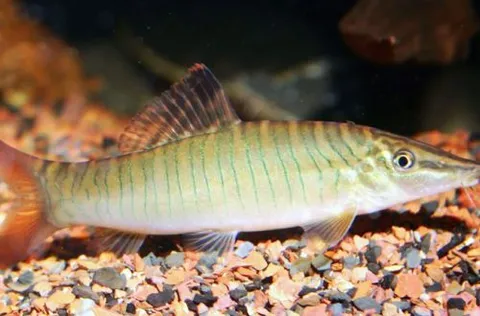
Syncrossus hymenophysa
The Tiger Loach, also known as the Tiger Botia or Green Tiger Loach (scientific name Syncrossus hymenophysa), belongs to the family Botiidae. Its limited suitability for a community aquarium is due to its complex…
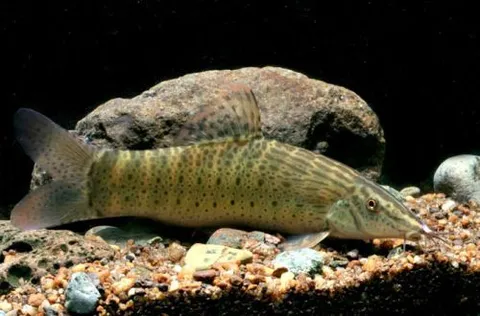
Syncrossus beauforti
The Chameleon Loach, officially known by its scientific name Syncrossus beauforti, belongs to the family Botiidae. This species can be unfriendly towards other aquarium inhabitants, which sometimes complicates the…
Yasuhikotakia modesta
The Modesta Loach, or Blue Botia (scientific name Yasuhikotakia modesta), belongs to the family Botiidae and is also known as the Red-tailed Botia. This peaceful fish reaches a medium size and is easy to care for,…