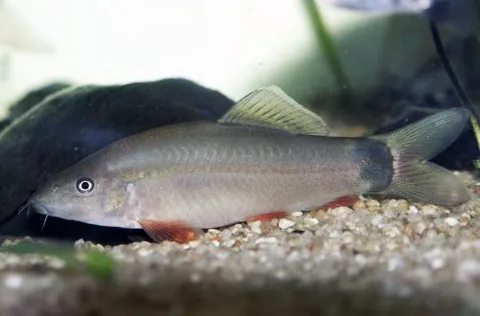
Temperature23 – 28 °C
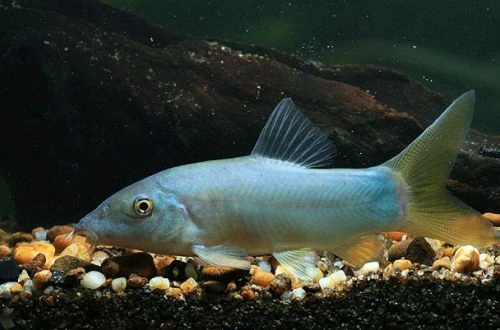
The Modesta Loach, or Blue Botia (scientific name Yasuhikotakia modesta), belongs to the family Botiidae and is also known as the Red-tailed Botia. This peaceful fish reaches a medium size and is easy to care for, making it a good choice for a community tank, as it is compatible with many other calm species.
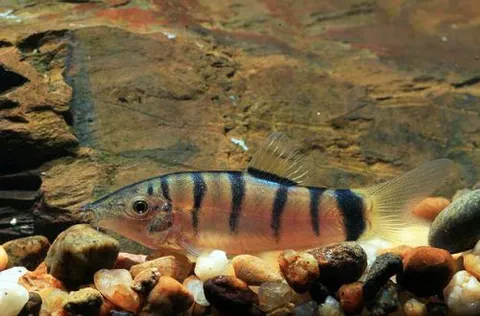
Adults of this fish can reach approximately 25 cm in length. Distinguishing males from females is quite difficult due to weakly expressed sexual dimorphism, although females are usually slightly larger. The fish's body is uniformly grey-blue, which becomes bright blue under optimal conditions. The fins and tail have an orange hue.
Its natural habitat is in Southeast Asia, covering the territories of modern-day Thailand, Laos, Cambodia, and Vietnam. The Blue Botia inhabits the middle and lower reaches of the Mekong River, as well as the Chao Phraya and Mae Klong river basins. These fish are found almost along the entire length of the mentioned rivers and in temporarily flooded coastal areas during the rainy season. They prefer areas with moderate currents, where they find shelter among underwater rocks and tree roots during the day, and set out to forage at dusk.
Compared to other members of its genus, this fish is distinguished by its peaceful and calm disposition. It coexists well with many species of similar or slightly smaller size. Aggressive behavior may only manifest when kept alone, so it is recommended to acquire at least 5 individuals, and preferably to increase the number of Blue Botias to 10 or more. Their tendency to nip the long fins of tank mates should be considered.
For a group of 5 fish, an aquarium of at least 300 liters is recommended. The decor can be arbitrary, but the following conditions must be met: use a soft sandy substrate, provide shelters, and subdued lighting. Live plants are welcome, preferably shade-loving and rooted species. Optimal keeping conditions are achieved with a weak or moderate internal current, in clean and well-oxygenated water. To maintain such conditions, in addition to an effective filtration system, it is necessary to refresh 30–35% of the water volume weekly and regularly clean the aquarium of organic waste.
This fish is a carnivorous species. In its natural habitat, its diet includes aquatic insects and their larvae, small crustaceans, and other zooplankton living on the riverbed. In the aquarium, it is necessary to offer sinking foods, such as dry flakes, pellets, as well as frozen bloodworms, brine shrimp, and daphnia. Pieces of earthworms and mollusks can also be added to the diet. It is important to ensure the presence of plant supplements in the diet, as their absence can lead to the fish damaging fine-leaved plants.
In the wild, the peak spawning season occurs during the rainy season, from May to July, preceded by the migration of fish upstream. After spawning, the fish return. Botias are constantly on the move, traveling hundreds of kilometers along riverbeds throughout the year. Since parental instincts are not developed in them, the eggs are left unattended after spawning. They drift with the current, with some attaching to riparian vegetation, which subsequently serves as a refuge for the fry. Others perish in open water, becoming prey for other fish. Breeding these fish in home aquariums is extremely rare, whereas in commercial fish farms, offspring are obtained through hormonal injections. In addition to artificially bred individuals, wild-caught fish are still found for sale. In some villages, the collection of riparian aquatic vegetation with attached eggs serves as a kind of fishery, and the eggs collected in this way are sold to buyers for fish farms.
Health problems usually arise only as a result of injuries or keeping in unsuitable conditions, which leads to a weakening of the immune system and, as a rule, provokes the development of various diseases. At the first signs of illness, the primary task is to check the water parameters for excesses or dangerous concentrations of toxic substances (nitrates, nitrites, ammonia, etc.). After bringing all indicators back to normal, treatment can begin.
When selecting a blue botia in a store, preference should be given to individuals with clean skin without visible damage, ulcers, white spots, or film. A healthy fish should be active, react lively to external stimuli, and actively explore the substrate. Avoid purchasing individuals with signs of apathy, rapid breathing, or those that constantly stay alone, if the species implies schooling behavior. It is categorically not recommended to purchase fish with unnaturally bright, "neon," or spotted coloration that is not characteristic of the species. Often, such individuals are artificially colored using dye injections, which extremely negatively affects their immunity, leads to a reduction in lifespan, and makes them susceptible to various diseases. Also, carefully inspect the fins: they should be intact, without signs of fraying or damaged edges.
The essentials: size, tank volume, water parameters and care
An adult reaches 20–25 cm in length. Plan the tank around the maximum size: the fish quickly outgrows a cramped setup.
The recommended volume is 300 L. A smaller tank speeds up nitrate build-up and raises stress levels.
Temperature 23–28 °C, pH 6–8, hardness 2–12 dGH. Stability matters more than exact values: sudden swings are harder on the fish than a small deviation from the ideal.
Around 10 years when kept properly. Lifespan depends directly on tank volume, water quality and a varied diet.
Temperament: semi-peaceful (dangerous to smaller ones). Not a predatory species, but small fish that fit in its mouth will eventually be eaten.
Recommended setup: small group (5–6 individuals). Ignoring this is a common cause of stress and disease.
Diet type: sinking (any). Feed small portions that are finished within a couple of minutes — overfeeding does more harm than underfeeding.
The scientific name of the species is Yasuhikotakia modesta, family Botiidae. It also appears in the literature as: Botia modesta, Botia rubripinnis.
The water suits 197 of 208 plants in the catalogue — the easiest ones are shown first.
Afzelius's AnubiasAnacharisAnubiasBrazilian PennywortDwarf CloverDwarf CloverDwarf HygrophilaDwarf SagittariaDwarf ValGuppy GrassHornwortJava FernJava MossMoneywortMud SwordNair's LagenandraNarrow Leaf AnacharisNarrow-leaf CloverStringy MossSüsswassertangTaiwan MossTape GrassTemple PlantUssuri Watermilfoil
Matched by family, categories and overlapping keeping conditions
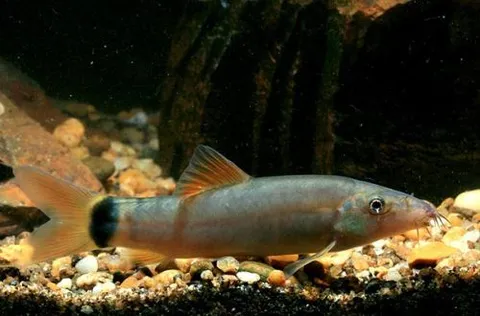
Yasuhikotakia lecontei
The Silver Loach, or Leconte's Loach (scientific name Yasuhikotakia lecontei), is a member of the Botiidae family. This name was given in honor of Dr. and entomologist John L. LeConte from Philadelphia, USA. Provided…
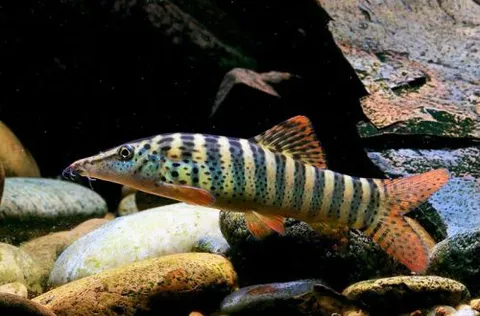
Syncrossus berdmorei
Berdmore's Loach, also known as the Red-tailed Tiger Botia or Blyth's Loach (Syncrossus berdmorei, family Botiidae), is a striking fish that can truly adorn a freshwater aquarium with its original pattern. However, its…
Yasuhikotakia morleti
The Skunk Botia, or Skunk Loach, is also known as the Skunk Botia. Its scientific name is Yasuhikotakia morleti, and it belongs to the family Botiidae. This fish is considered relatively peaceful provided that tank…