Temperature25 – 33 °C
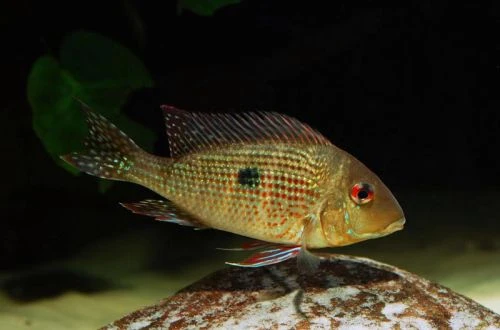
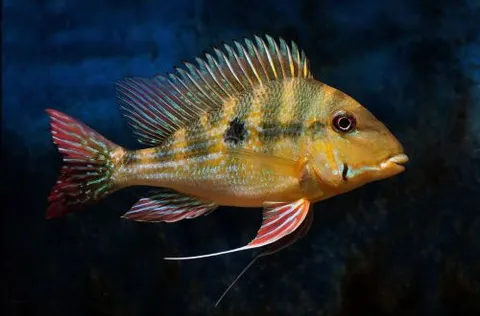
Geophagus brokopondo is the scientific name for this species, which belongs to the family Cichlidae. Geophagus brokopondo is not commonly encountered in the aquarium hobby; it is often supplied in batches with other Geophagus species. Keeping this fish is not difficult, provided it can be given a sufficiently spacious aquarium. It coexists well with representatives of other species.
Adults can reach a length of 15 cm. Sexual dimorphism is weakly expressed, with males and females being almost identical in appearance. The fish have a robust body with a rather large head. Juveniles have a gray coloration, which transforms into golden as they mature. Under various lighting conditions and changes in the angle of incident light, red stripes, composed of tiny speckles, may appear on their bodies. The fins and caudal fin are colored in red or burgundy tones with blue spots.
Its origin is linked to South America, specifically the Suriname River basin, which flows through the country of the same name, as well as the vast artificial lake — the Brokopondo Reservoir — which formed in the 1960s after the construction of a dam. These fish prefer to inhabit regions with sandy substrates, located along the shoreline and in the shallows near islands. The conditions of their natural habitat are characterized by variability. For example, during the rainy season, the water level can rise by several meters, which also affects its chemical composition.
These fish are peaceful towards other species and are well-compatible with many non-aggressive fish of similar or smaller size. It is recommended to maintain a school of at least 5–8 individuals. If the number of fish is smaller, weaker individuals may be subjected to attacks by dominant conspecifics.
For a school of 5–8 individuals, the optimal aquarium volume starts from 500 liters. The decor can be arbitrary, but the choice of substrate is extremely important. As mentioned earlier, sandy substrate must be used. If breeding is planned, it is advisable to install several large flat stones, which can serve as spawning sites. Although Geophagus brokopondo can adapt to a fairly wide range of conditions, it is crucial to avoid sharp fluctuations in temperature, pH, and dGH values. It is also necessary to prevent the accumulation of dangerous concentrations of nitrogen cycle products (ammonia, nitrites, nitrates), which is especially relevant in aquariums without live plants. To maintain stable water conditions, the aquarium should be equipped with the necessary gear and undergo regular maintenance: weekly partial water changes with fresh water, as well as the removal of organic waste (food remnants, excrement), and so on. When choosing a filtration system, it is worth considering that during feeding, the fish can create clouds of suspended particles that can clog the filter, so not every model will be suitable. In such a situation, it is recommended to consult with specialists.
Feeding occurs in the benthic zone. Geophagus take sand into their mouths, then sift it through their gills, searching for small invertebrates, as well as particles of vegetation and algae. Given this method of foraging, a sandy substrate must be provided in the aquarium, and sinking foods should be used. Excellent choices include dry flakes or granules, which can be supplemented with frozen artemia, daphnia, and pieces of bloodworms.
The choice of breeding strategy and offspring protection depends on the conditions: fish can adhere to one of two. In the first case, during spawning, fertilized eggs are attached to a surface, such as a stone, and the parents remain in close proximity to guard them. In the second option, the female collects fertilized eggs into her mouth, where they spend the entire incubation period. As of the creation of this description, successful breeding cases of Geophagus brokopondo have not yet been recorded. The lack of such information is likely due to the limited prevalence of this species in the aquarium hobby.
The main cause of diseases often lies in the keeping conditions: if they go beyond acceptable limits, immunity decreases, making the fish vulnerable to various infections inevitably present in the environment. At the first suspicion of illness, it is important first of all to check the water parameters and ensure there are no dangerous concentrations of nitrogen cycle products. Often, restoring normal, suitable conditions promotes recovery. However, in some cases, medication may be required.
When purchasing, it should be noted that this species is rarely available for sale, so it is important to ensure the correct identification of the individual. Healthy fish should swim actively, show interest in food, and have no external damage, such as ulcers, fin rot, or cloudy film on their scales. Avoid individuals with sunken bellies or signs of emaciation, as this may indicate hidden diseases or problems with adaptation to captivity. Since the species is schooling, it is recommended to acquire a group of 5–8 individuals to reduce stress during transport and subsequent introduction into the aquarium. Ask the seller about the conditions in the store, as stress from abrupt changes in water parameters can negatively affect the health of these cichlids.
The essentials: size, tank volume, water parameters and care
An adult reaches 15 cm in length. Plan the tank around the maximum size: the fish quickly outgrows a cramped setup.
The recommended volume is 500 L. A smaller tank speeds up nitrate build-up and raises stress levels.
Temperature 25–33 °C, pH 5–7, hardness 1–10 dGH. Stability matters more than exact values: sudden swings are harder on the fish than a small deviation from the ideal.
Around 12 years when kept properly. Lifespan depends directly on tank volume, water quality and a varied diet.
Temperament: peaceful (regular). Keep this in mind when choosing tank mates.
Recommended setup: medium group (6–8 individuals). Ignoring this is a common cause of stress and disease.
Diet type: sinking (any). Feed small portions that are finished within a couple of minutes — overfeeding does more harm than underfeeding.
The scientific name of the species is Geophagus brokopondo, family Cichlids (Cichlidae).
The water suits 186 of 208 plants in the catalogue — the easiest ones are shown first.
Afzelius's AnubiasAnacharisAnubiasBrazilian PennywortDwarf CloverDwarf CloverDwarf HygrophilaDwarf SagittariaDwarf ValGuppy GrassHornwortJava FernJava MossMoneywortMud SwordNair's LagenandraNarrow Leaf AnacharisNarrow-leaf CloverSüsswassertangTaiwan MossTape GrassTemple PlantUssuri WatermilfoilWater Wisteria
Matched by family, categories and overlapping keeping conditions
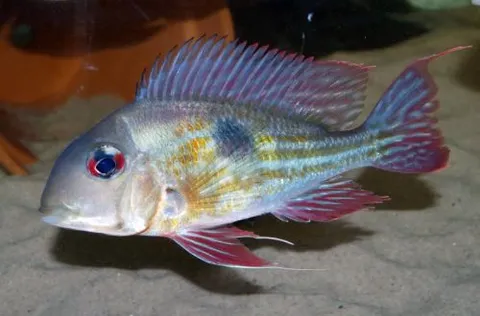
Geophagus proximus
Geophagus proximus, known scientifically as Geophagus proximus, belongs to the family Cichlidae, or cichlids. This species is not frequently sold individually; it more often enters home aquariums as part of large…
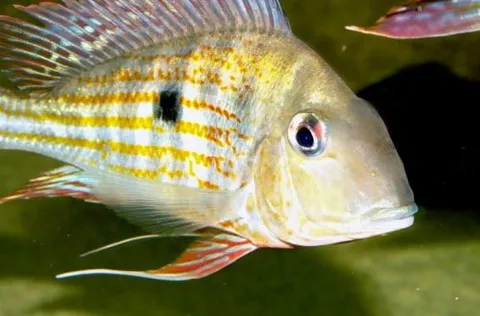
Geophagus abalios
Geophagus abalios, also known as the Spotted Geophagus, belongs to the Cichlidae family. It is rarely found under its true name in retail outlets; more often, it is mistakenly offered as the Surinam Geophagus. This…
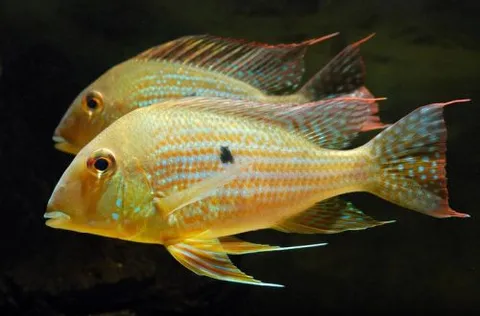
Geophagus neambi
Geophagus neambi, widely known as Geophagus neambi or Geophagus Tocantins, is a member of the Cichlidae family. This popular American cichlid is actively offered to buyers, and its keeping, as well as breeding, does not…
Geophagus dicrozoster
Geophagus dicrozoster, a member of the Cichlidae family, is the scientific name for this aquarium fish. In the trade, it can often be found under other names, such as Geophagus Surinam, Geophagus Colombia, or Geophagus…