Temperature26 – 30 °C
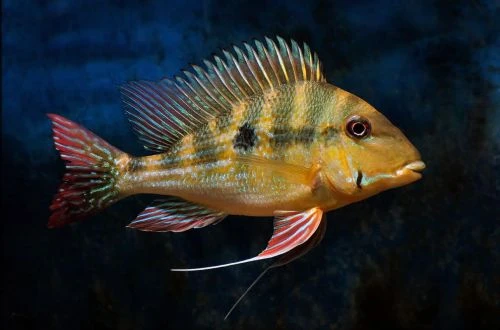
Geophagus dicrozoster, a member of the Cichlidae family, is the scientific name for this aquarium fish. In the trade, it can often be found under other names, such as Geophagus Surinam, Geophagus Colombia, or Geophagus Rio Negro, although these are not accurate. If you can provide a large aquarium, keeping and breeding this species will not present difficulties. The fish shows excellent compatibility with other species.
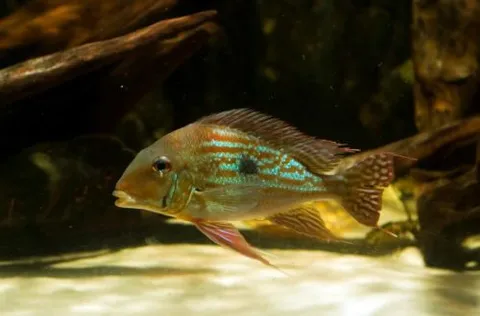
These fish grow up to 20 cm in length. Sexual dimorphism is not pronounced, although males are usually larger and have elongated rays on their pelvic fins. The main body color is yellow, and the fins and tail shimmer with red hues and blue strokes. A characteristic feature is a black spot on the body. Dominant males may develop vertical dark stripes.
This species originates from South America, specifically from the Apure and Bolívar regions of Venezuela, where it can be found in the Orinoco River basin. The fish's natural habitat consists of small rivers and streams winding through humid tropical forests. The bottom of these bodies of water is often covered with fallen leaves on sandy substrate, and the riverbed abounds with fallen tree trunks and branches. The water here acquires a rich brown hue due to the abundance of tannins released during the decomposition of plant organic matter. Due to low transparency, aquatic vegetation is extremely rare.
Towards other species, these cichlids are peaceful and can coexist with non-aggressive fish of similar or slightly smaller size. Intraspecific interactions are based on a hierarchy, with an alpha male dominating. It is desirable to maintain a group size of at least 5–8 individuals, as with fewer numbers, weaker fish may be attacked by dominant members of the school.
For comfortable keeping of a group of 5–8 Geophagus dicrozoster, an aquarium of at least 600 liters will be required. For decor, a sandy substrate is preferred, supplemented with several large flat stones and various snags. Shade-loving plants are permissible, although they are practically absent in nature. For convenience, it is best to plant them in separate pots submerged in the substrate so that the fish do not dig them up during feeding. Lighting should be subdued. These cichlids are sensitive to changes in water quality, such as the accumulation of nitrogen cycle products, as well as fluctuations in hydrochemical parameters and temperature. To maintain stable conditions in the aquarium, it is necessary to equip it with all the necessary equipment, with a central role given to the filtration system, and to perform regular maintenance. This includes weekly water changes of approximately 50% with fresh water, as well as the removal of organic waste such as food remnants and excrement.
In search of food, the fish thoroughly explore the bottom, taking substrate into their mouths and sifting the sand to find small invertebrates. In aquarium conditions, they readily accept sinking foods, such as dry flakes or pellets. Their diet can be enriched with frozen brine shrimp, daphnia, and pieces of bloodworms. It is recommended to feed them small portions 3–4 times a day.
Under favorable conditions, offspring are very likely to appear. At the beginning of the breeding season, the male and female form a temporary pair. The female lays eggs on a smooth, flat surface, such as a stone, and stays near the clutch until the fry hatch. Fry emerge after 3–4 days. Sometimes the female may take them into her mouth for protection; they remain there until they grow larger. Periodically, the fry will emerge from their hiding place to feed. A caring male sometimes also participates in caring for the offspring, but more often he shifts his attention to courting another female.
The main cause of diseases often lies in the keeping conditions: if they go beyond acceptable limits, immunity decreases, making the fish vulnerable to various infections inevitably present in the environment. At the first suspicion of illness, it is important first of all to check the water parameters and ensure there are no dangerous concentrations of nitrogen cycle products. Often, restoring normal, suitable conditions promotes recovery. However, in some cases, medication may be required.
When choosing Geophagus dicrozoster, preference should be given to individuals with clean fins and no visible skin damage. It is important to assess the fish's behavior: healthy specimens are active, constantly exploring the substrate for food, and demonstrate strong sociality, staying in a group. Avoid purchasing fish that appear emaciated, have sunken bellies, or show signs of apathy, as this species is sensitive to water quality and stress during transport. — Inspect the fish for signs of lateral line erosion or spots, which may indicate chronic poor husbandry. — Ensure that there are no signs of mass diseases in the store's aquarium, as this species is extremely susceptible to unstable environmental parameters. — Since a group of 5–8 individuals is required for normal adaptation, it is recommended to purchase young fish of the same size to minimize intraspecific aggression.
The essentials: size, tank volume, water parameters and care
An adult reaches 20 cm in length. Plan the tank around the maximum size: the fish quickly outgrows a cramped setup.
The recommended volume is 600 L. A smaller tank speeds up nitrate build-up and raises stress levels.
Temperature 26–30 °C, pH 4–7, hardness 1–10 dGH. Stability matters more than exact values: sudden swings are harder on the fish than a small deviation from the ideal.
Around 8 years when kept properly. Lifespan depends directly on tank volume, water quality and a varied diet.
Temperament: peaceful (regular). Keep this in mind when choosing tank mates.
Recommended setup: medium group (6–8 individuals). Ignoring this is a common cause of stress and disease.
Diet type: sinking (any). Feed small portions that are finished within a couple of minutes — overfeeding does more harm than underfeeding.
The scientific name of the species is Geophagus dicrozoster, family Cichlids (Cichlidae).
The water suits 175 of 208 plants in the catalogue — the easiest ones are shown first.
Afzelius's AnubiasAnacharisAnubiasBrazilian PennywortDwarf CloverDwarf CloverDwarf HygrophilaDwarf SagittariaDwarf ValGuppy GrassHornwortJava FernJava MossMoneywortMud SwordNair's LagenandraNarrow Leaf AnacharisNarrow-leaf CloverSüsswassertangTaiwan MossTape GrassTemple PlantUssuri WatermilfoilWater Wisteria
Matched by family, categories and overlapping keeping conditions
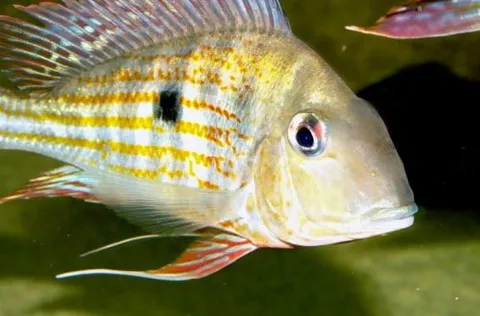
Geophagus abalios
Geophagus abalios, also known as the Spotted Geophagus, belongs to the Cichlidae family. It is rarely found under its true name in retail outlets; more often, it is mistakenly offered as the Surinam Geophagus. This…
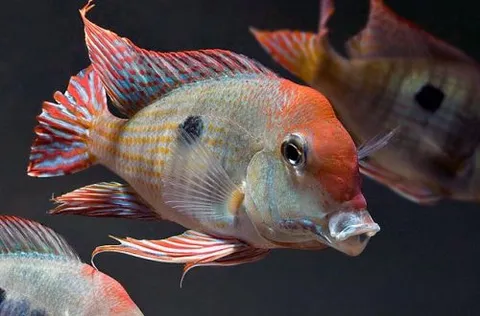
Geophagus sp. «Orange head»
Geophagus sp. «Orange head», widely known as the Orange Head or Red Hump Geophagus, belongs to the Cichlidae family. This South American cichlid has gained significant popularity among aquarists due to its ease of care…
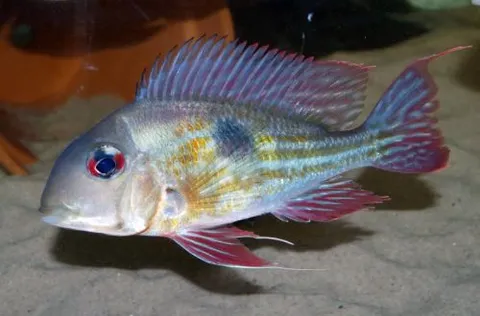
Geophagus proximus
Geophagus proximus, known scientifically as Geophagus proximus, belongs to the family Cichlidae, or cichlids. This species is not frequently sold individually; it more often enters home aquariums as part of large…
Geophagus winemilleri
Geophagus winemilleri, scientifically known as Geophagus winemilleri, belongs to the Cichlidae family. The fish was named after zoologist Kirk O. Winemiller, who actively studied tropical fish in Venezuela for two…