Temperature26 – 30 °C
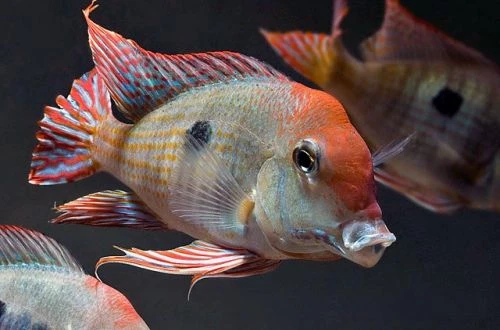
Geophagus sp. «Orange head», widely known as the Orange Head or Red Hump Geophagus, belongs to the Cichlidae family. This South American cichlid has gained significant popularity among aquarists due to its ease of care and breeding, as well as its excellent compatibility with many freshwater species.
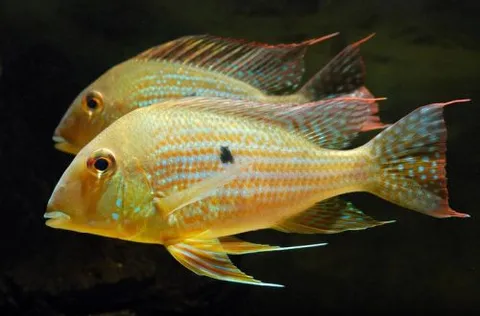
Adults of this species reach a length of 20 to 25 cm. Males are typically larger and have more intense coloration. Their dorsal fin is pointed, and alpha males often develop a noticeable nuchal hump on their head. Body coloration varies from gray with rows of pale orange stripes and streaks, while the head has an orange, transitioning to red, hue. Bright fins display a combination of blue and red colors.
The natural habitat of this species covers the central regions of Brazil in South America, specifically the lower Tapajós River basin, which is a large right tributary of the Amazon. There is also a separate population in the Araguaia River, located deep within the continent. Although these fish are supplied under a single name, the geographical distance and lack of direct connection between these rivers raise doubts among some researchers about their belonging to a single species. It is possible that over time, Geophagus from the Tapajós and Araguaia will be classified as separate species. The waters of the Araguaia River are characterized by a brown tint and transparency, due to the high content of tannins, which are formed during the decomposition of organic material — roots, tree branches, leaves, and riparian grasses. In contrast, the Tapajós River is known for its turbid, so-called “white” waters, saturated with a large number of suspended particles resembling a suspension. During the rainy season, the water turbidity there increases significantly. However, despite differences in water quality, the habitat in both cases is similar: sandy, silty substrates, rich in fallen trees, which serve as shelter for numerous fish species.
These fish have a calm and peaceful nature, allowing them to coexist peacefully even with smaller species. Within a group of Geophagus, relationships are built on a hierarchy, with an alpha male dominating. However, other individuals lower in the hierarchy do not experience oppression from their conspecifics. It is recommended to keep a group of 5–8 individuals. Often, mature males and females form a pair that lasts for a long time.
For a group of 6–8 Red Hump Geophagus, the optimal aquarium volume starts from 600 liters. In terms of aquarium design, essentially only the substrate is important. Given the feeding habits of these fish, a sandy substrate free of large or abrasive inclusions that could get stuck in their mouths is preferable. Although decor requirements are minimal, the fish will look more harmonious in conditions that recreate their natural environment: snags forming reliable shelters, and subdued lighting. The use of fallen leaves, characteristic of natural biotopes, is not recommended in this case, as they can clog the substrate and create obstacles for normal feeding. For the long-term well-being of the fish, it is crucial to maintain stable water parameters within the acceptable range of temperatures and key hydrochemical indicators (pH, dGH), and to prevent the accumulation of nitrogen cycle products (nitrites, nitrates, ammonia) to dangerous concentrations. To this end, the aquarium must be equipped with all necessary equipment and regularly maintained. When choosing a filtration system, it should be able to effectively handle the large volume of suspended matter produced during fish feeding. Many filters can quickly become clogged with sand, reducing their effectiveness or leading to breakdown. Most often, a dual purification system is used, where water first enters a buffer tank for the settling of large particles and the retention of fine particles by a mechanical filter, and then is pumped into the main filter.
The fish actively forage for food from the bottom, taking substrate into their mouths and sifting it through their gills to filter out edible particles. This highlights the importance of choosing the right substrate in the aquarium. Their diet should be varied, including a sufficient amount of plant components. In a home aquarium, it is recommended to offer sinking foods in small portions, 3–4 times a day. It is interesting to note that despite the impressive size of these fish, they can only consume small food particles.
Under favorable aquarium conditions, breeding Red Hump Geophagus is not particularly difficult. At the beginning of the breeding season, the male and female choose an area on the aquarium bottom, usually with a flat surface, such as a stone, in its center. After brief courtship, the fish begin spawning, which can last several hours. The female lays eggs in batches, a few at a time. The incubation period is approximately 72 hours, and throughout this time, the parents stay near the clutch, protecting it. Parental care continues after the fry emerge: in case of danger or at night, they hide in the female's mouth; sometimes the male also participates in this process. As they grow and develop, the fry resort to this unusual hiding place less and less often.
The main cause of diseases often lies in the keeping conditions: if they go beyond acceptable limits, immunity decreases, making the fish vulnerable to various infections inevitably present in the environment. At the first suspicion of illness, it is important first of all to check the water parameters and ensure there are no dangerous concentrations of nitrogen cycle products. Often, restoring normal, suitable conditions promotes recovery. However, in some cases, medication may be required.
When choosing Red Hump Geophagus, it is important to pay attention to their activity and skin condition. Healthy individuals should be mobile, show curiosity about their surroundings, and actively explore the bottom. Avoid fish with signs of emaciation, sunken bellies, or fin damage, as these cichlids are sensitive to water quality and stress during transport. — Inspect the fish for spots, sores, or unusual film on the body, which may indicate bacterial or parasitic diseases. — Ensure that the fish's eyes are clear and transparent, without cloudiness. — Observe their behavior in the store: fish that constantly hide in corners or appear lethargic may be sick or experiencing severe stress.
The essentials: size, tank volume, water parameters and care
An adult reaches 20–25 cm in length. Plan the tank around the maximum size: the fish quickly outgrows a cramped setup.
The recommended volume is 600 L. A smaller tank speeds up nitrate build-up and raises stress levels.
Temperature 26–30 °C, pH 4.5–7.5, hardness 1–10 dGH. Stability matters more than exact values: sudden swings are harder on the fish than a small deviation from the ideal.
Around 8 years when kept properly. Lifespan depends directly on tank volume, water quality and a varied diet.
Temperament: peaceful (regular). Keep this in mind when choosing tank mates.
Recommended setup: medium group (6–8 individuals). Ignoring this is a common cause of stress and disease.
Diet type: sinking (any). Feed small portions that are finished within a couple of minutes — overfeeding does more harm than underfeeding.
The scientific name of the species is Geophagus sp. «Orange head», family Cichlids (Cichlidae).
The water suits 175 of 208 plants in the catalogue — the easiest ones are shown first.
Afzelius's AnubiasAnacharisAnubiasBrazilian PennywortDwarf CloverDwarf CloverDwarf HygrophilaDwarf SagittariaDwarf ValGuppy GrassHornwortJava FernJava MossMoneywortMud SwordNair's LagenandraNarrow Leaf AnacharisNarrow-leaf CloverSüsswassertangTaiwan MossTape GrassTemple PlantUssuri WatermilfoilWater Wisteria
Matched by family, categories and overlapping keeping conditions
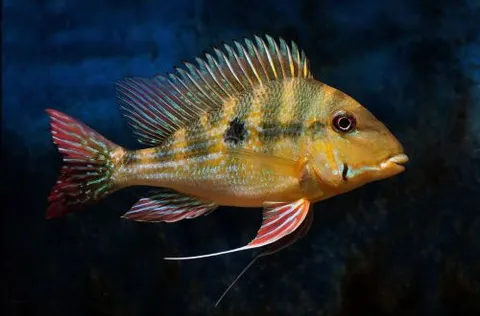
Geophagus dicrozoster
Geophagus dicrozoster, a member of the Cichlidae family, is the scientific name for this aquarium fish. In the trade, it can often be found under other names, such as Geophagus Surinam, Geophagus Colombia, or Geophagus…
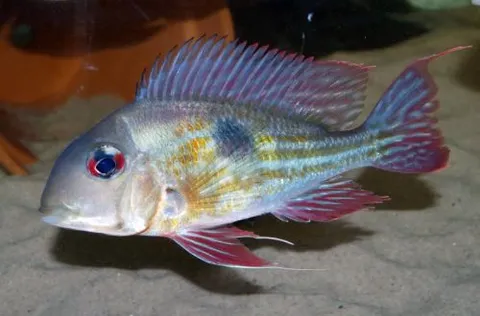
Geophagus proximus
Geophagus proximus, known scientifically as Geophagus proximus, belongs to the family Cichlidae, or cichlids. This species is not frequently sold individually; it more often enters home aquariums as part of large…
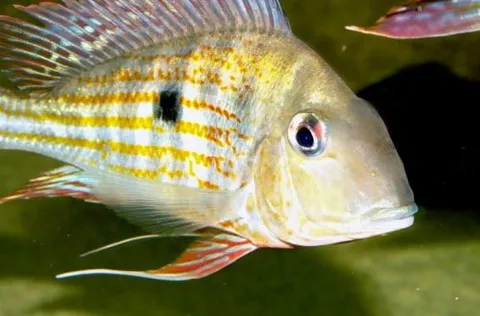
Geophagus abalios
Geophagus abalios, also known as the Spotted Geophagus, belongs to the Cichlidae family. It is rarely found under its true name in retail outlets; more often, it is mistakenly offered as the Surinam Geophagus. This…
Geophagus neambi
Geophagus neambi, widely known as Geophagus neambi or Geophagus Tocantins, is a member of the Cichlidae family. This popular American cichlid is actively offered to buyers, and its keeping, as well as breeding, does not…