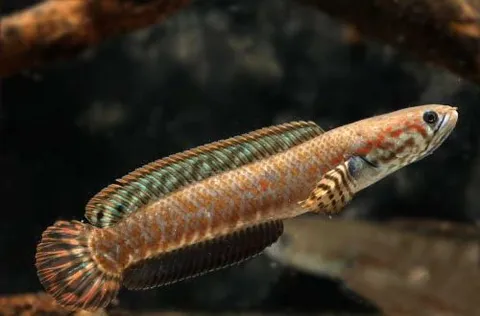
Rainbow Snakehead
Channa bleheri
The rainbow snakehead, Channa bleheri, is a member of the family Channidae. It originates from Asia, with its natural range believed to be limited to the Brahmaputra River basin in the Indian states of Assam and…
The Golden Cobra Snakehead, known scientifically as Channa aurantimaculata, is a member of the family Channidae, or snakeheads. This fish originates from Asia. It is considered endemic to the Brahmaputra River, and its natural habitat is limited to areas of the Indian states of Assam and Arunachal Pradesh.
Predator: dangerous to small fish
Adults of this fish can reach a length of up to 40 cm. Its elongated body resembles an eel in appearance. The head is characterized by a flat shape, a large mouth studded with many teeth, and widely spaced eyes, giving it a resemblance to a snake's head. The dorsal fin extends almost the entire length of the body, from the head to the caudal fin. The pelvic fin, located approximately in the middle of the body, is significantly shorter than the dorsal fin. The coloration of the back and most of the head is dark gray. Along the sides of the body, a pattern of alternating dark and yellow (or orange) vertical stripes can be observed. These fish are unique in their ability to breathe atmospheric air and remain out of water for extended periods if high humidity is maintained. This adaptive ability allows them to successfully survive in conditions of low dissolved oxygen and during droughts, when they are forced to seek refuge in caves.
The species is endemic to the Brahmaputra River basin in the states of Assam and Arunachal Pradesh, India. It inhabits forest streams, swamps, and stagnant water bodies with dense riparian vegetation. In nature, it prefers biotopes with a subtropical monsoon climate, where during the dry winter season, fish often take refuge in deep burrows, and during the monsoon period, water bodies overflow, providing conditions for reproduction.
This species is characterized by territoriality and aggression. The behavior of snakeheads is difficult to predict, especially in relation to conspecifics. It is not uncommon for two individuals, raised together and previously coexisting peacefully, to suddenly begin to show hostility. Such clashes can lead to serious injuries and even the death of the weaker fish. If the aquarium size is relatively small (for this species, the acceptable minimum is about 300 liters), it is recommended to keep only one adult individual, without representatives of other species.
The required aquarium volume starts from 540 liters, with a minimum tank depth of 30 cm, while its height does not play a significant role. It is advisable to place shelters on the bottom of the aquarium, such as large snags, and also to create areas with lush aquatic vegetation. Lighting should be subdued. The presence of floating plants, such as Water Wisteria, which is found in the natural habitat of snakeheads, is welcome. The aquarium should be equipped with a tight-fitting lid so that the Golden Cobra Snakehead cannot escape the tank. It is important to leave an air gap between the water surface and the lid, as the fish needs to breathe atmospheric air. The previously noted unpretentiousness allows this species to survive in natural conditions that are extreme for other fish. Basic water parameters, such as pH and GH, are not critical if they are within acceptable limits. However, the temperature regime requires adjustment to mimic natural seasonal changes. Thus, in the summer months, it is recommended to maintain a temperature between 26–28°C, and in winter, the heater can be turned off, allowing the temperature to drop to room values. In the wild, the diet consists mainly of small fish, amphibians, and insects. In a home aquarium, they successfully adapt to fresh or pre-thawed products, such as pieces of fish, shrimp, and mussels. Large earthworms can also be offered. Dry granulated or tablet foods are acceptable, but only as additional sources of minerals and vitamins.
In natural conditions, the Golden Cobra Snakehead feeds on small fish, amphibians, and various insects. In aquarium conditions, this fish successfully adapts to fresh or thawed products, such as chopped fish meat, shrimp, or mussels. Large earthworms can also be included in the diet. Dry foods, presented as granules or tablets, are allowed, but they should only be used as an additional source of vitamins and minerals. They must not be fed mammalian or avian meat: the lipids it contains cannot be properly metabolised by the fish and lead to excess fat deposits and even organ degeneration.
The snakehead is a mouthbrooding species, with the male usually taking care of the offspring. Spawning is paired, often stimulated by imitating seasonal changes: a decrease in water temperature in winter, followed by its gradual increase and imitation of rains. The eggs are large; after fertilization, the male collects them in his mouth, where they incubate for about 10 days. Fry, after hatching, need small live foods, such as Artemia nauplii or small insect larvae.
Fish are susceptible to bacterial infections, including ulcerative lesions, often caused by pathogens of the genus Aeromonas, especially when keeping conditions are violated and water quality is poor. Cases of cloudy eyes, fungal diseases, and parasitic infestations, such as ichthyophthiriasis, are also common. For prevention, it is necessary to maintain stable environmental parameters, prevent the accumulation of organic matter, and ensure a seasonal temperature regime, as constant maintenance at high temperatures negatively affects immunity.
When purchasing, choose active individuals with clean skin without visible ulcers, spots, or fin damage. It is important to pay attention to behavior: a healthy fish should show curiosity, have clear eyes, and be well-fed without signs of emaciation. Avoid individuals that appear sluggish, constantly lie on the bottom, or have a sunken abdomen, as this may indicate stress, internal parasitic infections, or problems adapting to captivity.
There are no pair reviews for this species yet — check tankmates in the matcher.
All tankmatesThe water suits 197 of 208 plants in the catalogue — the easiest ones are shown first.
Afzelius's AnubiasAnacharisAnubiasBrazilian PennywortDwarf CloverDwarf CloverDwarf HygrophilaDwarf SagittariaDwarf ValGuppy GrassHornwortJava FernJava MossMoneywortMud SwordNair's LagenandraNarrow Leaf AnacharisNarrow-leaf CloverStringy MossSüsswassertangTaiwan MossTape GrassTemple PlantUssuri Watermilfoil
Matching water does not mean the plant will stay intact.
The essentials: size, tank volume, water parameters and care
An adult reaches 40 cm in length. Plan the tank around the maximum size: the fish quickly outgrows a cramped setup.
The recommended volume is 540 L. A smaller tank speeds up nitrate build-up and raises stress levels.
Temperature 10–28 °C, pH 6–8, hardness 3–20 dGH. Stability matters more than exact values: sudden swings are harder on the fish than a small deviation from the ideal.
Around 10 years when kept properly. Lifespan depends directly on tank volume, water quality and a varied diet.
Temperament: aggressive / incompatible / unfriendly. This is a predatory species — any fish small enough to fit in its mouth will eventually be eaten.
Recommended setup: solitary. Ignoring this is a common cause of stress and disease.
Diet type: meat / protein (live, frozen, fresh). Feed small portions that are finished within a couple of minutes — overfeeding does more harm than underfeeding.
The scientific name of the species is Channa aurantimaculata, family Snakeheads (Channidae).
Matched by family, categories and overlapping keeping conditions
Channa bleheri
The rainbow snakehead, Channa bleheri, is a member of the family Channidae. It originates from Asia, with its natural range believed to be limited to the Brahmaputra River basin in the Indian states of Assam and…
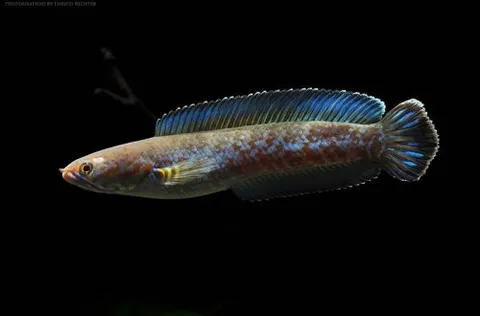
Channa andrao
The scientific name Channa andrao belongs to the Channa andrao snakehead, a representative of the family Channidae (snakeheads). Although this fish was described by researcher Ralf Britz in 2013, it was known to…
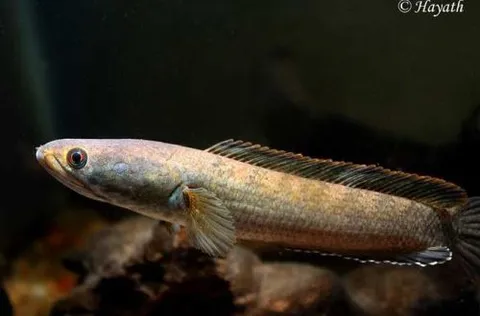
Channa gachua
The Dwarf Snakehead (Channa gachua), a member of the family Channidae, inhabits a vast natural range. It extends from Afghanistan and Pakistan, across Asia, all the way to the islands of Indonesia in Southeast Asia.…
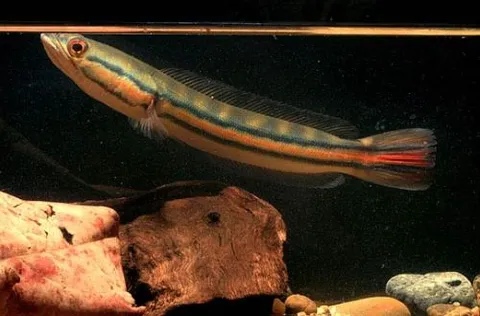
Channa micropeltes
Channa micropeltes is a member of the family Channidae. This fish is also called the red snakehead or striped snakehead. Its large size has earned it the common names giant snakehead and Indonesian snakehead; the latter…