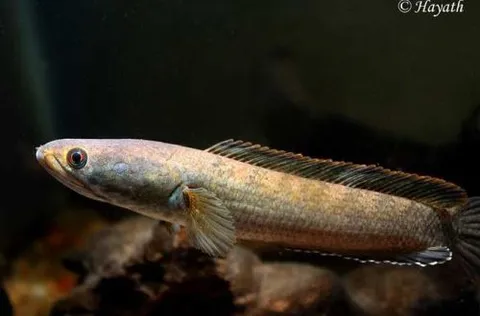
Dwarf Snakehead
Channa gachua
The Dwarf Snakehead (Channa gachua), a member of the family Channidae, inhabits a vast natural range. It extends from Afghanistan and Pakistan, across Asia, all the way to the islands of Indonesia in Southeast Asia.…
Channa micropeltes is a member of the family Channidae. This fish is also called the red snakehead or striped snakehead. Its large size has earned it the common names giant snakehead and Indonesian snakehead; the latter refers to the region where European naturalists first encountered it.
Predator: dangerous to small fish
Adults impress with their size, reaching up to 130 cm in length and weighing up to 20 kg. They have an elongated, snake-like body and a large head with a big mouth armed with sharp teeth. Young fish are strikingly bright: fry are nearly entirely red. As they grow, they develop a pattern of two narrow black stripes with a broad red band between them. With age, these stripes fade, and the red pigment on the tail is the last to go. Adult snakeheads have a brown back and sides with a greenish pattern resembling light water ripples, while the belly is pale and silvery. Members of the genus Channa are adapted to harsh conditions such as drying pools or low oxygen. They breathe atmospheric air and can survive out of water for long periods if protected from direct sunlight—for example, by hiding in mud, silt, or burrows. They can also travel short distances overland to move from one body of water to another.
This species inhabits vast areas of Southeast Asia, from the river systems of Laos and Thailand to the islands of Indonesia, including the Greater Sunda Islands. It is found in main river channels, swamps, lakes, and man-made waters such as ponds and reservoirs. It prefers deep areas with slow flow or still water.
Young fish live in large schools, but as they mature they become solitary and aggressive toward their own kind. As a predator, this fish is compatible only with other fish of similar size that it will not regard as food.
Red snakeheads usually enter the hobby when young, while their bright colours are still intact. Beginners often make the mistake of placing small fish in relatively small tanks without considering the adult's potential maximum size. As the fish grows, loses its distinctive pattern, and the tank becomes cramped, the aquarist faces a problem. Red snakeheads are frequently released into the wild. This irresponsible behaviour has already introduced the striped snakehead to regions far from its native range, including North America. Although it has not established itself everywhere due to climate, in some areas it has become a dominant predator, causing serious damage to local ecosystems. If you plan to keep this species long-term, you will need a spacious tank of at least 1000 litres. A dimly lit aquarium with numerous hiding places formed from rocks, driftwood, and other décor is recommended. This species is hardy and adaptable to substantial changes in the environment. In the aquarium it tolerates a wide range of pH and dGH values, shows no sensitivity to oxygen levels, and handles moderate levels of natural pollution. A cover or other safety device is essential to prevent the snakehead from escaping the tank. Since the fish breathes atmospheric air, maintain an air gap between the lid and the water surface. Routine maintenance includes regular cleaning of the substrate from organic waste (food scraps, faeces), partial water changes with fresh water, and equipment checks. This is a predator that eats everything it can swallow. In the wild its diet consists of smaller fish, amphibians, insects, their larvae, and other invertebrates. In captivity they can be trained to take alternatives such as pieces of fish flesh, mussels, shrimp, earthworms, large bloodworms, and similar foods.
This species is a predator that eats everything it can swallow. In nature its diet consists mainly of smaller fish, amphibians, insects, their larvae, and other invertebrates. In the aquarium these fish can be trained to accept alternative foods such as pieces of fish flesh, mussels, shrimp, earthworms, or large bloodworms. Never feed mammal or bird meat: the lipids in it are not digested by the fish, leading to fat deposits and even organ degeneration.
Breeding in captivity is extremely difficult due to the fish's giant size and the huge volumes of water required. Fish reach maturity at around two to four years of age. Spawning is pairwise and is often triggered by raising the temperature to 27°C. In nature, fish build nests or lay eggs among vegetation, which the parents guard. Fry require abundant feeding on plankton and live foods, and the male may guard the offspring for several weeks.
The red snakehead is sensitive to water quality and the buildup of organic waste, which often leads to bacterial infections, fin damage, and skin disease. Ectoparasites such as flukes are common and require specific treatment. Poor filtration and high levels of nitrogenous compounds cause stress and reduce immunity. Prevention involves maintaining stable water parameters, regular water changes, and avoiding feeding live fish from questionable sources, as these often carry parasites.
When buying, choose active fish with clean skin free of visible ulcers, film, or fin damage. Assess their behaviour: a healthy fish shows curiosity, has good appetite, and breathes normally. Avoid specimens with sunken bellies, cloudy eyes, or unnaturally sluggish behaviour. Given the aggressive nature of the species, it is wise to ensure in advance that you have suitable conditions for an adult, as these fish grow very quickly and require considerable space.
There are no pair reviews for this species yet — check tankmates in the matcher.
All tankmatesThe water suits 197 of 208 plants in the catalogue — the easiest ones are shown first.
Afzelius's AnubiasAnacharisAnubiasBrazilian PennywortDwarf CloverDwarf CloverDwarf HygrophilaDwarf SagittariaDwarf ValGuppy GrassHornwortJava FernJava MossMoneywortMud SwordNair's LagenandraNarrow Leaf AnacharisNarrow-leaf CloverStringy MossSüsswassertangTaiwan MossTape GrassTemple PlantUssuri Watermilfoil
Matching water does not mean the plant will stay intact.
The essentials: size, tank volume, water parameters and care
An adult reaches 130 cm in length. Plan the tank around the maximum size: the fish quickly outgrows a cramped setup.
The recommended volume is 1000 L. A smaller tank speeds up nitrate build-up and raises stress levels.
Temperature 20–30 °C, pH 6–8, hardness 3–20 dGH. Stability matters more than exact values: sudden swings are harder on the fish than a small deviation from the ideal.
Around 12 years when kept properly. Lifespan depends directly on tank volume, water quality and a varied diet.
Temperament: aggressive / incompatible / unfriendly. This is a predatory species — any fish small enough to fit in its mouth will eventually be eaten.
Recommended setup: solitary + other species (large / compatible). Ignoring this is a common cause of stress and disease.
Diet type: meat / protein (live, frozen, fresh). Feed small portions that are finished within a couple of minutes — overfeeding does more harm than underfeeding.
The scientific name of the species is Channa micropeltes, family Snakeheads (Channidae). It also appears in the literature as: Channa micropeltis, Ophicephalus bivittatus, Ophicephalus micropeltes.
Matched by family, categories and overlapping keeping conditions
Channa gachua
The Dwarf Snakehead (Channa gachua), a member of the family Channidae, inhabits a vast natural range. It extends from Afghanistan and Pakistan, across Asia, all the way to the islands of Indonesia in Southeast Asia.…
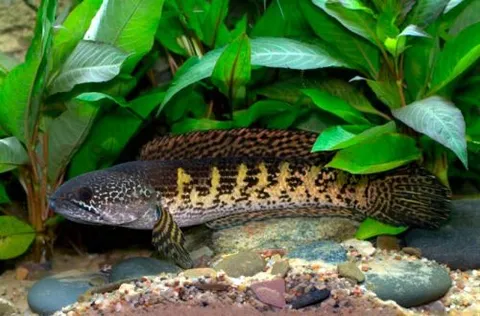
Channa aurantimaculata
The Golden Cobra Snakehead, known scientifically as Channa aurantimaculata, is a member of the family Channidae, or snakeheads. This fish originates from Asia. It is considered endemic to the Brahmaputra River, and its…
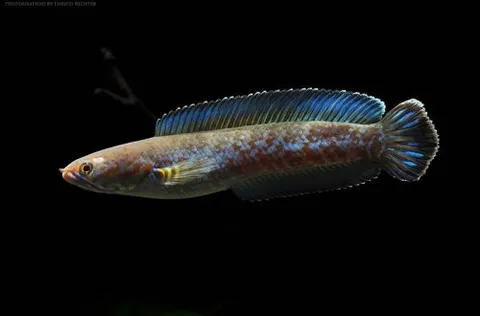
Channa andrao
The scientific name Channa andrao belongs to the Channa andrao snakehead, a representative of the family Channidae (snakeheads). Although this fish was described by researcher Ralf Britz in 2013, it was known to…
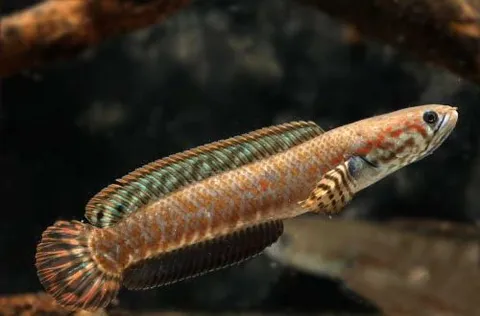
Channa bleheri
The rainbow snakehead, Channa bleheri, is a member of the family Channidae. It originates from Asia, with its natural range believed to be limited to the Brahmaputra River basin in the Indian states of Assam and…