Temperature20 – 26 °C
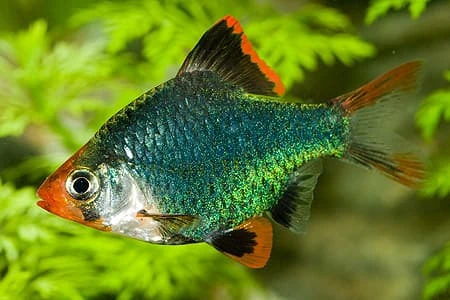
The Green Barb is a result of artificial selection, an improved form of the well-known Sumatra Barb (Puntigrus tetrazona). This energetic schooling fish has gained popularity among aquarists due to its vibrant coloration and ease of care.
This fish inherited a streamlined physique from its ancestors: a rounded silhouette, a prominent dorsal fin, and a pointed head—all indicative of its active lifestyle. Its coloration is characterized by a rich green hue with a metallic blue sheen. It is worth noting that this vibrancy is characteristic of young individuals and may fade slightly over time. Unlike its progenitor, the Sumatra Barb, the Green Barb lacks clearly defined vertical dark stripes. The fins are adorned with a red outline, which becomes particularly noticeable and bright during spawning. During this time, the males' heads acquire a rich red color.
The Green Barb has no natural range of its own: it is a man-made colour form that does not occur in the wild. The line was fixed by aquarium breeding in the 1970s and has been produced on fish farms ever since. The green colouration results from enhanced melanism: the dark vertical bars of the original form merge into a continuous dark zone, while the characteristic metallic greenish-blue sheen comes not from pigment but from light scattering over the melanin. The parent species, the tiger barb, originates in Southeast Asia — from Sumatra and, according to a number of sources, Borneo as well, where it inhabits tributaries and streams with soft water and dense marginal vegetation. To keep the green colour in the offspring, these fish are bred only among themselves.
This is an active and friendly fish that coexists well with other active species of similar size. They must be kept in schools—from 6–7 individuals or more. If the group is too small or the fish are kept alone, Barbs often start to show aggression towards tank mates; the smaller the school, the more pronounced the aggression. Additionally, they have a tendency to nip and damage the fins of slower inhabitants.
The Green Barb thrives in high-quality water. To maintain this, it is recommended to use a powerful filter and regularly, once a week, renew a quarter of the aquarium water volume. The currents created by the filtration system mimic natural flow, which positively affects the fish's tone. Barbs prefer the middle layers of water. For this reason, when decorating the aquarium, decor elements should be placed to leave sufficient free swimming space. Dense plant thickets along the walls will serve as excellent hiding places. Using a sandy substrate in combination with elements of natural bogwood (including roots, branches, and pieces of wood) will be very appropriate for decoration.
This fish eagerly accepts a variety of foods: live, frozen, and dry, of appropriate size. Small invertebrates, such as Daphnia, bloodworms, or Artemia, can be considered an excellent choice.
These fish reach sexual maturity when their body length is approximately 2–3 cm. During the spawning period, the male and female form a temporary pair, which is easy to distinguish in the school: the female has a larger body and a full abdomen, while the male is somewhat smaller, has more intense coloration, and a bright red head. A separate tank of at least 40 L is required for spawning, equipped with an air-lift filter and a heater. Several plants and a substrate of large pebbles are placed in it. Optimal water parameters for spawning include softness (up to 10 GH), slightly acidic reaction (around 6.5 pH), and a temperature range of 24–26 °C. First, the female is transferred to the spawning tank, and the male is introduced to her only two days later. During the courtship dance, the female releases 1–3 eggs at a time, which are immediately fertilized and sink to the bottom. A total of at least 300 eggs will be laid. After spawning is complete, the adult fish should be immediately returned to the main aquarium to prevent them from eating their own eggs. Fry hatch after 2 days, and after another 5 days, they are able to swim freely.
Under favorable conditions, health problems are extremely rare. Most often, they arise due to deteriorating water quality or the introduction of sick individuals into the main aquarium.
When selecting individuals in a store, attention should be paid to the activity and appearance of the fish. Healthy barbs should be active, without visible damage to scales, fins, or signs of plaque on the body. It is important to avoid purchasing fish that appear sluggish, stay near the water surface, or have an unnaturally bloated abdomen. Since the species is schooling, it is recommended to acquire a group of 6–7 individuals at once, as solitary keeping leads to stress, loss of vibrant coloration, and aggression.
The essentials: size, tank volume, water parameters and care
An adult reaches 7 cm in length. Plan the tank around the maximum size: the fish quickly outgrows a cramped setup.
The recommended volume is 60 L. A smaller tank speeds up nitrate build-up and raises stress levels.
Temperature 20–26 °C, pH 6–8, hardness 5–20 dGH. Stability matters more than exact values: sudden swings are harder on the fish than a small deviation from the ideal.
Around 7 years when kept properly. Lifespan depends directly on tank volume, water quality and a varied diet.
Temperament: peaceful, but may bite fins. Keep this in mind when choosing tank mates.
Recommended setup: schooling (usually from 5–6 individuals and more). Ignoring this is a common cause of stress and disease.
Diet type: any (universal). Feed small portions that are finished within a couple of minutes — overfeeding does more harm than underfeeding.
The scientific name of the species is Puntigrus tetrazona, family Cyprinids (Cyprinidae). It also appears in the literature as: Barbus aureus, Barbus hainani, Barbus semifasciolatus.
The water suits 197 of 208 plants in the catalogue — the easiest ones are shown first.
Afzelius's AnubiasAnacharisAnubiasBrazilian PennywortDwarf CloverDwarf CloverDwarf HygrophilaDwarf SagittariaDwarf ValGuppy GrassHornwortJava FernJava MossMoneywortMud SwordNair's LagenandraNarrow Leaf AnacharisNarrow-leaf CloverStringy MossSüsswassertangTaiwan MossTape GrassTemple PlantUssuri Watermilfoil
Matched by family, categories and overlapping keeping conditions
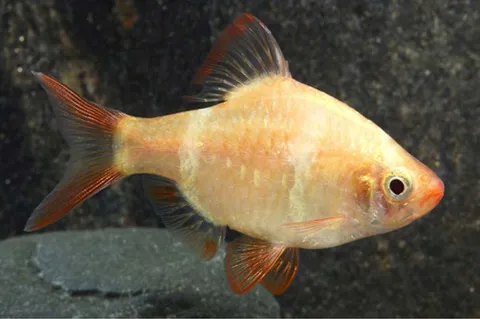
Puntigrus tetrazona
The scientific name Systomus tetrazona belongs to the Sumatra Barb (albino), a representative of the Cyprinidae family. This subspecies emerged as a result of selective breeding of the Sumatra Barb, acquiring a new body…
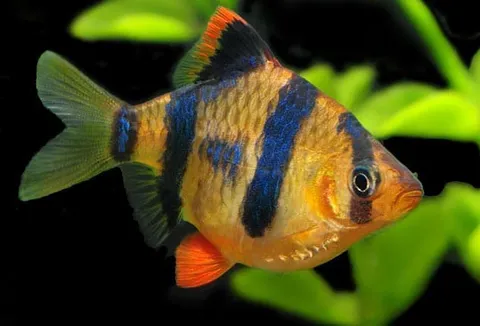
Puntigrus tetrazona
The Sumatran Barb, or Tiger Barb, scientifically known as Puntigrus tetrazona, belongs to the family Cyprinidae. This aquarium fish is among the most familiar and widespread species. For many decades, its popularity has…
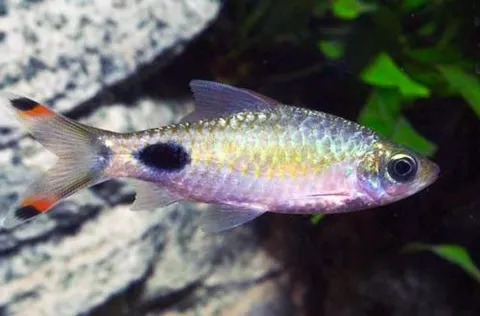
Puntius mahecola
The fish known as Mahecola Barb (scientific name Puntius mahecola) is classified within the family Cyprinidae. It is very popular in Asian countries, especially India, but outside of this region, in Europe and America,…
Kottelatia brittani
Kottelatia brittani, known as Brittan's Kottelatia, is a member of the Cyprinidae family. The fish is named after the Swiss ichthyologist Maurice Kottelat, as well as Martin Brittan, the monographer and reviser of the…